
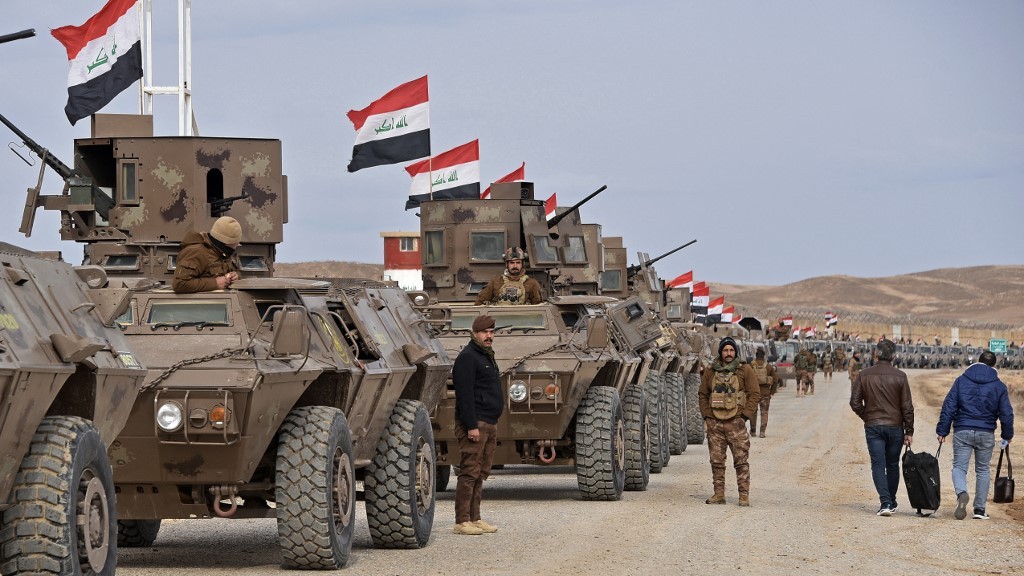
Earlier this week, the Iraqi government announced that the Yazidi-led armed group that had been a dominant force in the Sinjar governorate had finally been integrated into the state. The Sinjar Resistance Units (YBS), a group linked to the Kurdistan Workers' Party (PKK), were formed in the 2000s to protect the Yazidi religious minority, who have faced discrimination and sectarian attacks for decades. They mobilised after August 2014 to fight the Islamic State group (IS), who carried out a genocide against the Yazidis in Sinjar, killing at least 5,000 people and abducting thousands of women and girls. A state ceremony on Monday officially saw the group integrated into the state, with an estimated 2,500 YBS local fighters expected to join the Iraqi security forces. Iraqi Prime Minister Ali Faleh al-Zaidi announced the measure last month after meeting a delegation of the Yazidi Cause Alliance led by Iraqi MP Murad Ismael, in a move similar to the integration into the Syrian state of the Syrian Democratic Forces (SDF). New MEE newsletter: Jerusalem Dispatch Sign up to get the latest insights and analysis on Israel-Palestine, alongside Turkey Unpacked and other MEE newsletters “The implementation effectively started today by handing over some positions on top of mount Sinjar to the Iraqi Army,” Ismael told Middle East Eye. “The details are being worked out where these fighters will be integrated to – it won’t be just one branch of security forces, it will be multiple. Lists of names were also handed over today for the appropriate steps to be taken by the state." Yazidis left out in cold following Iraqi deal to remove armed groups from Sinjar Read More » Although the Kurdistan Regional Government (KRG)’s Peshmerga forces retook Sinjar city in 2015 and the Baghdad-backed Hashd al-Shaabi (PMF) took control of southern Sinjar in 2017, political disputes between competing armed factions have persisted. The latest announcement has, as a result, provoked controversy. The KRG Interior Ministry on Tuesday voiced concerns over Baghdad’s steps to resolve the situation in Sinjar, arguing that it should implement the UN-backed 2020 Sinjar agreement, which would have removed the YBS and other non-state actors from the governorate. “We reiterate that any steps taken in Sinjar without consultation and coordination with the KRG will not produce good results,” KRG Interior Minister Reber Ahmed told reporters on Tuesday, adding that this would not contribute to restoring stability or enable displaced Yazidis to return. In response, the Iraqi government defended its policies and underlined that the measures taken in Sinjar are entirely subject to the authority of Baghdad. “The ongoing steps to reorganise the security and administrative framework in Sinjar District come within the context of the Iraqi government's comprehensive vision to reinforce the rule of law and regulate weapons strictly under official federal and military security institutions,” Sabah al-Numan, spokesperson for the Iraqi prime minister, told MEE. 'It is primarily a proxy conflict driven by the interests of either Iran or Turkey' – Ahmad Shingali, journalist The 2020 KRG-Baghdad agreement, which was never implemented, was opposed by the YBS and Iran-backed factions who refused to leave, while it was backed by Turkey, which was eager to neutralise an ally of its enemy, the PKK. Peshmerga forces also withdrew from Sinjar in October 2017, limiting KRG influence in Sinjar. “This struggle is essentially a conflict between the two governments – or more precisely, a clash between the [ruling] Kurdistan Democratic Party (KDP) and other Yazidi, Sunni and Shia factions, alongside the federal government, over control of Sinjar,” Sinjar-based journalist and analyst Ahmad Shingali told MEE. “Each faction seeks to shape Sinjar according to its own agenda and interests... in reality, it is primarily a proxy conflict driven by the interests of either Iran or Turkey.” The fall of the Assad regime in Syria in 2024 has also reduced Sinjar’s strategic importance to Iran as a potential alternative route to Syria. The question now is whether the new move by Baghdad will resolve Sinjar’s long-standing security and political challenges, especially since the KRG feels sidelined and thousands of Yazidis remain displaced. Ankara's role Sinjar has long been one of the most contentious issues between Ankara and Baghdad. Turkey has long opposed the presence of the YBS in Sinjar over its links to the PKK, whose fighters entered Sinjar in 2014 from Syria and saved many Yazidis after the Peshmerga withdrew in August 2014. Turkey has repeatedly carried out strikes against the YBS, but these attacks stopped after Ankara initiated a peace process with the PKK in October 2024. This process has opened up a means for Ankara to accept the integration of the YBS. 'Sinjar should be made into a region with its own administration' – Mahma Khalil, Sinjar district mayor “Ankara categorically supports the integration of armed groups operating outside state control in Iraq into state institutions,” Mehmet Alaca, an Ankara-based researcher and senior adviser at Babil Research, told MEE. “Turkey does not actually have a problem with local forces. Rather, the main concern is the PKK cadres, who have come to the region from outside. It can be expected that the situation will normalise in line with local dynamics, as in the case of the SDF." On 23 September the Turkish and Iraqi government also jointly announced that the Turkish army would hand over the Zilkan military camp in Bashiqa to the Iraqi military, on the condition that Iraq would end the presence of "banned foreign elements" in Sinjar. How Iraq's Sinjar became a battleground between Turkey and Iran Read More » The Turkish Ministry of Defence announced on Wednesday that it welcomed Iraq’s efforts to strengthen state authority in Sinjar. After the integration of the YBS, the biggest challenges remain the creation of a new Sinjar administration, reconstruction and the return of internally displaced persons (IDPs), Yazidis say. For instance, Yazidi activist Mirza Dinnayi, founder of the House of Coexistence in Sinjar, told MEE that the extent to which the Iraqi government can resolve Sinjar’s other complex issues remains “a grey zone”. “The future steps are dependent on the political will of all partners, on the local and regional level," he said. "If the Iraqi government goes further to the next step of normalisation in Sinjar without raising any concerns of exclusion to other local actors, for example the KDP and acting fronts in Nineveh, this will be a success." Moreover, Dinnayi underlined that another question is how much Baghdad is willing to invest in Sinjar’s reconstruction and prepare a proper plan for the return of IDPs, rebuilding, reparation and justice. Prolonged displacement According to an August report by the International Organization for Migration (IOM) and the UN Refugee Agency (UNHCR), 89,709 people, mostly Yazidis, remain displaced in camps in the Kurdistan Region. They haven’t returned home due to security concerns, weak governance structures, insufficient reconstruction, limited livelihood opportunities, and compensation. “The next major challenge confronting Sinjar is the prolonged displacement of residents living in camps, who still lack compensation and finalised return documentation, effectively leaving them as political leverage between the Kurdistan Region and the central government,” Shingali said. “The KRG cannot provide them with a dignified life in the camps, nor can the federal government resolve their status, compensate their losses, or remedy the devastating harm inflicted by IS’s invasion of the city.” Muqtada al-Sadr says US should compensate Iraqis as last American forces leave Read More » Sinjar has also lacked a mayor since Iraq held provincial elections in 2023, due to disputes between political factions. Nineveh Provincial Council has recently opened a nomination window for the post. “An administration should be established in accordance with the Iraqi constitution, and Sinjar should be made into a region with its own administration,” former MP and Sinjar district mayor Mahma Khalil said, adding that the people of Sinjar should be compensated, the displaced should return, and destroyed homes should be rebuilt. Numan, the spokesperson for the Iraqi prime minister, told MEE that the government is working with local authorities in Nineveh to fill the administrative vacuum by selecting a “competent local administration that enjoys consensus and meets the service needs of the district's residents”. Furthermore, Numan said Baghdad has plans for economic development and the reconstruction of Sinjar and is planning to establish “comprehensive security and service conditions to facilitate the safe and dignified return of displaced families to their homes". “Ultimately, resolving the administrative stalemate and addressing the plight of the displaced remain the two largest hurdles to enabling the population to recover, rebuilding the city, and restoring normalcy to the district," he said.
Can Baghdad finally resolve the crisis in Sinjar?
Full Article
Original Source
Read the full article at Middleeasteye →KhanList aggregates and links to publicly available news content. We do not host full articles from third-party sources. Always verify important information with original sources.