
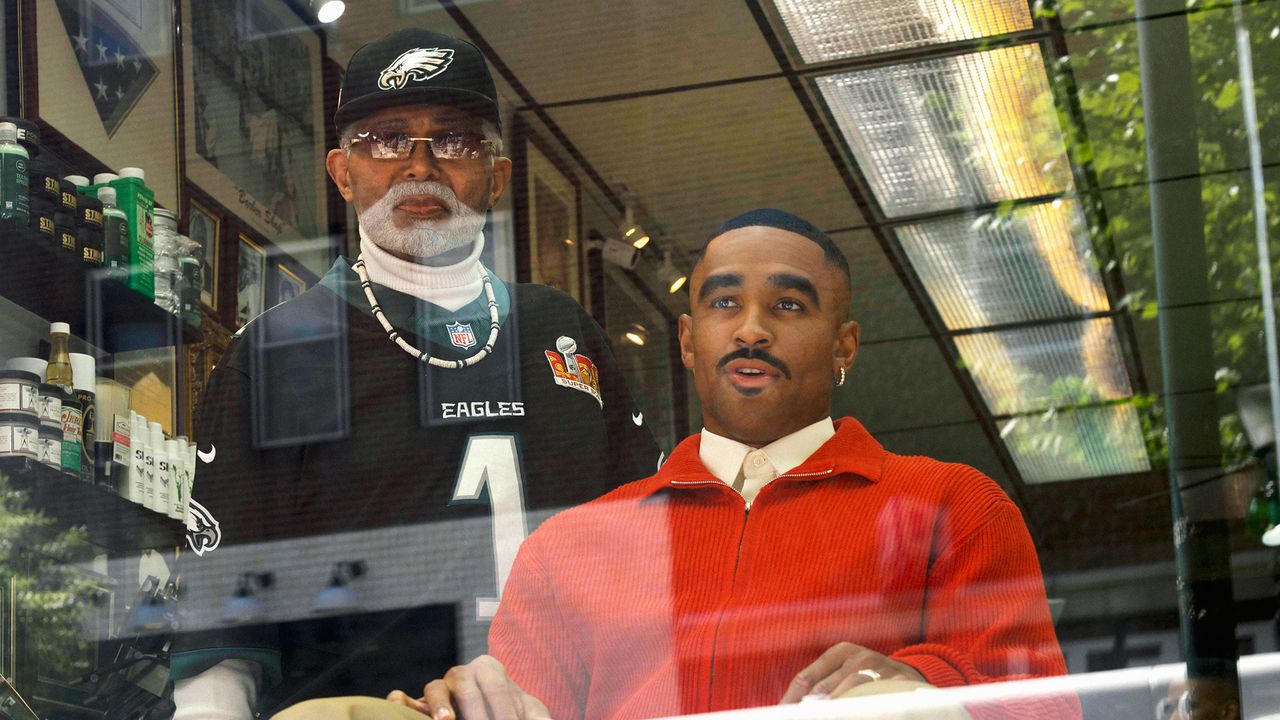
One quiet Monday in June, an SUV pulls up to the base of the Philadelphia Museum of Art steps a few minutes past 5 a.m., and out of the car and into the blue morning air walks Jalen Hurts. Gray Jordan Brand sweatshirt hood cinched down low over his eyes, but still: probably the most recognizable athlete in the city, the Super Bowl-winning quarterback of the Philadelphia Eagles, in the city’s most recognizable spot. A statue of Rocky, on loan from Sylvester Stallone’s personal collection, stands at the top of these stairs, where it is surrounded during daylight hours by tourists waiting in line to take photos. When I was a teenager in this town, 1,000 years ago, prom kids would pull up in their rented limousines and four-button tuxedos and run the stairs, throwing mock boxing combinations when they got to the top. Now Hurts takes a look up at the empty stairs and begins to climb.Hurts has been here precisely once before, he says. The Art Museum steps were the last stop on the Eagles’ championship parade route. The celebration in 2025, for the team’s second Super Bowl win and Jalen Hurts’s first, was his only time here, and he hasn’t been back since. He says part of the reason he wanted to come here today was to feel something that he didn’t feel the first time around. “You don’t really get to enjoy a lot of this stuff as you’re actively doing it,” Hurts says. “I think there’s moments. You got moments that bring you happiness. But you don’t really enjoy it until it’s done.”I say, to this person I just met, that I think there’s something kind of sad in that.“It’s just a part of it,” Hurts says, not arguing.Coat by Saint Laurent by Anthony Vaccarello. Shirt by Brioni. Tie by Dolce & Gabbana. Sunglasses by Jacques Marie Mage. Eagles fans—football fans—know this version of Jalen Hurts: stoic, measured, slightly removed. He is beloved in Philadelphia for winning but is also in many ways a mystery. He doesn’t say much, doesn’t show much. Hurts is the rare athlete of his caliber and stature who doesn’t come with an easy-to-digest narrative: He wasn’t a first-round pick, but he wasn’t a fifth-round pick either; he has won more than quarterbacks who are generally considered “better,” and yet much of the discussion about him is about his limitations, real or perceived. If Hurts has feelings about any of this, he doesn’t share them.We stand and watch the sun rise over Philadelphia. Hurts says he’s awake at this time most days. “You got to fix yourself and posture yourself,” he says. “Let Him go before you and in this imperfect world. This world filled with many imperfections. Many things that I couldn’t even…. Undescribable. Undescribable. Undescribable lessons. At the same time, life in the world is very balanced with joys and pain. Sunshine brings rain. All one and the same.”And then he turns and asks me, because he knows I’m from the city: “What does this view do to you?”It’s a thoughtful question. Not the last one he’ll ask me, either. I’m not sure what I expected with Hurts, but it wasn’t quite this—someone who genuinely wants to know what I think about anything. Someone, even, who will retain that curiosity through a lot of awkward questioning on my part.What does this view do to me? By way of answering, I mention something about my parents, about how familiar the drive down was from their house, tracing the lazy curves of Kelly Drive along the Schuylkill River, past the boathouses to here. And I confess, inevitably, what Hurts surely already suspects, which is that I am a degenerate Eagles fan. Degenerate enough that my brain can’t quite be normal or objective on the subject. Though I haven’t lived in this town for many years, I spend a lot of time thinking about the sports teams here, and in particular, the Eagles. I share my love for the team with some of the closest people in my life and find that love to be one of the few uncomplicated things left to me as an adult: I never get bored, I never stop caring, I can never get enough.When I share all this with Hurts, he takes it well enough.“It’s a great city,” he says. “You come from a great place. I’ll say that. Passionate place. Gritty place. I’m sure you have those qualities.”Do I?“Do you?”June in Philadelphia—everything looks super green, abundant. The birds are loud at dawn. And everyone is taking a hard look at the quarterback. The Eagles, in Hurts’s time, have won a lot of games, and gone to two Super Bowls. But they have also been prone to season-long spells of unhappiness, drama, weird vibes. Last year was a drag—they returned most of a Super Bowl–winning roster and yet struggled to score points or, seemingly, to enjoy it when they did. They lost, without much of a fight, in the first round of the playoffs. An April ESPN.com article put some share of the blame for the team’s struggles on Jalen Hurts, whose purportedly “strong preferences” and “penchant to resist change” were said to be part of the reason why the team failed to evolve. Hurts, who idolizes Michael Jordan and Kobe Bryant, was portrayed as having an “unrelenting, demanding mentality”—a dedicated teammate but not a warm or empathetic one. In June, wide receiver A.J. Brown, whose run in Philadelphia was among the best stretches of any in the history of the team, finally got the trade out of town he’d seemingly been seeking for some time. Notably, on his way out, Brown talked about the way he and his quarterback, who is the godfather to his daughter, had grown apart the past few years.Hurts has a vague answer to my questions about Brown—“You can’t replace the greatness that we have achieved and the presence and the success that he’s had on the field, but we’ve got to go to work”—and, when pressed a bit, a slightly more nuanced answer. “It’s a game where we’ve all got to have a shared mission,” he says, when I ask what happened that things got to the point where Brown reportedly wanted to be traded. “We all got to be in pursuit of the collective. And it’s not something I can speak on from his behalf, but I can tell you my focus has always been to pursue the mission.”Unsurprisingly, given the fact that the two men had once been close, much scrutiny had fallen on their relationship. Brown, in the interview he gave after being traded, said the two of them had grown apart. I ask Hurts if he feels the same way. He responds with a single-word answer: “Clearly.”At the Fitler Club, a members-only building on the west side of Center City, Hurts listens to me ask these questions about his old teammate, and about all the skeptical reporting and bits of recent history from this offseason, with a pointedly unreadable expression. “I take ownership because it’s my job,” he says, about the claims made in the ESPN.com article. He doesn’t deny them, even as he makes it clear he’s accepting them mostly because he sees it as his duty to move forward, and to argue would be to go backward. “It’s my responsibility. My job, I’ve always saw it from a perspective of: Go out there and lead the team and find a way to win a game, most importantly. And so we’re going to be judged off of that. And I think accountability and ownership and responsibility, those are all important factors when you play the quarterback position. You have to have those qualities. You have to be able to own it.”Hurts says he used to live by a typically Hurts-like mantra, which was: It’s not about proving anybody wrong, it’s about proving myself right. He says he’s updated that a bit to take all the proving out of it. Rightly or wrongly, the only response he knows to anything is to keep working. “It’s really about just continuing the mission. Continue the mission. Work, and continue the mission,” he says.A couple years ago, in 2024, Hurts gave a quote that has haunted him a bit since, and which has since been cited as a skeleton key, a rare moment of truth, from an athlete who doesn’t often reveal his own internal monologue. Asked about the sluggish offense then, he said: “It’s going to look how Jalen Hurts wants it to look.” Since then, this quote has been cited in arguments city-wide about Hurts, sometimes as proof that he is somehow uncoachable or at minimum very stubborn.I wondered if, given another chance, he might have wanted to say it differently, or not at all.“I can see how that’s something that was taken literally,” Hurts says. “At the same time, I said what I said and there’s no retracting what I said.”But there is clarifying, I say.Jacket and jeans by Visvim at Mr Porter. Boots by Carmina. Watch by Omega. Bracelet (throughout) by David Yurman. And so he clarifies, a bit. The idea there, he says, was that on a team that was always changing—a new offensive coordinator practically every year, new teammates, new schemes, and so on—he was the one factor that didn’t change. “I’ve always had to adjust to the change in the voice in my ear, the play caller, quarterback coach in the room, and those are the challenges that I’ve always embraced,” Hurts says. “And you get to a point where you see so much change going on around you, you see that you’re the constant. And that goes for a lot of my teammates as well.”And Hurts is big on responsibility, and so: Why not put it on himself? “I’ve always admired those who have taken ownership for the things that they don’t control, they can’t control,” he says. “I have nothing to do with that, but you know what? I have humility about myself to say, ‘Hey, I could have been better right here. I could do that.’ And I think that’s where that comes from.”Hurts starts to say more, then stops. “Let me bust your ass real quick,” he says, gesturing at the pool table we’ve been standing around these past 20 minutes.Jalen Hurts is the type of guy to own his own pool cue, so it is not a surprise to me when it turns out he owns his own pool cue. His comes in a soft leather bag that says “Everything for Fun.” I would describe his playing style as: Professional Athlete. He is competitive, unsparing. I don’t want to sound like I’m making excuses, but I’m pretty sure he makes some sort of noise or sudden motion nearly every time I try to strike a ball. I have just one remaining when he finally sinks the eight ball. “Love hurts,” he says. He also says, a while later, with an obvious trace of annoyance: “I let that game get a little too close.”Hurts says he likes the game because the problem-solving feels like football. “You may think you may not have a shot, when in reality, there’s always a shot on the table,” he says. It’s also a game he saw his father play while growing up. Hurts’s father, Averion, was a football coach who recently retired after 31 years in Channelview, Texas, turning boys to men, including his two sons, Averion Jr. and Jalen.Hurts attributes a lot of his personality, and his life in football, to his dad. “I saw a disciple of men, and I saw what it was like to lead. I saw what it was like to instill character and have integrity and represent something bigger than yourself. I saw what it was like to take care of other people’s kids. My father being the head coach, that’s something that comes with their duty. And so my perspective on it is a little bit different. At an early age, he held me to a very high standard, but he also pushed me.”Hurts has become famous, even by the elevated standards of the NFL, for a kind of stubborn determination to improve. He likes a difficult situation where the only way out is through. In high school, he got into powerlifting: “I got this weight on my back. Get the shit up, and figure it out.” His heroes are guys whose will to get better is unstinting and maybe even a bit pathological. Tom Brady. Peyton Manning. The aforementioned Michael Jordan and Kobe Bryant. “MJ, Kobe, they had great work ethic, had a great mentality,” Hurts says.Hurts mentioning Jordan in this moment reminds me of something I recently heard an Eagles beat writer say, which is that many of the criticisms of Hurts are unfair but one that has some legitimacy is that he doesn’t show a lot of vulnerability. This is something I’ve noticed too. Not at the podium before or after games. Certainly not during them. Again, who knows: The weirdest part of sports fandom is the way you psychologically analyze people you don’t know, will never meet. Except Hurts is right in front of me now, so I bring it up, this criticism that he doesn’t show much weakness or doubt, in a way that Michael Jordan and Kobe Bryant were also famous for.“Is that criticism?” Hurts responds. It’s a weird question that I’ve asked him, and we have a weird conversation about it. The first thing Hurts returns to is his father again, the example he set. “I go back all the way to my childhood,” he says. “I go back to the things that I saw. Not many can say that they’re a coach’s kid, one. And then for my dad to be an African American coach and for me to be a Black quarterback in this league. I’ve seen and been introduced to so much that has been good, and sometimes in some situations hard to relate to, because of my experiences when I was coming up.”Hurts says that I’m thinking about it the wrong way. “It’s not about showing weakness or projecting yourself as someone who’s strong,” he says. “It’s about doing a thing that can’t be denied. So when you’re able to filter through how you feel and define how you feel and then find solutions and do something about it, that’s being active towards it.”That’s a very second-order way to feel. Almost like you’re looking above yourself at your own feelings, and being like, “All right, that one we’re going to process into this, this one we’re going to process into this.” But it’s not just feeling the feeling, you know what I’m saying?“I think that it is exactly what you’re saying it’s not. I think everybody just has a different grace period. Everybody has a different process and period of how they process something, how they process a set of emotions, and then their process and their posture and the systems they rely on to actually find solutions in it and manage it. Everybody’s process is different. Mine has just always been that way, and it’s worked.”And then I ask another weird question, because I think it’s relevant:Would you describe yourself as an introvert?“What is an introvert?”Someone who keeps to themselves, someone who is not necessarily a huge people person.“Is that an introvert?”That would be my definition.“That’s your definition of introvert.”Yeah, yeah.“I would say…yeah.”Sunglasses by Jacques Marie Mage. Here’s why I’m curious. Because I think the job of quarterback: inherently social job, right? Literal leader of men. Communicator. Do you ever feel the contradiction between that and what your job ended up being?“I think it’s evolved over time. Because when I was a younger player, when I was coming into college and starting as a freshman, it was a different time where it was very straightforward in earning the respect of the guys around you. You earned it by your actions. You earned it by what you prove to them and the respect that you earn. As you grow, there’s a mystique and an outside perspective or a narrative that’s built, and it’s not a lot of times built by the person himself, but by what other people project or interpret from that. And so my perspective, my approach, hasn’t necessarily differed in terms of what’s the priority, but I am mindful of how the things around me have changed.”Hurts says, basically, he lives by something Nick Saban, the former coach of Alabama, once told him, which was: “What you do speaks so loudly, I can’t hear what you say.”He continues: “Well, you say I’m an introvert. I say I’m about action. I’m about doing the things that are required to win. And so I think that’s to one’s interpretation, but you never go wrong doing a thing that can’t be denied.”I say sure, but on any team, in any workplace even, there are personal dynamics beyond winning and losing. People want to know what their boss thinks about them. They want to know where they stand with their coworkers.There’s got to be somebody on your team that’s like, “What does my quarterback think about me?”“Yeah,” says Hurts, because the answer to him is self-evident. The answer is: “Let’s win.”Hurts tells me, unprompted, that he recently asked ChatGPT about the odds of a hypothetical quarterback, who shares a biography not unlike that of Jalen Hurts, making it to the NFL. Just gave it some minimal information and let it think. It told him: “There’s a 60 to 70 percent chance that he’ll get to the NFL,” Hurts says. “Twenty to 30 percent chance that he would start. And there’s a 5 percent chance that he would be exactly what he is today.”I’m confused, and tell him so: Shouldn’t all those odds be much, much lower? How many quarterbacks from Channelview, Texas, play in the league? How many of his dad’s other high school players made it? But then it turns out the minimal information, the exact prompt, that Hurts gave to the chatbot was: What are the odds of making it after being benched in the college national championship game?This, of course, happened to Hurts, and is fundamental to his story as other people tell it and, evidently, how he thinks about himself. After Alabama went down 13-0 to the Georgia Bulldogs in the 2018 championship game, Hurts was removed at halftime, despite having started all year, and replaced by Tua Tagovailoa, who went on to help Alabama come back and win the game. Hurts played one more year at Alabama, primarily as a backup, and then transferred to Oklahoma. He rebuilt himself from being embarrassed on national television and exceeded his odds. “It’s kind of like shooting pool,” Hurts says, about how he did it. “There’s always a shot on the table. How do I figure this out?”Less cited, though maybe equally relevant to Hurts’s story as a starting quarterback in the NFL, is that he was not in fact drafted to be a starting quarterback in the NFL. The Eagles selected him as a backup in the second round of the 2020 NFL draft, when Carson Wentz was the established starter on the team. Hurts admits that he was surprised when this happened—he hadn’t heard much from the Eagles before they took him. “I figured I’d wait my turn and start in two, three years” was his mentality. And then someone Hurts trusts told him: “Nah, bro, you need to get ready.” By the end of the year, he had replaced Wentz, and by the beginning of the next year, he was starting. The year after that, the 2022 season, the Eagles went to the Super Bowl, where they lost in a game that was among the best that Hurts has ever played. “I remember setting out a goal before that year and saying, ‘We’re going to go to the Super Bowl,’ ” Hurts says. “Now I’m like, ‘Well, shit, I should have said we’re going to go win the Super Bowl.’ Maybe we would have won.”They won two years later—I took off my shirt, I screamed so loud I scared my kids—but a strange thing about Hurts, which is maybe true of many athletes of his caliber, is he is far more in touch with his failures, his disappointments and losses, than he is with the wins. “Sometimes I feel like there haven’t even been any wins, because you get so attached to the losses and how you can improve from those,” he says.Which is how you end up standing on the Art Museum steps trying to capture that feeling of winning on a random Monday morning in June, I guess. Trying to remember what it felt like when you didn’t lose.All clothing by Brunello Cucinelli. Watch by Jaeger-LeCoultre. Turtleneck by Brunello. Earring, his own. And now at the Fitler Club, Hurts turns to me: “What don’t you know?”Again I’m confused and say so.“I mean, in terms of—not what don’t you know, but it’s very…beat-writer-esque.”He’s talking about our conversation. Hurts says that if he wanted to talk about the Eagles this much, “I would’ve talked to Jeff McLane”—longtime reporter for the Philadelphia Inquirer. “I would have called Eliot Shorr….” Hurts doesn’t remember this beat reporter’s full name but I do: Eliot Shorr-Parks, town gadfly. “I would have talked to those guys. So I’m trying to see what else is it.”And so we try, for a while, to see what else there is. My sense—and this is just a sense—is of a person struggling to articulate a version of himself he won’t actually share, or perhaps more accurately, of a person waiting to be asked a more illuminating set of questions than the ones he’s gotten. Finally, after we audition a couple topics—leadership, whether or not he got into football to realize his father’s dream—he turns the interview back on me.“Tell me about your style,” he says.You mean, like, my personal style? Or my style as a human being?Hurts says he was thinking about clothes.The first rule of interviewing is: Don’t talk about yourself. But for a while, I do. I tell him about the San Francisco–based designer who made the shirt I am wearing, Evan Kinori; how much I personally like and respect him and his work.Shirt by Dolce & Gabbana. Tank top by Calvin Klein. Pants by Amiri. Jumpsuit by Yohji Yamamoto Pour Homme. Sweater by Tom Ford. Boots by La Sportiva. Necklace (throughout) by David Yurman. Earring, his own. “It represents something,” Hurts says.I say yes, exactly. I say this is what I am seeking out in clothes and in life in general: a personal connection. It’s part of the reason I’m here, I say, seeking to talk to Hurts.Because there is the journalist part of me, the Jeff McLane [part], that you fairly critiqued, right? Where it’s like: Let’s go get news.“Not a critique,” Hurts says.But, I tell him, there is also the part of me that has been a fan of the Eagles my entire life. I’ve probably seen every game he’s played as a professional. And though I did not come to Philadelphia for a picture or an autograph or anything like that, I did come out of some genuine connection to Jalen Hurts and his story, out of a desire to hear him say more about certain things he’s mentioned only briefly before.“Well, I think with those things, you say: It’s not understood. And I’m like, I said what I said. That is exactly what I meant.”I say one interesting thing about watching the Eagles closely, in fact, is that you never actually can tell what Hurts is thinking. Other Eagles will come off the field, obviously happy or angry or frustrated, you can see whatever it is on their face. And then they cut to Hurts and, I say—I feel like I never know what you think.“The thing is, you talk about vulnerability, and you talk about are you able to define who you are, what your passions are? The football field is one of the very few places I feel like I can be myself. But the raw emotions—I think I give you grace because competitively, the fire and the moment and the preparation and everything that you’ve done to get to this point, not many understand what is required of that. And it demands everything. And it demands even more when you experience failure, when you come up short of something and you have to humble yourself and find solutions, but first go to work and make sure you’re doing the right things. So when you’re in the process of a middle of a game, you’ve got a fine focus on what exactly you’re trying to do, and that’s my approach.”He says, basically, that he is unreadable because he is so internal, so entirely concerned with processing what he’s seeing and experiencing and solving, that there is no room for expression beyond that. What I’m seeing, he says, is a person taking seriously, at every moment, the long odds he had of making it, the difficulty of each step, the loneliness and intensity and sacrifice of what he’s had to do to get to where he is.Why do you think you feel most like yourself on a football field?“Because it’s what I love. It’s what I know. It’s what I come up around. It’s who I am. It’s who I’ve been groomed to be.”And when you’re not on that field?“I pray I got a lot of life ahead of me with a lot more memories to build. But right now? That’s what my focus is.”And then Hurts looks back at the pool table, his win already forgotten. What he wants to do is play again: “You got one more in you, right?”Jacket by Acne Studios. Tank top by Calvin Klein. Pants by Burberry. Boots by Marsell. Necklaces (on top and middle), his own. PRODUCTION CREDITS:Photography by Eric JohnsonStyling by Mobolaji DawoduBarbering by Berto MartinGrooming by Barry White for barrywhitemensgrooming.comTailoring by Ksenia GolubProduction by the Morrison GroupShot on location in Philadelphia at Mr. Edison, The Bellevue Hotel, Maxamillion’s Gentlemen’s Quarters Barber Parlor, and Larry’s SteaksA version of this story originally appeared in the September 2026 issue of GQ with the title “Can Anyone Decode the NFL’s Most Cryptic Quarterback?”
Can Anyone Decode Jalen Hurts, the NFL’s Most Cryptic Quarterback?
Full Article
Original Source
Read the full article at Gq →KhanList aggregates and links to publicly available news content. We do not host full articles from third-party sources. Always verify important information with original sources.