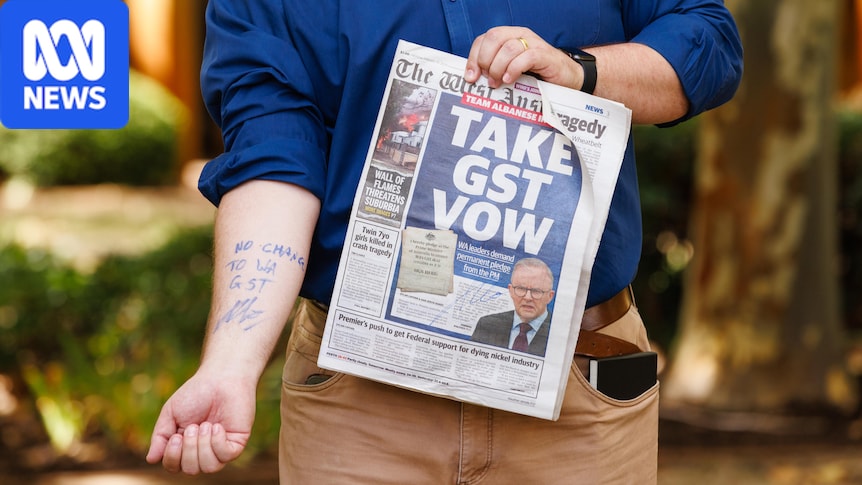
A permanent marker is, by design, very difficult to erase, but a damning new report suggests Anthony Albanese is going to have to give it a crack.Two years ago, the prime minister cheerfully took a Sharpie proffered by a West Australian journalist to sign a paper pledge to retain the state's GST deal.For good measure he then grabbed the reporter's arm and scrawled "no change to WA GST" — even suggesting the signature would make a nice tattoo.Now, the Productivity Commission has given Albanese plenty of reasons to reconsider reaching for that pen.Its interim review delivered a brutal assessment of the GST deal struck by the former Coalition government in 2018 and enthusiastically inherited by Labor.Those changes guaranteed states a minimum GST share, while Canberra agreed to compensate states left worse off than under the previous system.In practice, the commission has found one state has been left significantly better off: Western Australia.A permanent marker is, by design, very difficult to erase, but a damning new report suggests Anthony Albanese is going to have to give it a crack. (AAP: Richard Wainwright)A big $23b billEvery other jurisdiction has required "no worse off" payments since the new standard took effect, and that has come at a considerable price.The reforms were expected to cost the Commonwealth about $5 billion by 2024-25 but have instead soared to almost $23 billion.And money is only part of the commission's objection.The GST system exists to smooth out the differences between states so Australians can receive broadly comparable public services regardless of where they live.But the commission found the 2018 changes had weakened that principle without delivering sufficient improvements elsewhere.Its preferred prescription is dramatic: unwind the central architecture of the deal, move back towards the pre-2018 system and deal directly with the particular distortion caused by WA's dominance of mining revenues.Unsurprisingly, this has set up a good old-fashioned federation fight.Every other state welcomed the commission's interim findings on Friday.South Australia said the current GST carve up was a "dog of a deal," while NSW branded the recommendation to ditch it as "historic".Victoria concurred the current deal should be "scrapped", a move Queensland agreed was in the "national interest".The Productivity Commission has published its interim report into the WA GST deal, calling it a "costly mistake" and recommending the government scrap it. (ABC News: Courtney Withers)'East coast clowns': WA premierWest Australian Premier Roger Cook was, by contrast, dripping with disdain as he criticised the "east coast clowns" behind the commission's report."The change would punish Western Australia for its success, simply to prop up other lazy states," he warned.Cook said he had spoken to Albanese, who had told him the current GST arrangements would "remain".When this column asked the PM, though, he was much more careful to only promise WA would get a "fair" deal.Albanese was also at pains to emphasise the review was a product of the Morrison government's own legislation.But there's no avoiding the fact many economists have also long argued the GST deal was a stinker.Independent economist Saul Eslake could have well released a statement simply saying "I told you so" after the productivity commission report was published.The electoral map that made surrendering to Western Australia irresistible to the prime minister has changed, but taking something back is always hard. (AAP: Lukas Coch)A new electoral mapThere is a strong political reason federal Labor has been so willing to capitulate to the west on GST in the past.The state was crucial in delivering Albanese to government in 2022, producing a double-digit two-party swing and four additional Labor seats as the Coalition vote collapsed.Rather than snap back three years later, the west consolidated as Labor territory.Albanese emerged from the 2025 election with 11 of WA's 16 seats.While the political importance of keeping WA happy has not disappeared, Labor is no longer as dependent on the west as it appeared after 2022.Queensland, long difficult terrain for federal Labor, delivered 12 seats to Albanese last year, while Tasmania returned four Labor MPs out of five.It leaves Albanese confronting a different version of the federation politics that produced his Sharpie pledge.The electoral map that made surrendering to WA irresistible has changed, but taking something back is always hard.National cabinet meeting loomsThe next meeting of the national cabinet due later this month is sure to have some fireworks, and not just over GST.Premiers and chief ministers will also be discussing the Albanese government's plan to legislate national standards for data centres, regardless of what the states and territories think.Northern Territorians famously don't mind a cracker night, so expect a few fiery contributions from their government over renewables.Queensland has taken particular issue with being told what to do when it comes to either energy or water, with Energy Minister David Janetzki saying the state doesn't support "underdeveloped ideas that hand increased power to Canberra".Albanese has so far presided over a relatively harmonious federation — or at least been able to find the money to make tough deals more palatable.Labor is confident the public is overwhelmingly on the side of tougher data centre regulation, but on GST there is undoubtedly going to be some political cost.When it comes to that Sharpie, there is no need for Albanese to reach for the rubbing alcohol and sponge just yet.The productivity commission report is only an interim one, so he can wait for the final recommendations in December before making a choice.The ink on that journalist's arm disappeared long ago, but the political promise will prove rather harder to remove.
Can Albanese erase his permanent marker GST pledge?
Full Article
Original Source
Read the full article at Abc →KhanList aggregates and links to publicly available news content. We do not host full articles from third-party sources. Always verify important information with original sources.