
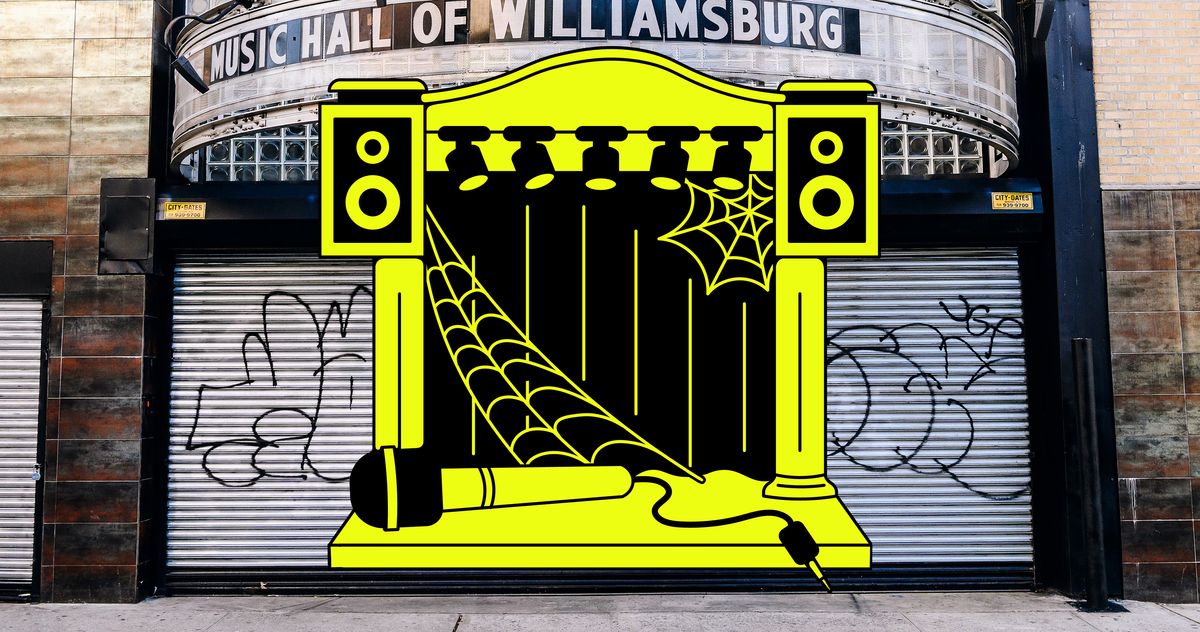
A young person used to be able to stumble along Kent Avenue into live music. Now, nowhere can stay open. Illustration: Emma Erickson; Photo Nina Westervelt/Bloomberg via Getty Images Illustration: Emma Erickson; Photo Nina Westervelt/Bloomberg via Getty Images As the Bowery Presents co-founder John Moore prepared to open Music Hall of Williamsburg, he wondered if the neighborhood had already peaked. It was 2007, more than a decade after artists and musicians began fleeing Manhattan rents for a “new bohemia” in North Brooklyn. The postindustrial warehouses were no longer empty or inexpensive. The food-and-nightlife scene was thriving: Eat at Marlow & Sons, Fette Sau, and Planet Thailand; party at Union Pool, Royal Oak, and Trash Bar. “The concern was that the neighborhood was already becoming a bit too ‘high rent’ for a music club,” Moore says. “We felt like we weren’t pioneers any longer.” Still, this was before the Starbucks and Whole Foods, before the Apple and Google stores. In 2007, condo towers were only starting to rise over the recently rezoned waterfront. A group of DIY and small venues were still scattered around Williamsburg. To some, Music Hall’s arrival represented the beginning of the end: one of the first Brooklyn rock clubs made out of the Manhattan mold. Moore and Jim Glancy, his co-founder, aimed to bring a professional sheen and top-notch sound to the scene with their space at 66 North 6th Street, the former home of a trailblazing club, Northsix. “They were early, they did a great thing,” says Moore, but “we took it to the next level.” Gainesville, Florida, punks Against Me! played the first night at Music Hall with downtown icon Patti Smith headlining the second; a buzzy band out of Morningside Heights called Vampire Weekend hit the stage two days later — still several months before their debut album dropped. The opening of Music Hall was part of an old story repeating in Williamsburg. Artists and musicians had flocked to dirt-cheap rents, populating the neighborhood with small clubs and cheap tickets. In time, more gentrifiers came and with them professional venues. The cool was commercialized. Over the next two decades, Music Hall booked thousands of acts that would never play in a dingy living room or crowded garage: the Weeknd, Ed Sheeran, Maggie Rogers, Tame Impala, RZA, the 1975. For up-and-comers, the 650-capacity venue could be a career leap; for global superstars like Harry Styles and Kendrick Lamar, an underplay, an opportunity to debut new material in an intimate setting, as Charli XCX did in July before releasing her album Music, Fashion, Film. But around the venue, the original places that had made the scene began to disappear. Glasslands, Death by Audio, and 285 Kent have all closed. Barcade, which opened in 2004, recently announced plans to exit Williamsburg after its lease expires; the bar’s management said they know “the end is coming” because “nearly all the brick and wood buildings around us have been demolished and rebuilt in steel and glass, and the nightlife has mostly faded away.” The story of Williamsburg’s gentrification is cliché at this point. But the closing of Music Hall seems a particularly poignant death knell. Williamsburg’s main artery off the Bedford L has reached a period of late-stage gentrification in which establishments that once seemed like the big capitalists pushing out small businesses are being driven out themselves by the same unforgiving market forces that displaced earlier inhabitants. “In those years leading up to opening, I think we were worried the neighborhood had lost its ‘edge,’ if you will,” Moore says. “Now we look back and it’s crazy, given what was to follow.” When Music Hall launched, chain stores — save for American Apparel, one block down at 104 North 6th — were rare. But then came creative-class-friendly mid-tier chains such as Warby Parker, Everlane, and Madewell, followed by upscale shops like Chanel and Hermès. The numbers are stark, according to Alex Beard, a vice president at RIPCO Real Estate’s Brooklyn office. He says buildings can command $350 to $400 a square foot on North 6th Street. “Live music does not work at 400 bucks a foot,” says Beard. “Few things do. You’ve got to be selling very expensive, very nice stuff.” Some independent venues still exist in Williamsburg. There is Union Pool, a neighborhood fixture with a 150-cap backroom performance space. But it as much a bar as it is a club. Baby’s All Right, which accommodates closer to 300 people, is still open. But is far away from the Bedford–North 6th Street shopping corridor. Larger venues draw crowds on the outskirts. The Bowery Presents — which sold a majority stake to concert-and-sports giant AEG in 2017 — operates the 1,800-cap Brooklyn Steel in East Williamsburg and Under the K Bridge, an 8,500-cap pop-up assembled beneath the Kosciuszko Bridge, amid the rumbling BQE. Concert juggernaut Live Nation operates Warsaw, an 1,100-cap venue in Greenpoint’s Polish National Home. When late last year, Moore and Glancy announced that even they would not be able to continue, with the club’s final shows planned for early December, it was presented as basic economics. “I think Williamsburg may have priced itself out of being a great location for a music venue,” says Glancy, “everything has shifted out to Bushwick, to Ridgewood.” Even during Williamsburg’s heights as a hipster playground, there were signs the party wouldn’t last forever. When reporting in 2005 on the rezoning of the North Brooklyn waterfront for the New York Observer, one real-estate broker told me, “It will look like Battery Park City in a couple of years.” The 2008 financial crash slowed down development enough for a dynamic scene to take root, driven by DIY venues. “No matter where you lived, you always ended up along that singular strip of Kent Avenue, where it was both a party and experiment in self-governance, every single night,” author and concert booker Ronen Givony wrote in his book Us v. Them: The Age of Indie Music and a Decade in New York (2004–2014). Proximity led to serendipity: Givony recalls on one November 2011 night seeing Brooklyn’s Parts & Labor at Death by Audio before wandering into Small Black’s record release show for Moon Killer next door at Glasslands. Rami Haykal-Manning, who started out booking shows at Glasslands before co-founding the sprawling Bushwick venue Elsewhere, recalls how “the second you got off the Bedford stop, you would hear live music coming out from apartments, various other warehouses.” Back then, he adds, “it wasn’t hard to put together something or stumble into something new. It was very much an artist-friendly neighborhood.” Givony purposefully ended his book in 2014. It was then, he says, that a “chapter” of local music history culminated with the closing of Death by Audio, Glasslands, and 285 Kent. The first two were displaced by headquarters for Vice Media, the once-renegade youth-targeted company that took in hundreds of millions from giants like Disney before collapsing. “It did feel like a bit of a finishing blow to a certain naïveté or romanticism that was going on then,” Givony says of that era. Now, not only is rent cheaper several stops down the L train, but it’s also where your likely ticket-buyers are: young people flocking for (somewhat) affordable apartments and nightlife, similar to the recent grads who once inundated Williamsburg. Saint Vitus, a metal-and-hardcore haven that closed in 2024 in Greenpoint, will reopen next month in a space roughly double its former size off the Jefferson L stop in Bushwick. It’s a late-night hub that’s perhaps the closest thing to being transported to Bedford Avenue two decades ago, a crush of energy spilling out of bars and clubs. Piotr Orlov, who writes the musically omnivorous “Bklyn Sounds” listings column as part of his newsletter Dada Strain, lived through Williamsburg’s mid-’90s bohemian heyday and still applauds Union Pool for putting on an eclectic mix of shows. But he also embraces newer venues like Cassette in Ridgewood, which often showcases indie singer-songwriters, and rattles off favorites in Park Slope (Barbès), Crown Heights (Barzakh Café), and Sunset Park (Mama Tried). Plus, he says, house shows aren’t going anywhere: “As long as you have young people who are like, ‘I want to make some noise, I want to throw a party, I want my band to play, and I want my friend’s band to play,’ that is going to continue happening.” As it should. The pangs of nostalgia for a neighborhood’s previous incarnation are part of living in New York, but you can’t always go home again. I was struck by a hand-scrawled sign recently posted in a window at 560 Manhattan Avenue, seemingly intended for locals pining for Enid’s, a beloved spot for messy dance nights and hangover eggs. The old Enid’s signage had been revealed during renovations for a new restaurant, Matches, which just opened across the street from the former home of Matchless and the current site of condos. “PLEASE STOP: It ain’t coming back,” the message began, before offering sound advice to those longing for bygone days: “We are not able to recreate the memories. We are just hoping to make new BAD DECISIONS.” What Will Become of the Ed Sullivan Theater? In Defense of Murray Hill Where Is a Celebrity to Live in This Town? See All Can a Rock Club Survive in North Brooklyn? Your product is saved! You’ll receive emails when your saved products go on sale. Manage preferences.
Can a Rock Club Survive in North Brooklyn?
Full Article
Original Source
Read the full article at Curbed →KhanList aggregates and links to publicly available news content. We do not host full articles from third-party sources. Always verify important information with original sources.