
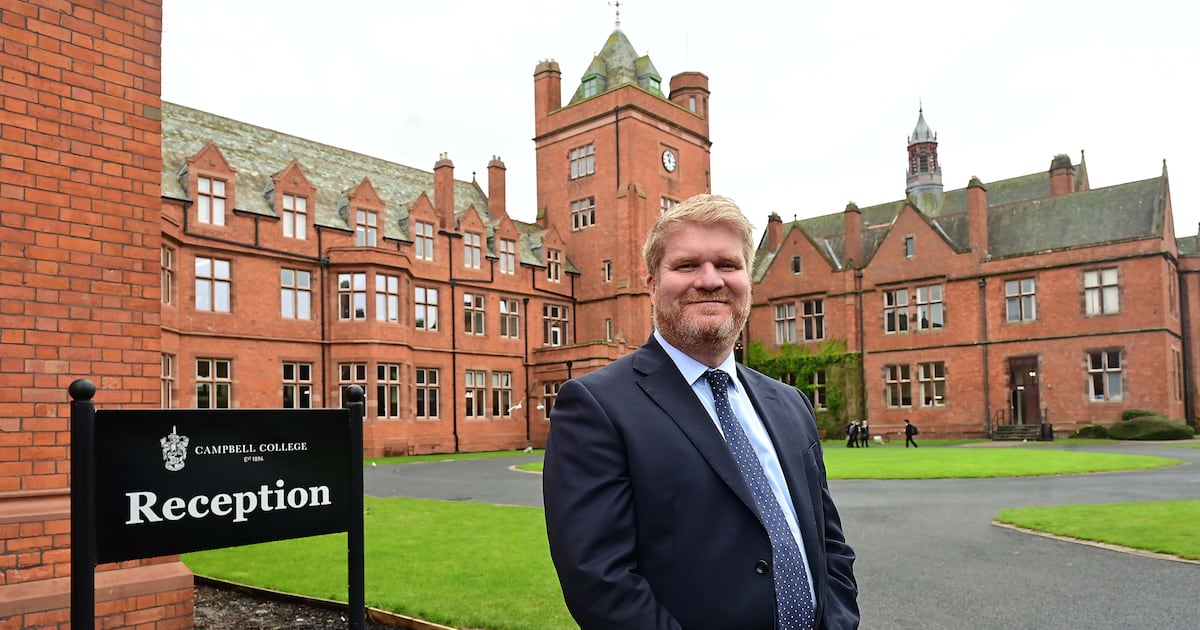
Jonathan Anderson, headmaster of Campbell College, Northern Ireland’s last remaining all-boys boarding school, goes straight into a debate about toxic masculinity when we meet at the prestigious redbrick Victorian school on the edge of Belfast city.“There is a perception that all-boys schools are dominated by alpha males, but I think it’s the opposite,” he says. “In an all-boys school, boys have a safe psychological space to learn how to be young men without the pressures of coeducational school.”Referencing the school’s involvement with a positive masculinity education group within Northern Ireland, Anderson says toxic masculinity is openly discussed. “It’s important for the boys to know they are not under attack, and it is our job to guide them correctly,” he says. “There is a willingness among boys here to be really open, whereas in coeducational schools, boys can be more reluctant to take centre stage.”Students and staff at Campbell College were also one of the first schools in Northern Ireland to sign the White Ribbon charter. By signing it, they commit not to be bystanders, but instead to play an active part in resolving gender-based violence when they witness it. “We have worked closely with Ulster Rugby over the last couple of years to reinforce positive attitudes towards and relationships with women and girls,” says Anderson.READ MOREFollowing discussion about these important issues, head of boarding Bert Robinson gives The Irish Times a tour of the facilities at the school, which was founded by Ulster Scots linen merchant Henry James Campbell in 1894.Bert Robinson, head of boarding. All photographs: Arthur Allison/Pacemaker Press Past pupils include Nobel laureate Prof William Campbell, historian Paul Bew, members of the band Snow Patrol, and several Olympians and international rugby players such as Mike Gibson.The school, set in 100 acres of woodland, has about 950 students in the senior school for boys aged 11-18. About 100 are boarders. Classrooms are divided between the wood-panelled interiors of the original 19th-century building, an adjoining modern block and a new arts block. The Central Hall, with vaulted ceiling and balconies, has a display of photographs of former Campbellians who were killed in the world wars.[ ‘It makes them more resilient’: Life in Ireland’s only Irish-language primary boarding schoolOpens in new window ]The sporting facilities include a large new gym, two sports halls, a climbing wall, 11 rugby pitches, two soccer pitches and two AstroTurf hockey pitches. Since 2024 the Irish Football Association has based its youth academy at the school.Sport facilities The gym The boarders’ accommodation is divided into Armour House for boys aged 11-15 in the original school building, and Bowes House and Chases House in newer blocks for boys aged 15-18. The Irish Football Academy boarders are in a separate 1960s block.Boarders' accommodation A communal area Kitchen A workspace All boarders have private rooms with a single bed, a wardrobe, a desk and an en-suite toilet. Shared washrooms and showers are on nearby corridors, as are common rooms and kitchens for use by students and “house mothers”. Boarders are free to go home from 3.30pm on a Friday to 8.30am on a Monday. International boarders remain on campus at weekends.Lorraine Cooke has been a house mother at Campbell College for 30 years. “It’s very homely. We are here for the boys. They can come up at breaktime, at lunchtime and to change for games instead of being in the locker rooms,” she says. Teachers and classroom assistants help the house mothers from 5pm-8.30pm as the boarders do their study in their bedrooms or in shared study rooms in the boarding houses. There is a matron on site every day until 4pm, and the house mothers all have first-aid training.Anderson says that while the school has a nondenominational Christian ethos, it is not defined by religion. “We don’t have a chapel or a chaplain, but the Central Hall is consecrated and is used as a meeting place and for Sunday family services,” he says.Central Hall Having returned to Northern Ireland after 30 years working in Britain, he adds: “When I was growing up here, religion defined so much of what you did in life. That’s no longer the case. East Belfast is a diverse religious and ethnic community. We don’t do a headcount of different religions in the school.”Woodwork facilities The library The school offers 28 A-level subjects in total (including home economics and Latin) and has an agreement with Strathearn girls’ grammar school in Belfast for girls there to take German at Campbell College while the boys go to Strathearn for psychology and media studies. The boys’ and girls’ schools also come together to work on an annual drama production.Joel Davey is the outdoor education manager at the school. He runs outdoor pursuits such as sailing, flying and shooting from his Combined Cadet Force office on the school campus.Campbell College is one of 12 schools in the North that offers this education programme for the British army, the royal navy and royal air force. “It’s not a recruitment drive, but an opportunity to take part in outdoor activities and competitions such as the Duke of Edinburgh award,” says Davey.[ Inside the only girls’ boarding school taught entirely through IrishOpens in new window ] The atmosphere around the school on our visit was friendly and calm, with teachers greeting students as they crossed the campus between various class periods. Teachers who also do boarding house duty say this out-of-classroom contact with the boys gives them a more holistic understanding of the students. Boarders also join local sporting clubs outside the school and some have sleepovers and visits to the homes of day-student friends.“It can be easy for some international students to retreat into smartphone videos in their own language but, one, you get them out of their rooms – they get involved,” says Sam McClure, one of two assistant heads of boarding who live on the school campus with their families. “They see your whole life when you live on campus. It’s a unique experience and influences my teaching massively having out-of-school contact with the boarders,” says Jonny McNerlin, another assistant head of boarding.The headmaster, Anderson, also lives on campus with his family, as does head of boarding Bert Robinson and some maintenance staff.[ Life at Ireland’s biggest boarding school: ‘I have so much more independence’Opens in new window ]About half of the boarders at Campbell College are Irish or British. The other half are from the European mainland, Asia, South Africa, the Cayman Islands and Canada. Children who have a parent from the North but working overseas make up a significant portion of these international boarders. “There are also friends of theirs with no association with Northern Ireland who send their boys here,” says Robinson. The school helps families seeking educational visas and guardianship as each international student must stay with local host families during school holidays.Anderson and Robinson were scheduled to fly to Hong Kong and China days after our visit to partake in international boarding schools recruiting fairs. Robinson says boarder numbers are down from a high of 150 in 2024-2025, but Anderson is keen to point out that fees (£26,070 for UK/Ireland boarders; £30,174 for EU citizens and £36,570 for others) are less than fees in Scottish and English schools with equivalent facilities to Campbell College. Teachers’ salaries are paid by the Northern Ireland Education Authority, which isn’t the case for private schools in England and Scotland.Boarding SchoolsThis is part of a series by Sylvia Thompson on boarding schools in Ireland – life inside the schools for students and teachers, pros and cons, the costs involved, and the freedoms and limitations. And why parents would choose to send their children to a boarding school in 21st century Ireland. ReadStudent voices: ‘It’s very different to Bermuda’Tavimba Muyirimi, Prefect in Year 14 from Zimbabwe“I was in a boarding school in Zimbabwe, but my mum moved here from Sheffield in England, where I was born. She wanted me to find a school here. It’s less strict than my school in Zimbabwe, and the teachers trust you more. I like the sense of community and socialising with people after school, but being away from my family for long periods of time is hard.”Isaac Hatch Isaac Hatch, prefect in Year 14 from Ontario, Canada“My dad is from Belfast and my mum is from Canada. My granny lives here so I have family here. I was attracted to the school for rugby. In my first year I struggled, but then I made friends and got into the routine. Last year got a lot better for me. I’m in the Rugby Academy of Northern Ireland and I’d love to become a rugby player.”Freddy von Hermanni Freddy Von Hermanni, Year 11 from Munich, Germany“I arrived here one month ago. Learning English is the biggest reason to be here. I have made friends from Berlin and Hamburg since I came. At the start, my English was very bad, but I’ve had a lot of help from the boys and staff. There is a nice family feeling here.”Aaryan Bekal, Year 14 from Singapore“My parents were looking at boarding schools in the UK, but there were long waiting lists, and then they saw the Campbell College website. It was a big culture shock to come here because Singapore is more diverse, but people here are very friendly. I’ve become more independent and have learned to handle stuff on my own. I like being in an all-boys school and we can still meet up with girls at the weekends.”Martin Bondarenko, Year 14 from Moscow, Russia“My mum wanted me to study abroad, and an agent offered this school as it’s not as expensive as English schools. Subjects are more practical here than in Russia, where it is more theoretical. I feel privileged and grateful to my parents for sending me here. I love being at a boys’ school because you don’t have to care about how you look and you can concentrate on your studies. I’ve made a lot of good friends and I’m on the volleyball team which won the All-Ireland last year.” Alby Mowat, Year 10 from Bermuda“I arrived here five weeks ago. It’s very different to Bermuda. I like how we are all friends. We might be mad at each other but eventually we sort it out.”Patrick McFarland, Year 12 from Co Down“I went to a boarding school in Co Meath [Headfort School] and came here because some of my family came to Campbell College. The whole vibe of the place and the teachers are nice. It’s a really friendly school. I found the switch from coeducational to a boys-only school quite easy. Boarding school is a community – you can knock on someone’s door to go do something. There is always something to do and you make closer friends than you would as a day student.”Nico Diaz Nico Diaz, Year 10, from Madrid, Spain“My parents knew somebody who came to the school and said it was good. My brother is in Year 10. There aren’t a lot of Spanish students here so I will get to know people from other cultures and learn English. I like football, rugby and badminton.”
Campbell College: ‘There is a willingness among boys here to be really open’
Full Article
Original Source
Read the full article at Irishtimes →KhanList aggregates and links to publicly available news content. We do not host full articles from third-party sources. Always verify important information with original sources.