
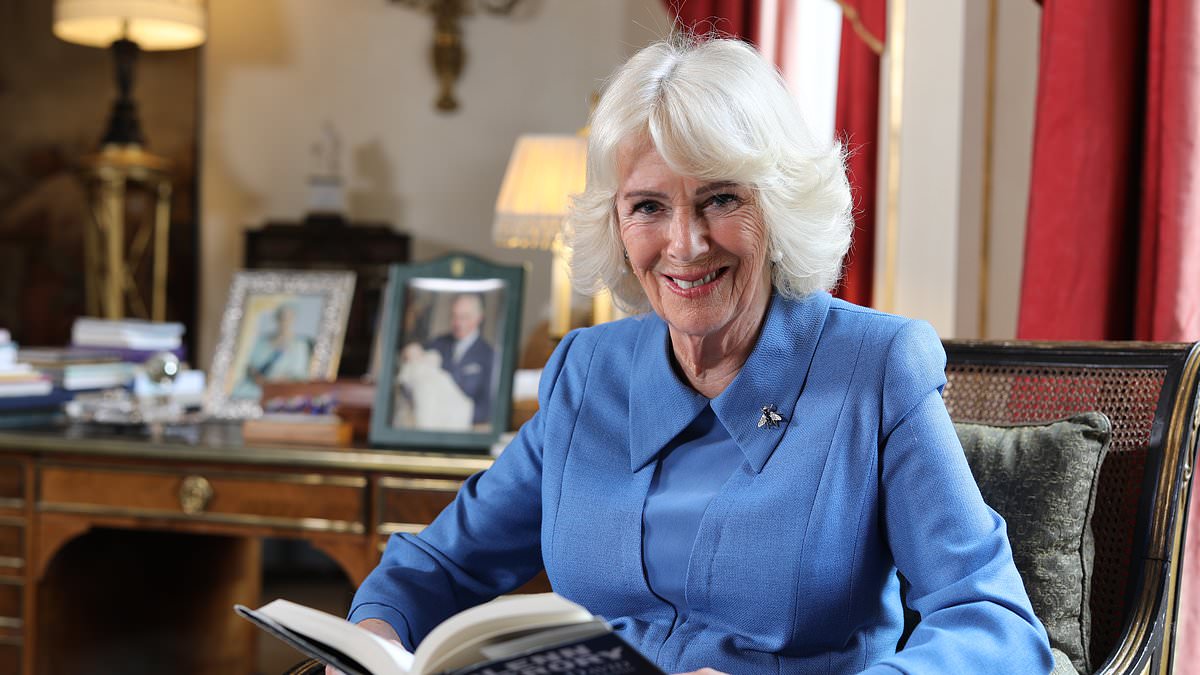
An ex-prisoner, a traumatised carer, a bereaved fish-and-chip cafe proprietor, a depressed lorry driver – and a queen. As book clubs go, this one is certainly unusual, as is the location for their meeting: Clarence House. But as tea and shortbread are served in the King’s drawing room, so this little group find an easy common ground since they are all here for the same reason: their lives have been turned around by a good book.It’s not surprising, then, that things get emotional – at times, tearful – during a remarkable new documentary in which Queen Camilla offers a stark warning. ‘If there’s no reading,’ she tells us, ‘I don’t think we’d even be human any longer.’ And with sobering new research which shows that 40 per cent of British people have not read a single book in the last year, she is trying to redress the balance.Ever since she married into the Royal Family in 2005, Queen Camilla has made the promotion of reading one of her key priorities, taking on the patronage of umpteen charities and campaigns dedicated to literacy and literature.During Covid, she went on to create an online book club, the Queen’s Reading Room, which now has more than 12 million followers in 184 countries. As well as staging major festivals and events around the UK, it aims to champion the mental health benefits of reading and spread the joy of stories.Since 2026 is the UK’s National Year of Reading, she had the idea of tracking down a cross-section of people for whom one book has opened a window to another world. Their inspirational stories form the spine of a landmark BBC2 programme, The Book That Changed My Life. Ever since she married into the Royal Family in 2005, Queen Camilla has made the promotion of reading one of her key priorities, taking on the patronage of umpteen charities and campaigns dedicated to literacy and literatureIn the case of the Queen, it was reading Previous Engagements, the wartime memoir of her much-decorated father Major Bruce Shand – a man who, like so many war veterans, never talked to his family about his shocking experiences.During the film, she reads us extracts, including the moment when Major Shand is shot in the face while commanding a squadron of armoured cars during the Battle of El Alamein.The bullet somehow misses his tongue, teeth and brain, but his driver is killed, and he himself is soon taken prisoner. ‘It was written from the heart,’ the Queen recalls. ‘I cried through most of it. I found it so moving because I didn’t know anything about it.’It was while being held as a prisoner of war for more than two years that Major Shand developed his love of reading – ‘he read every single book from the Bible to the encyclopaedia’ – and later passed that on to his daughter. As she recalls, it accounts for a large part of her learning: ‘We left school quite young because in my day women didn’t go to universities. So I think reading has been most of my education. You learn much about people, about life. It’s so important to get children reading early. You can go anywhere, get your magic carpet and off you go.’As a child, the Queen recalls, she adored Treasure Island, Peter Pan, The Scarlet Pimpernel and A Tale Of Two Cities – she admits to being transfixed by the drama of the guillotine in the latter two novels: ‘I was mesmerised by the tricoteuses, these ghastly women sitting there doing their knitting while everybody had their heads chopped off.’She also points out that few things can foster interest in a book as effectively as prohibition. She fondly recalls the excitement surrounding DH Lawrence’s Lady Chatterley’s Lover, the graphic tale of love across the class divide which was the subject of an obscenity trial in 1960. ‘As teenagers, you read a lot of romances. It was the moment of Lady Chatterley under our pillows – reading that by torchlight. You know, the minute something’s forbidden, you want to get hold of it!’ Along the way, the Queen also reveals that, every night before dinner, she and the King like to disappear into a book (a biography or PG Wodehouse in his case). ‘It’s the best tonic in the world,’ she says. ‘Occasionally, when I’m deep in a book, I hear him roaring with laughter about something. It’s very off-putting. I can’t get back into my book – or I’ll suddenly start weeping.’The programme introduces her – and us – to people of all ages and literary tastes as they reflect on their own inspirational must-reads. Director Toby Trackman focuses on four stories, opening with Omar Mentesh, 44, whose life has been shaped by two random moments. The first came at the age of five, when he was picking berries with his cousins in north London. They slipped through a fence and across a railway line where ‘all of a sudden, a giant picked me up and was shaking me’. He woke in hospital, covered in bandages and lucky to have survived electrocution.It took him years to recover fully, during which time he fell behind at school while his family – part Irish, part Cypriot – were constantly moving from one north London home to the next. By eight, he was breaking into cars. That progressed to burgling offices and shops until, at 15, he was caught, sentenced and despatched to Feltham prison for young offenders. There, mortified by the prospect of no television and with nothing to do, he picked up a book – The Eagle Has Landed by Jack Higgins. ‘I could read enough where I could be in the scene. I think that was it for me. To be out of that cell and to be in that scene, that was amazing.’After being released, he returned to a life of petty crime, and further burglaries would lead to a total of seven years in prison, all endured with the help of ‘piles of books’. It was another one, Man’s Search For Meaning, Viktor Frankl’s haunting account of survival in a Nazi concentration camp, which turned his life around again. ‘It’s a powerful book, reframing negative and horrible experiences and finding meaning to life,’ Omar explains.It inspired him to go to university, set up workshops for prisoners and, ultimately, to set up his own company educating offenders. His proudest achievement, he tells me, is to have instilled a love of reading into his own young son (one of the most poignant moments of the whole programme is Omar reading Alice in Wonderland to his boy).For Sarah Heward, life was going swimmingly in the London wine trade when her Scottish boyfriend, Steve, proposed and they took a giant leap of faith, throwing in their jobs to open a fish-and-chip cafe in the Highlands. They loved it but just over a year later, Steve died from an undiagnosed aneurysm. Sarah’s world might have fallen apart. All her friends expected her to abandon her cod-and-chips pipe dream and go back to city life. During Covid, she went on to create an online book club, the Queen’s Reading Room, which now has more than 12 million followers in 184 countriesYet it was re-reading Tracks by Robyn Davidson, the story of a young woman traversing the Australian Outback with four camels and a dog, that set her on a different path – as viewers will discover (along with some glorious shots looking out over Loch Tay).For Ian Kirby, life fell apart after giving up his job as a retail manager to care for his elderly mother. One day, a disturbed intruder fought his way into their home in Tyne & Wear and threw Ian out of the house. Though the police soon appeared and arrested the man, Ian was so devastated by the sense of having let down his mother that he became a nervous wreck. Following her death seven months later, he effectively became a hermit for more than a year, sitting alone all day harbouring suicidal thoughts.Eventually, a health worker persuaded him to attend a reading workshop and he picked a book off the table, Carrying David, the autobiography of boxing champion Glenn McCrory.It was not the boxing that caught Ian’s eye, but the introduction: ‘From the stunning highs to the many lows, Glenn has drawn inspiration from his adopted brother David, whose battle against the degenerative disease that would eventually claim his life was fought with bravery and dignity.’ As Ian, close to tears, explains, ‘This was the book that truly changed my life. That really did speak to me. Somebody who was suffering so much could still find the joy in life, could still find why they wanted to live.’Equally moving is the story of Southport lorry driver, Peter Lloyd. Having endured the misery of partial deafness as a child – he struggles to spit out the words ‘special school’ – he fell so far behind that he more or less gave up and left school unable to read. Though that did not stop him getting a job as a driver, he felt more and more worthless as he started raising a family. Just going to the shops was a challenge since he could not read the names of products. Worst of all, he was unable to read to his children. ‘I made every excuse under the sun, saying, “Daddy’s busy... got to do the dishes... get tea ready.” The most bonding parts of doing something with your child, I couldn’t do. It just destroyed you.’ It left him feeling ‘physically sick... I didn’t want to be here any more.’Eventually, his wife persuaded him to attend an adult literacy course called Read Easy, where something just clicked thanks to a single teacher. ‘Alison just got me from the word go. She got me and it changed my life.’ So, too, did the book he now carries in the cab of his truck: JK Rowling’s Harry Potter. It’s another enchanting scene as we see him reading with his own son. ‘It’s given me the inspiration to actually believe in myself and the power inside me to say, “I can. I will.”’We are used to TV shows featuring people claiming to be ‘on a journey’, when it might involve losing weight or going on a blind date. But this show is the real deal. These are inspirational stories involving people who have all been on an epic journey, one that leads them to Clarence House. There, as we will see, they meet for the first time and swap notes.Director Toby Trackman says he was pleasantly surprised about how easy it was filming around the Queen. ‘We weren’t talking about her royal duties. We were talking about things connected to her personally and that she cared about, and reflecting on those experiences.’ He hadn’t expected her to be discussing guillotines or Lady Chatterley. ‘I don’t think any of us were expecting her to say that to us. But I think that speaks to how passionate she is about the subject and how much of a personal connection she has to it.’ There is nothing staged about this happy ending. Indeed, I learn that things have continued to get even happier since. Sarah’s award-winning fish-and-chip establishment, The Real Food Cafe, is thriving; Omar’s educational business is booming; Peter is considering new job opportunities; and Ian has just been appointed a lay minister by the Bishop of Durham. ‘Truly, my life has been returned to me,’ he says.The show closes with the words of our royal bibliophile. ‘I think it’s wonderful,’ says the Queen. ‘Books change people’s lives.’ Here’s how.The Book That Changed My Life, Wednesday, 9pm, BBC2 & iPlayer.
Camilla reveals the books that make King Charles roar with laughter in new BBC documentary about how reading changed her life
Full Article
Original Source
Read the full article at Dailymail →KhanList aggregates and links to publicly available news content. We do not host full articles from third-party sources. Always verify important information with original sources.