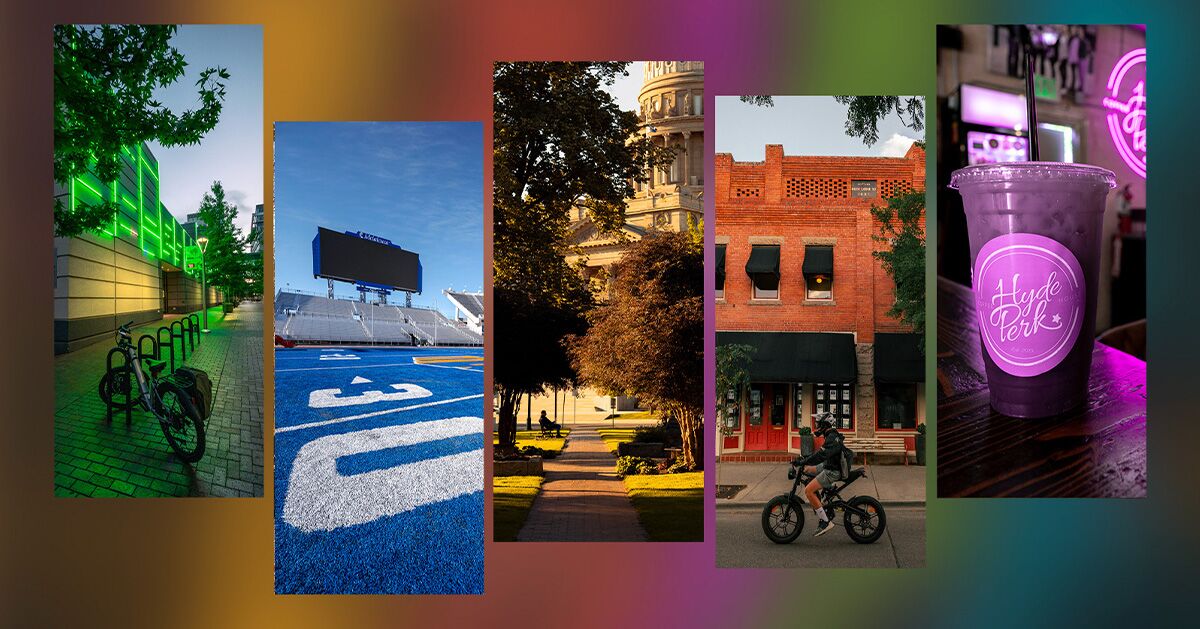
It was 9 PM when I landed in Boise, and the June sun had only just begun to set. The airport felt too quiet for a state capital. Everything looked clean, orderly, and almost empty. Without the passengers from my flight hurrying toward the exit, the place might have felt like the set of an apocalyptic movie. I had no idea what to expect from Idaho or its capital. During the first few minutes of the ride to my hotel, Boise seemed to spread across more land than it needed. There was little activity, apart from a few closed restaurants at major intersections. Then we crossed the Boise River, and the city came into focus. I was suddenly surrounded by historic buildings, downtown towers, and the fully lit Idaho State Capitol, closing the view at the end of one of the main streets. Boise looked like the kind of place where I could spend hours on a photo walk. Fortunately, that was exactly what I planned to do. I came to photograph Boise through some of its most distinctive colors. For two days, I walked the city streets and parks from sunrise to sunset. The palette I was looking for gave me a way into the city, one color at a time: the green that followed the river, the blue of Boise State University, the golden grass on the foothills, the copper tones on bridges and buildings, and the elusive purple hiding throughout the city. This is how I began to understand Boise through color. All photos by the author Blue: Boise’s official color Left: Albertsons Stadium. Right: Boise Whitewater ParkDowntown BoiseLeft: Julia Davis Park. Right: Boise Peanut ShopIdaho State CapitolAlbertsons StadiumLeft: Boise Whitewater Park. Right: Idaho Botanical GardenAlbertsons Stadium Blue is a marker of local identity in Boise. Boise State University long had a famously blue turf, and the color felt apt for the promise of 200-plus sunny days a year and an outdoor life along the Boise River. Blue was probably the only Boise color I knew exactly where to find before I arrived. But when I reached the university stadium, a renovation crew had torn up sections of the blue turf as part of a replacement project. Heavy machinery interrupted the shots I had pictured, so I shifted to tighter angles and close-ups. Later that day, blue appeared more naturally at Boise Whitewater Park. There I began to realize that while I had been chasing Boise’s best-known color, another one filled most of my frame. Green: The Boise I did not expect Left: Boise Centre. Right: Idaho Black History MuseumHyde ParkLeft: Julia Davis Park. Right: Idaho State CapitolBar GernikaIdaho Botanical GardenLeft: Idaho Botanical Garden. Right. Camel's Back ParkBoise Whitewater Park Boise first contradicted my expectations in shades of green woven throughout the natural infrastructure that connects the city. The Boise River Greenbelt, the botanical garden, and the dense tree cover in neighborhoods like Hyde Park changed my mental picture of Boise from my first walks. I expected Idaho to feel dry and agricultural. Instead, I found a city of parks, where green spaces fill with activity before sunrise, a large tree always seems close enough to offer shade, and flocks of geese can stop traffic for several minutes without upsetting anyone. Boise really lives up to its nickname, the City of Trees — the city name itself comes from the French boisé, or “wooded.” Gold: The color of light and the foothills Left: Boise Square Park. Right: Hyde Perk Coffee HouseCamel's Back ParkLeft: Hyde Park. Right: Julia Davis ParkThe view from Boise DepotLeft: Camel's Back Park. Right: Boise River GreenbeltCecil D. Andrus ParkLeft: The Idanha Building. Right: The Empire Building In Boise, gold belongs less to objects than to certain hours of the day and the landscape surrounding the city. It appears across the foothills and high desert, where sunrise and sunset seem to stretch through the longest days of summer. As a photographer, the progression of warm tones during an immense golden hour felt like the real luxury Boise offered. One of my favorite moments from the trip came at sunrise in Camel’s Back Park. The golden grass around me began to glow before the sun cleared the mountains, heavily contrasting with the dark-blue skies and the hues of green surrounding the park with a view of downtown Boise from above. Copper: The color of the city and its architecture Left: Boise High School Gymnasium. Right: Downtown BoiseHyde ParkLeft: Ann Morrison Memorial Park. Right: North EndFriendship Bridge on Boise RiverIdaho State Capitol interiorLeft: Idaho Botanical Garden. Right: The Egyptian TheatreDowntown Boise Gold changes with the light, but copper feels constant. That sense of permanence made copper a natural fit for Boise’s architectural history. I found those warm tones in the iron bridges catching the sun, the Capitol dome glowing under interior lights, the facades along the Basque Block, and downtown’s red-brick and sandstone architecture. The Idaho State Capitol gave copper more weight in the way I read the city. From the street, the building looked solemn and difficult to enter, and for a few minutes I wasn’t sure visitors could simply walk inside. I followed signs to an accessible entrance and ended up in the Garden Level Rotunda. From there, the dome opened above me in an unexpected view, and I took one of my favorite photos of the trip. By the end of my second day, I had come to associate green with Boise’s natural landscape and copper with the older layers of the city visible in its architecture. Purple: The color I had to ask for Left: Idaho State Capitol. Right: Idaho Botanical GardenDowntown BoiseLeft: Downtown Boise. Right: Hyde Perk Coffee HouseLeft: Downtown Boise. Right: Idaho Botanical GardenLeft: Freak Alley. Right: Pie HoleSplit Rail WineryDowntown Boise Purple rarely dominates urban or natural settings. In Boise, I found it in flowering shrubs of the Idaho Botanical Garden, sidewalk planters around town, Garden City’s wine culture and tasting rooms, and in the city’s street art. My search for purple also brought Boise’s hospitality into focus. While eating breakfast at Hyde Perk, I began chatting with the baristas about my project. They immediately offered to make a drink in a color I could use, on the house. “Don’t drink it,” they warned me. “We made it purple, not tasty.” Color Pop: When I left the palette behind Left: Freak Alley. Right: Boise Art MuseumFreak AlleyLeft: Boise Depot. Right: Downtown BoiseDowntown BoiseHyde ParkFreak AlleyDowntown Boise For two days, I tried to divide Boise into blue, green, gold, copper, and purple. Looking for all of them at once led me to Freak Alley, an open-air street art gallery where the full palette covers walls, doors, and downtown alleys. By the end of the trip, though, I understood that Boise’s real colors extended beyond the paint on its walls. The people I met ended up defining my time in Boise: those who stopped to ask about the photos I was taking, the employee at City Peanut Shop who recommended a place to watch the sunset, the can of kombucha the guys at Bar Gernika gave me so I could try something locally crafted, and the purple drink the baristas at Hyde Perk improvised just so I could take a photograph. I arrived in Boise without understanding its size, culture, or how it fit into the rest of Idaho. Two days later, on the way to the airport with a camera full of local color, I kept thinking about how welcome people had made me feel, how much I still had left to explore, and how different it would be to return with more time and no palette to chase. More like this
Camera Roll: Boise in Color
Full Article
Original Source
Read the full article at Matadornetwork →KhanList aggregates and links to publicly available news content. We do not host full articles from third-party sources. Always verify important information with original sources.