
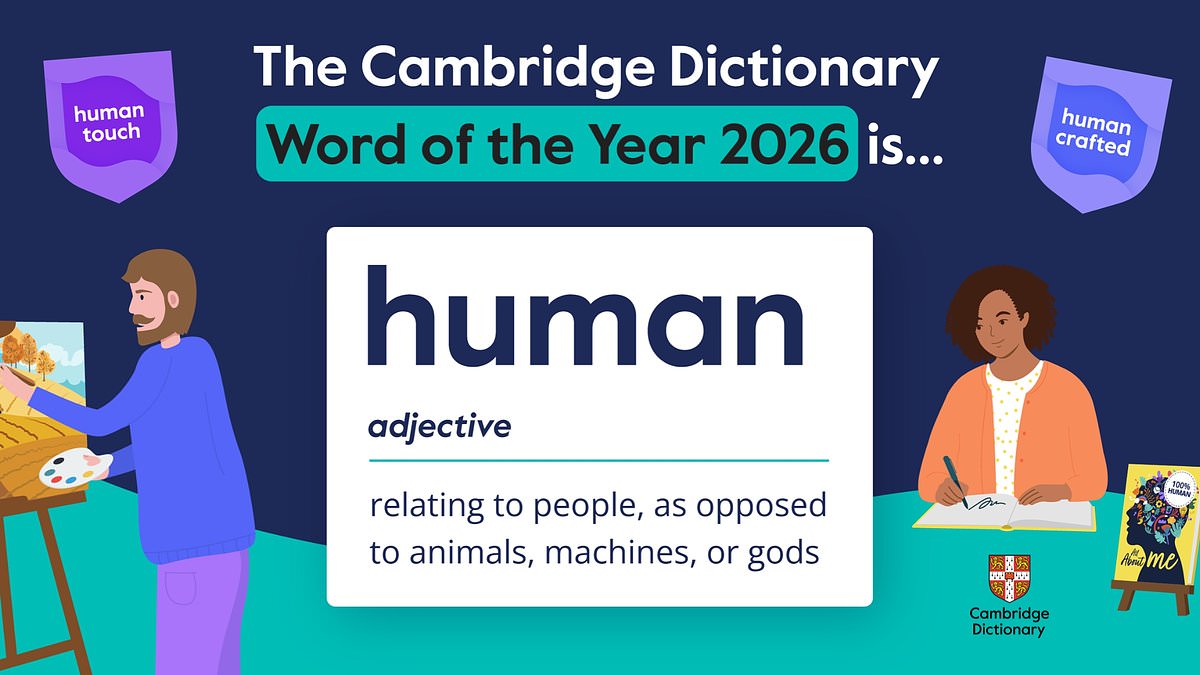
As AI becomes increasingly embedded in everyday life and we rely on cutting-edge technology more and more, you could be forgiven for thinking the tide is turning against the humble human. For the Cambridge Dictionary, however, this could not be further from the truth. Editors have named 'human' as its Word of the Year for 2026, saying the word has taken on renewed significance as artificial intelligence 'blurs the boundaries between people and machines'.The choice reflects growing debate over what separates people from bots as AI systems become more capable of mimicking human conversation, creativity and decision-making. It comes as high-profile figures have recently argued for the importance of preserving uniquely human qualities in the age of artificial intelligence.In a widely read essay published in August, Bill Gates made the case for 'human reserved jobs', such as caregivers, that should never be taken by machines.'AI is changing how we talk about being human,' Colin McIntosh, lexicographer at the Cambridge Dictionary, said.‘Fears about what humans may lose when we outsource our thinking has made us reconsider the extent to which we rely on AI: from top mathematicians to teachers of young children. Human is defined in the Cambridge Dictionary as 'having the qualities, faults, and feelings that people have, as opposed to gods, animals, or machines''The definition of "human" has traditionally distinguished us from gods, animals, and, latterly, from machines.'A recent increase in compounds such as "human-made" highlight how the word has come to distinguish works or qualities of people, as distinct from AI.'It's this renewed interest in the idea of being human that captured the zeitgeist and made "human" the Cambridge Dictionary Word of the Year.'Commenting on 2026's Word of the Year selection, Mr Gates said: 'AI is making us think harder about what it means to be human.'It could help us cure diseases, improve education, and give people more time to spend on the things that matter most.'But we need to make deliberate choices about how it fits into our lives, including where we want people to remain at the centre. The measure of AI's success should be how much it improves human lives.'Nobel laureate in Physics Geoffrey Hinton, often called the 'godfather of AI', also warned we are 'creating alien beings…and the reality is we only have a couple of years to adapt to that', adding: 'I'm willing to be selfish and choose humans.'And in his Magnifica Humanitas letter, Pope Leo XIV spoke of new forms of 'dehumanization' and the 'pressing duty to remain profoundly human'. Professor Geoffrey Hinton, a British-Canadian computer scientist known for his work on artificial neural artworks, warned we are 'creating alien beings' Experts have warned AI could 'lead to human extinction' if it became 'superintelligent', which has been the subject of many science fiction films, including 2009's Terminator SalvationHuman is defined in the Cambridge Dictionary as 'having the qualities, faults, and feelings that people have, as opposed to gods, animals, or machines'. New words added to the Cambridge Dictionary in 2026 Air jail: A method of trying to train an animal, especially a dog, that involves holding them off the ground for a period of time when they show aggressive or other unwanted behaviourAura farming: The activity of doing things with the intention of showing a personality that people admire and think is attractive and interesting, for example on social mediaLooksmaxxing: The activity of making yourself as physically attractive as possible, as encouraged by some people, mainly young men, on social media Dr Tom McClelland, a philosopher of science at the University of Cambridge, said choosing 'human' as Word of the Year is significant as our understanding of humanity is currently changing.'What it means to be human isn't a fixed thing,' he said. 'It's something that is always changing in response to political context, scientific understanding and current technology.'That means we need to decide what it means to be human. Discussions around AI reveal that this is something people think about in very different ways. I think "human" is a great word of the year precisely because it prompts those important questions.'Other additions to the dictionary in 2026 reflected some of the year's biggest online and cultural trends.New entries include 'air jail', a dog-training term that went viral after videos showed pets being lifted off the ground.Meanwhile 'aura farming' refers to the practice of carefully cultivating a cool or admirable image, for example on social media.Editors also added 'looksmaxxing', a trend – particularly among young men – focused on maximising physical attractiveness.Other Word of the Year contenders include 'agent', referring to autonomous AI systems capable of acting independently, 'wholesome', which saw renewed popularity thanks to feel-good moments at the 2026 World Cup, and 'analogue', reflecting growing interest in screen-free hobbies such as reading physical books, knitting and listening to vinyl records.The dictionary is also considering future additions including 'weather whiplash' for rapid swings between weather extremes, 'FOBO' or the fear of becoming obsolete due to AI, and 'dusking', the practice of watching the transition from daylight to darkness as a form of relaxation.Professor Rachel Adams, an expert on AI governance and human rights at the University of Cambridge, said: 'AI is going to be a profound test for humanity.'There's a real risk that it deepens existing inequalities, but it also has the potential to solve them. Collectively, we need to decide what we value and what we will allow to happen to each other.'There is no doubt that AI has vast potential to change the world. The question is whether the profits of AI – in terms of wealth, productivity and scientific advances – can be harnessed to tackle the great political challenges of our time.'
Cambridge Dictionary names 'human' the Word of the Year 2026 - as AI 'blurs the boundaries between people and machines'
Full Article
Original Source
Read the full article at Dailymail →KhanList aggregates and links to publicly available news content. We do not host full articles from third-party sources. Always verify important information with original sources.