
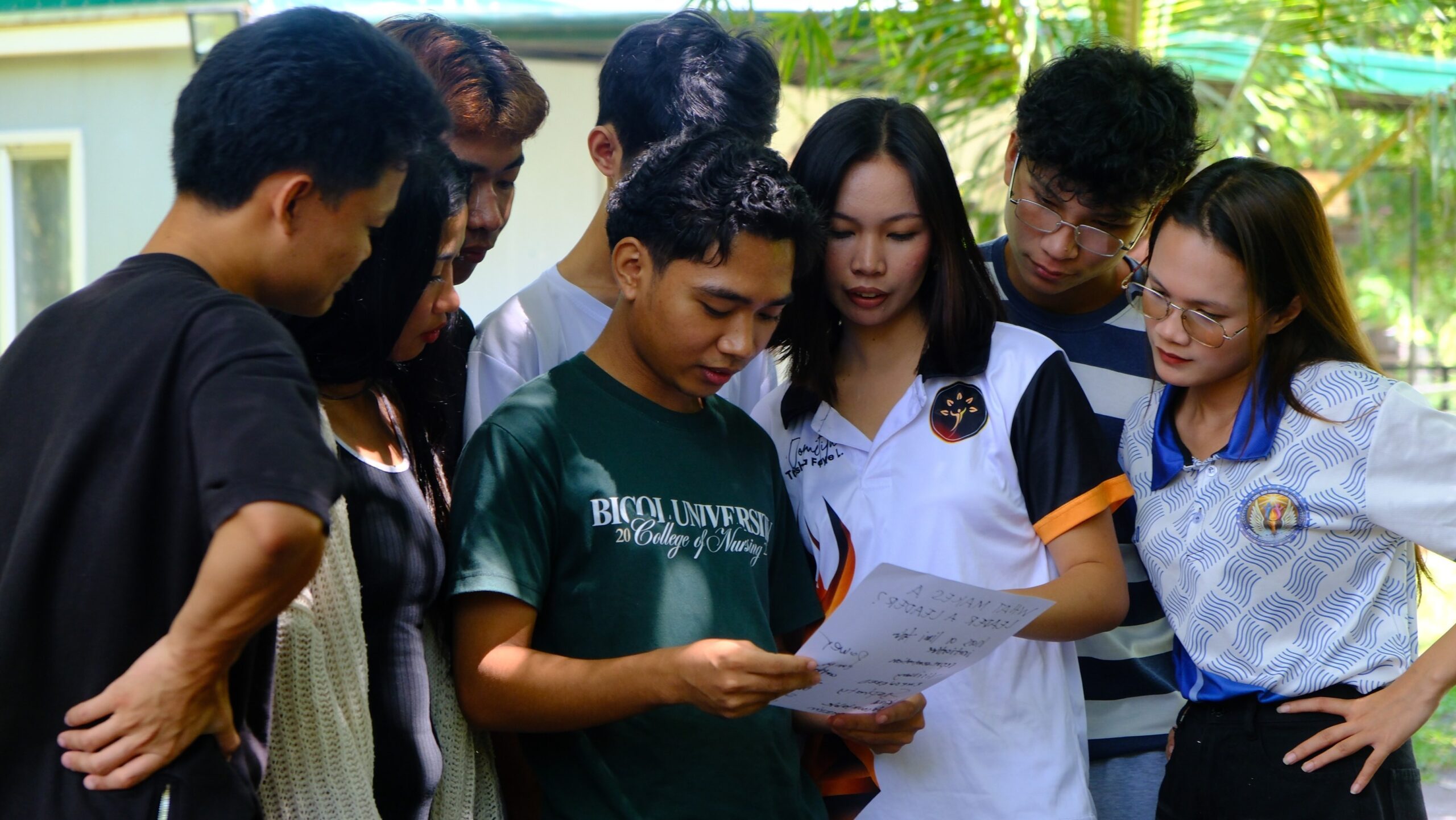
LOCAL LEADERS. The Climate Action Network - Camarines Norte (CANCN) trains student leaders across the Bicol region to spearhead the climate movement, emphasizing collaborative efforts between schools and communities to address local and national climate crises. CANCN By arming Camarines Norte residents with climate literacy, they learn to defend their rights and help shape decisions as big solar and wind projects boom across the province Camarines Norte has declared October as Climate Literacy Month to integrate climate education into school curricula and empower local communities against the impacts of climate change. Local advocates emphasize the importance of grassroots-driven climate empowerment and the need for just transitions to renewable energy, while cautioning against development aggression that threatens rural livelihoods. The initiative aims to equip residents with climate literacy to actively participate in local energy planning and ensure that developments benefit affected communities. This is AI-generated. Read the article for full context. Report any errors. ALBAY, Philippines – For decades, the provinces along Bicol’s eastern seaboard have stood directly in the path of destructive typhoons, trapping coastal communities in a repetitive cycle of disaster and relief aid. Now, local organizers and climate advocates in Camarines Norte are striving to end that cycle by placing communities at the center of the solution. In a landmark initiative for the region, the Climate Action Network – Camarines Norte (CANCN) and Reboot Philippines partnered with multi-sectoral groups to successfully lobby the provincial government into declaring October as Climate Literacy Month. Adonis Salen II, executive director of CANCN, highlighted how institutionalizing Climate Literacy Month will allow climate education to be integrated directly into school curricula, expanding outreach to local communities through an empowered network of volunteers and partners. “We believe that literacy is essential to understanding what climate change is, how it impacts us, and how we must respond,” Salen said. “Through Climate Literacy Month, we have partnered with schools to embed climate education into formal learning, while working with external organizations to bring these critical discussions into local communities.” He emphasized that this approach goes beyond classroom instruction, fostering open dialogue and raising awareness about the region’s most urgent environmental challenges. COMMUNITY POWER. Akbayan Representative Chel Diokno leads a discussion in Camarines Norte on how youth and civic leaders can support a just renewable energy transition through local and national policies. All photos from CANCN Christian Jay Marmol, secretary and treasurer of CANCN and local communications officer for Reboot Philippines, stressed that Camarines Norte, like much of Bicol, urgently requires grassroots-driven climate empowerment. He noted that strong community mobilization was pivotal in steering the provincial government toward actively supporting local climate advocacy. “Genuine climate action begins with education and literacy,” Marmol said. “Our partnerships with schools and civil society organizations successfully pushed the provincial government to establish a dedicated Climate Literacy Month — proving that real climate action starts not with solar panels alone, but with the radical democratization of climate knowledge.” As the first policy of its kind in Bicol, this declaration enables local climate organizations to secure funding and mobilize targeted initiatives alongside the communities they serve. According to Salen, this can serve as a blueprint for other vulnerable local government units trapped in cycles of relief-aid dependency. POLICY VISION. Adonis Salen outlines the policy framework and core agenda behind Camarines Norte’s Climate Literacy Month. Hope for just transition In addition to elevating climate education, local advocates emphasize that the newly established Climate Literacy Month will pave the way for a just transition to renewable energy — a critical priority as energy projects expand across Camarines Norte. “We are aware that renewable energy projects are increasing in Camarines Norte, so we must remain vigilant against potential development aggression,” Marmol said. On Saturday, October 24, YHP2 Energy Inc. inaugurated a 10-megawatt solar farm spanning 9.22 hectares in Barangay Bautista, Labo. The facility is set to supply electricity directly to the Camarines Norte Electric Cooperative (CANORECO), delivering locally generated clean power to residents. Despite these advances, Marmol cautioned that rapid infrastructure development poses significant risks to rural livelihoods. “When agricultural lands are hastily reclassified as industrial zones for infrastructure projects, it constitutes a form of development aggression against vulnerable farming sectors,” Marmol explained. “We must ensure that the transition to clean energy remains grounded in justice and protects the communities most affected by these projects.” CLIMATE ACTION. Youth and climate leaders convene in Camarines Norte to champion climate literacy as part of their pioneering annual observance of Climate Literacy Month in October. Beyond solar energy, Camarines Norte is also slated to host a major offshore wind project alongside Camarines Sur. Spanning the municipalities of Basud and Mercedes, as well as Calabanga, Cabusao, Tinambac, Siruma, and Sipocot in Camarines Sur, the foreign-funded wind farm is projected to generate 1,000 megawatts of electricity. However, the project is expected to impact at least 6,000 small-scale fisherfolk across both provinces. Such developments come with distinct challenges to rural and coastal livelihoods. “We are not against these developments because we are advocating for them. Rather, we are ensuring that these kinds of developments are just for the sectors or for the communities affected and that they are included in the consultation,” Marmol added. ENERGY LEADERSHIP. Christian Jay Marmol leads the discussion on climate and energy issues and policies during the executive signing event launching Climate Literacy Month. To prevent further development aggression, Salen stressed that equipping residents with climate literacy is key to helping them defend their rights and actively shape local energy planning. “While Climate Literacy Month could be seen as a simple observance, we designed it as a platform to advance broader agendas that empower our communities,” Salen said. “As the government opens doors to the Renewable Energy Roadmap, a climate-literate public will be far better equipped to participate meaningfully as members of the Just Energy Transition Council.” Beyond the ceremonial signings and policy roadmaps, both Salen and Marmol agree that the true test of Camarines Norte’s Climate Literacy Month lies in its permanence on the ground. They said that by transforming abstract climate discourse into tangible community power, the province’s residents are proving that when communities are armed with knowledge, they cease to be mere casualties of the climate crisis. – Rappler.com How does this make you feel? Loading
Camarines Norte communities take charge of local climate fight
Full Article
Original Source
Read the full article at Rappler →KhanList aggregates and links to publicly available news content. We do not host full articles from third-party sources. Always verify important information with original sources.