
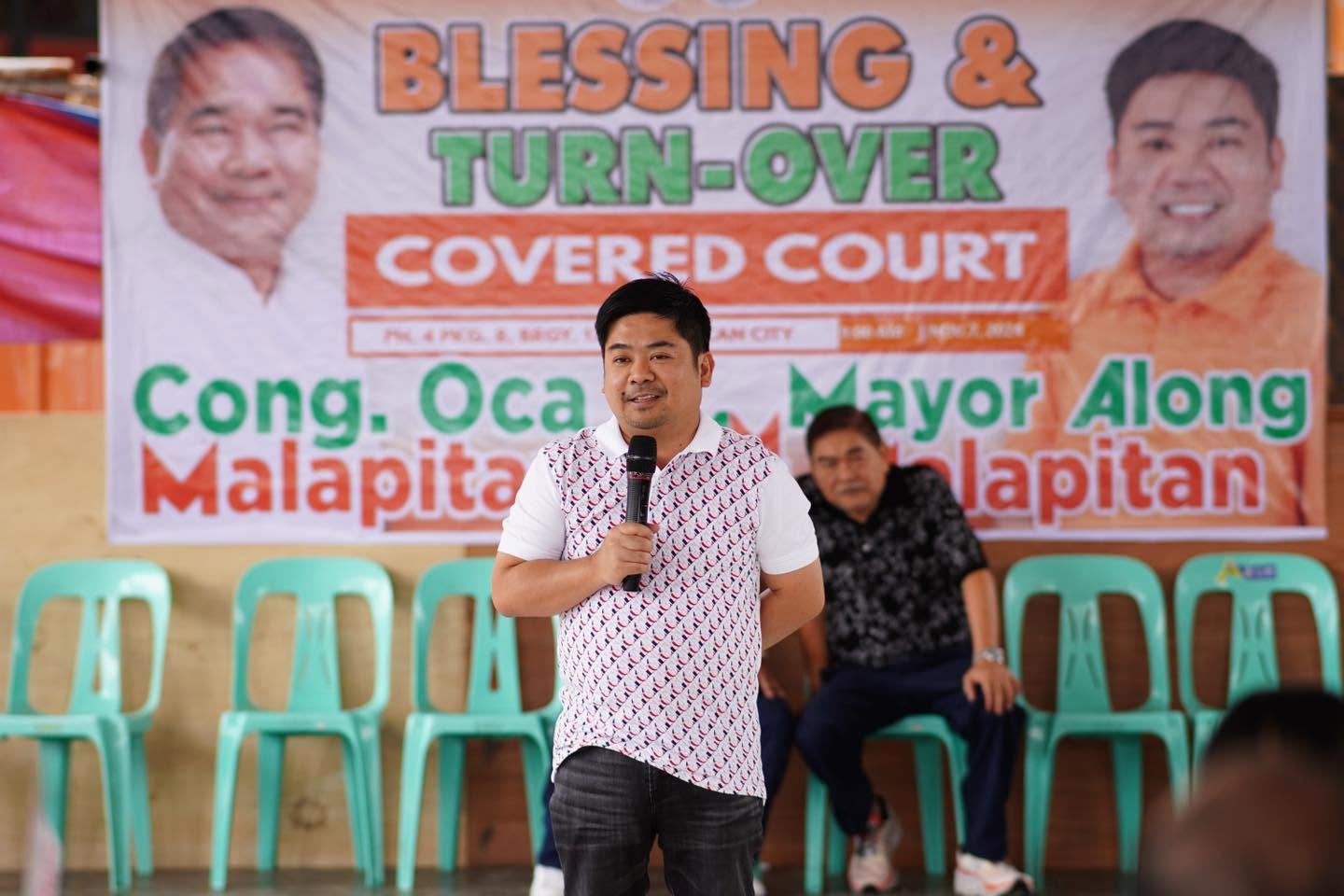
There are many government contractors in Caloocan City, but one, in particular, got the attention of locals because of its links to the city’s dominant political dynasty. The contractor drew little attention outside Caloocan, even when it appeared on a list of alleged Malacañang-dictated budget insertions cited by fugitive resigned lawmaker Zaldy Co in November 2025. After months in hiding following his implication in the flood control scandal, Co broke his silence with a series of Facebook videos. He tagged President Ferdinand Marcos Jr. and then-speaker Martin Romualdez as the alleged masterminds of P100 billion in insertions in the 2025 budget. Co released a 20-page list of insertions that Marcos allegedly requested, through Palace officials, at the bicameral conference committee level. He claimed he never received a single centavo from government coffers. Malacañang and Romualdez denied the allegations and challenged him to submit them formally under oath. Two projects on Co’s list, worth a total of P188 million, named Ave-Mira Construction and Trading as contractor. Days after Co’s bombshell, concerned citizen Christopher Orongan, a former soldier, asked on Facebook: “Marami yatang projects sa Caloocan itong Ave-Mira Construction and Trading. Sino kaya ang may-ari nito? Kilala ba?” (Ave-Mira Construction and Trading seems to have many projects in Caloocan. I wonder who its owner is? Are they known?) Five days later, Orongan asked a more pointed question: “Sino si Avelino Narciso? Related ba sa asawa ng kasalukuyang Mayor ng Caloocan City (Who is Avelino Narciso? Is he related to the wife of the incumbent Caloocan City mayor)?” Even after Orongan answered his own question, the posts gained little traction. Interest was localized, limited to Caloocan netizens or those aware of city politics. Public attention was focused on the top 15 flood control contractors Marcos had named months earlier, the resulting congressional inquiries, and the fugitive Co. The government investigation into flood control corruption was already in full swing, after Marcos formed the Independent Commission for Infrastructure (ICI) in September 2025. Ave-Mira Ave-Mira was established in Orani, Bataan, and is named after owner Avelino Narciso and his wife, Edelmira. Their daughter, Aubrey, is the wife of Caloocan City Mayor Dale Gonzalo “Along” Malapitan. The company’s General Information Sheet filed with the Securities and Exchange Commission in July 2025 lists the following: Narciso as the corporate secretary with a 33% share Son-in-law Rome Sicat as chairman with 33.5% Sicat’s wife, Abba Narciso Sicat, as treasurer with 33.5% Rome and Abba both served on the Orani Municipal Council. Rome was town councilor from 2010 to 2019, while Abba was first elected in 2019 and is on her third term. Ave-Mira began getting Department of Public Works and Highways contracts in 2019, starting with a project in Orani. That year, it secured eight DPWH contracts: seven in Bataan and one in Caloocan. Its other contracts are as follows: Bataan, 2019 to 2025: 49 contracts worth P727,956,762.16. 14 of them were in Orani. Bulacan, 2021 to 2024: P51,463,463 worth of road, building and flood control contracts under the Bulacan 1st District Engineering Office. Senator Panfilo Lacson highlighted that office in his August 2025 privilege speech on flood control corruption. Quezon City: the company also secured government contracts here. Malapitan political dynasty and Narcisos The Malapitans’ rise to the dominant political dynasty in Caloocan City started with their patriarch, Oscar, who served as Caloocan councilor from 1992 to 1998, vice mayor from 1998 to 2001, and 1st District congressman from 2004 to 2013. He was mayor from 2013 to 2022, and has been congressman again since 2022. Along was 1st District councilor when he married Aubrey Narciso in 2013. That year, he sought his father’s congressional seat but lost to then-outgoing mayor Recom Echiverri. He ran again in 2016 and won. He was reelected in 2019, and by the end of his second term in 2022, his father was a term-limited mayor. The two won each other’s posts in the 2022 elections and were both reelected in 2025. Along’s brother, Enteng, entered politics in 2019 as a 1st District councilor. He won a third term in 2025 and will serve until 2028. Narciso was among Along’s donors in the last two elections. He donated P3 million to his son-in-law’s 2022 election campaign, and the same amount to his 2025 election campaign, according to Along’s Statements of Contributions and Expenditures (SOCEs) obtained by Rappler from the Commission on Elections (Comelec). From 2019 to 2025, while Along and Oscar were either congressman or city mayor, Ave-Mira got 39 DPWH projects in Caloocan City worth P731,368,859.87. Two were joint ventures with Orani Construction and Supply Corporation. In early November 2024, Congressman Malapitan and Mayor Along led the blessing and turnover of covered courts in Barangays 174 and 176, both in the 1st District. A post on the congressman’s official Facebook page was accompanied by his photos with Along. It said in part, “Mula sa pondong inilaan ni Congressman Oca Malapitan sa mga proyektong ito, binuksan ito sa publiko partikular sa mga residente upang kanilang magamit at pagdausan ng iba’t ibang aktibidad.” (From the funds allocated by Congressman Oca Malapitan for these projects, these were opened to the public particularly for the residents’ use and for their activities.) The post added that the congressman will continue supporting the Caloocan government’s goals of building more infrastructure for the people’s welfare and community development. The Barangay 176 covered court cost P4,876,621.09, and the Barangay 174 covered court, P6,805,023.78. Ave-Mira was the contractor for both courts. Based on contracts on the DPWH website, covered courts in Metro Manila typically cost at least P4.8 million in 2024, but could cost double that, or more, depending on size and features. Responses Rappler asked the DPWH Metro Manila 3rd District Engineering Office, which implemented the projects, how Ave-Mira’s Caloocan contracts were procured. In a letter, it replied: “Based on official records, the projects were procured and implemented in accordance with applicable procurement laws, rules, regulations, and DPWH procedures. Any variation orders, extensions, additional works, or other modifications, if applicable, were likewise processed in accordance with existing rules.” District Engineer Maria Cristina Tacardon added: “No formal complaint from the concerned end-users regarding project implementation has been received or recorded by this Office. However, this does not cover concerns raised through other channels.” On possible communications, endorsements, recommendations or interventions in choosing Ave-Mira, she said her office “can only confirm matters supported by official records.” We reached out to Mayor Along’s office from September 21 to November 6 through his and city hall’s official emails, asking about possible conflicts of interest. A physical letter sent to city hall on November 4 was acknowledged and received the same day. We also contacted Ave-Mira through the email addresses in their GIS on September 21, and followed up by text and Viber until November 7. We will update this story once they respond. Laws, bills on conflict of interest The Philippine Constitution and various laws prohibit conflicts of interest. Politicians are barred from holding paid occupations other than their elective posts, and from having direct or indirect financial interests in government contracts. The Code of Conduct and Ethical Standards for Public Officials and Employees, Section 4(c) states: Public officials and employees “shall not dispense or extend undue favors on account of their office to their relatives whether by consanguinity or affinity.” The Anti-Graft and Corrupt Practices Act, Section 4(a) also states: It is illegal for any person having a familial relationship with any public official to take advantage of it by directly or indirectly requesting or receiving an advantage from “any other person having some business, transaction, application, request or contract with the government, in which such public official has to intervene.” Meanwhile, Section 89(a) of the Local Government Code prohibits local public officials and employees from directly or indirectly engaging in a business transaction in a local government unit where they serve. Congress has proposed measures to address the problem of conflict of interest. Senate Bill No. 1962 (Government Contracting and Procurement Act), approved on final reading in September: It would ban relatives of public officials within the fourth degree of consanguinity and affinity from all government contracts. The House version is pending. House Bill No. 9142 (Electoral Conflict of Interest Prevention Act): It would require candidates to submit a sworn declaration that they and their immediate family have had no interest in government contracts in the five years before filing their certificate of candidacy. House Bill No. 9906 (New Party-list System Act): It would bar political dynasty members, incumbent elective officials, recent electoral candidates, and persons with direct financial interests in government contracts from being party-list nominees. Power of the people The push for more laws shows how difficult it is to address conflict of interest. This is magnified by the infrastructure corruption scandal and the proliferation of “politicontractors.” Asked about Ave-Mira’s Caloocan contracts, People’s Budget Coalition national coordinator Mary Abigail Modales told Rappler: “Is there potential conflict of interest? Yes, there is potential conflict of interest. But before we reach a conclusion, we have to be careful because we’re accusing someone of conflict of interest.” Modales said that to determine conflict of interest, these issues must first be addressed: beneficial ownership of the company, degree of relationship, receipt of undue benefit, and if the biddings were rigged or influenced by a public official to favor a contractor. GoodGovPH chairperson Bryan Ezra Gonzales said ordinary citizens should know how to spot red flags in government projects and what to do about them. He cited transparency watchdogs and government feedback mechanisms — Bisto Proyekto, Sumbong sa Pangulo, the Department of Budget and Management’s Project Digital Information for Monitoring and Evaluation (DIME), and the DPWH which, he said, has been “pro-active” on complaints under Vince Dizon. He also acknowledged that many people are wary of becoming a whistleblower, underscoring the need for better government protection for them. With the country nearing another election year, Gonzales offered a reminder: “One way wherein the public can collectively hold someone to account, someone in elective office, is to vote them out.” – Rappler.com Eunicito Barreno is a 2026 Aries Rufo Fellow. He is a senior journalism student at the University of the Philippines Diliman, where he is also a news staffer at the Philippine Collegian, the university’s official student publication.
Caloocan DPWH deals with Malapitan kin raise conflict-of-interest questions
Full Article
Original Source
Read the full article at Rappler →KhanList aggregates and links to publicly available news content. We do not host full articles from third-party sources. Always verify important information with original sources.