
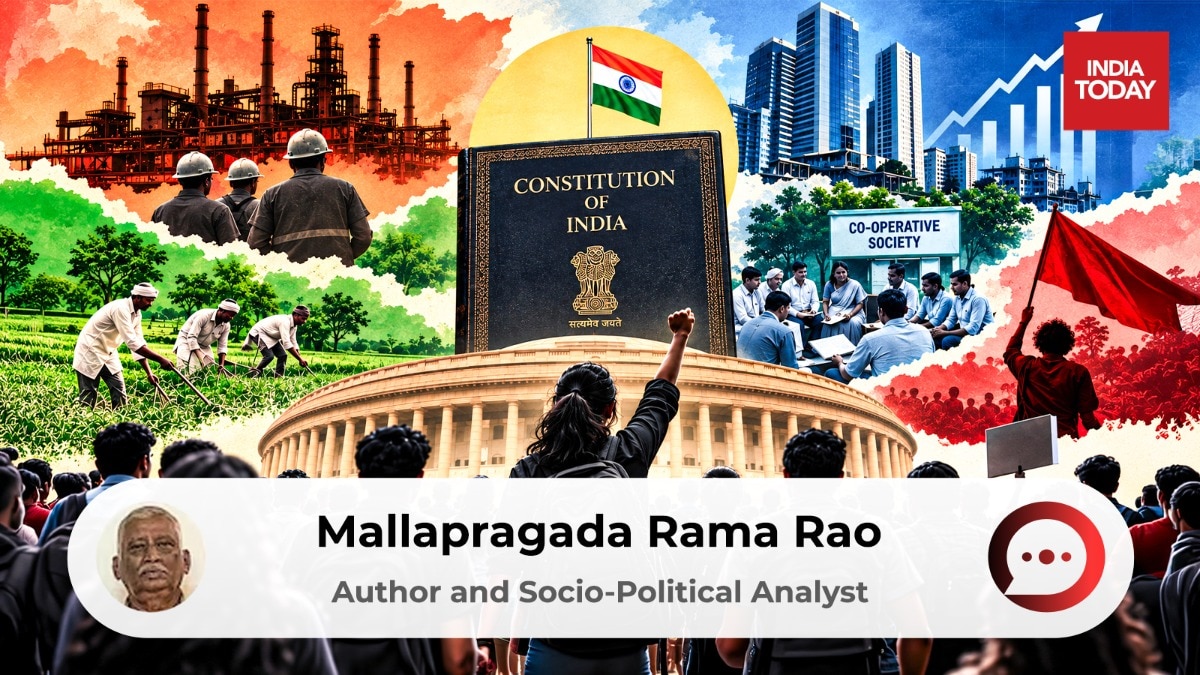
A newspaper columnist’s recent portrayal of student leader Neha Bora as the "Marxist Madonna of Hybrid Revolution" raises a question extending far beyond an individual activist. Emerging from a student organisation rooted in the radical Left, Bora has gained prominence through peaceful protests, a hunger strike, student mobilisation and social media.The apparent convergence of Gandhian methods and revolutionary traditions invites reflection.Can a younger generation draw upon different political philosophies to pursue social and economic justice through peaceful, democratic means? The question assumes particular significance in a country that has experimented with several approaches towards building a just and equitable society.State-led industrialisation, private enterprise, Gandhian trusteeship, Vinoba Bhave's Bhoodan movement, cooperatives and revolutionary struggles have all promised, in different ways, to address social and economic inequalities. Some achieved remarkable results. Others fell short of their objectives. None have completely eliminated the deep inequalities that continue to characterise Indian society.The question, therefore, is not merely which ideology offers the best alternative. It is whether we have made a sufficiently determined effort to realise the objectives already embodied in our Constitution, which we, the people of India, gave to ourselves.From a mixed economy to market-oriented reforms India's early development strategy adopted a mixed economy, with the public sector occupying the commanding heights of economic activity. The expectation was that national resources and essential industries would serve the larger public interest rather than private profit alone.Public enterprises undoubtedly contributed significantly to industrialisation, infrastructure and employment. Yet inefficiency, political interference and inadequate accountability undermined the performance of several undertakings.The organised labour movement also has a mixed record. It secured important rights and benefits for workers, but some powerful unions became preoccupied with protecting their own members, sometimes at the cost of the financial health of their enterprises, while paying insufficient attention to millions outside the organised sector.The balance-of-payments crisis of 1991, together with structural weaknesses in the highly regulated economy, led to a decisive shift towards liberalisation, privatisation and globalisation.The reforms expanded opportunities for investment, enterprise and competition. Subsequent policies encouraged disinvestment in public enterprises, greater private participation and regulatory reforms intended to improve the ease of doing business.Supporters regard these changes as necessary for efficiency and economic growth. Critics question their consequences for employment security, equitable distribution and the State's responsibilities towards vulnerable sections.The real test lies not in the ideological labels attached to economic policies, but in their social consequences.Ease of doing business is desirable. But it must never become ease of disregarding citizens' welfare.Economic growth and business efficiency must be accompanied by sustainable development, conservation of nature, effective labour protection, social security, commitment to the public good and responsible regulation.India is among the world's largest economies. Yet the United Nations Development Programme's 2025 Human Development Report, based on 2023 data, places India at 130th among 193 countries, behind smaller neighbours such as Sri Lanka, the Maldives and Bhutan, while sharing the same rank as Bangladesh.India has made considerable progress in human development. Nevertheless, the contrast between its economic size and human development ranking raises an important question about how equitably the fruits of economic growth are distributed.Other approaches have encountered their own limitations. Gandhi's doctrine of trusteeship sought to persuade owners of wealth to regard themselves as trustees for society. Its moral appeal remains significant, but it gained little practical acceptance even during Gandhi's lifetime. Voluntary trusteeship has proved insufficient to correct structural inequalities.Vinoba Bhave's Bhoodan movement inspired substantial donations of land and later expanded into Gramdan. Yet its predominantly land-centred approach, compounded by problems of ownership, land quality and distribution, could not adequately address the wider structural inequalities of rural society.Armed revolutionary movements arose in response to genuine social and economic injustices.Their grievances cannot be dismissed. But violence has brought suffering to all sides without providing a sustainable substitute for democratic institutions and accountable government.The co-operative movement offered another possibility. Often described as a golden mean between capitalism and socialism, it sought to reconcile economic enterprise with collective ownership, democratic control and mutual benefit.India has demonstrated its potential through a few notably successful cooperative enterprises.Cooperation has also long received government’s attention. The Vaikunth Mehta National Institute of Cooperative Management in Pune has provided national-level training and research. A separate Union Ministry of Cooperation was established in 2021.The Multi-State Cooperative Societies (Amendment) Act, 2023 introduced safeguards intended to strengthen democratic governance and accountability in multi-state cooperatives. The National Cooperation Policy, 2025 renewed the emphasis on autonomy, transparency and professional management.Yet in far too many cooperative institutions, political interference, corruption and mismanagement have undermined their functioning and eroded democratic member control.Even financially successful cooperatives can fall short of their fundamental purpose when decision-making power is concentrated in a few hands, leaving ordinary members with little meaningful role in policy formulation and management.These varied experiences point to a common lesson. No economic system, however attractive its philosophy, can deliver social justice without integrity, accountability and effective institutions.Popular movements: Promise and disappointmentIndependent India has also witnessed powerful popular movements seeking to transform public life.Jayaprakash Narayan's call for Sampoorna Kranti, or Total Revolution, attracted people from different political traditions. His movement contributed substantially to resistance against the Emergency and the restoration of democratic government in 1977.Yet the far-reaching social and economic transformation he envisaged remained unrealised.Decades later, Anna Hazare's anti-corruption movement generated extraordinary public enthusiasm. It helped create pressure for Lokpal legislation, but the larger expectation of transforming public administration remains unfulfilled. Whether the Lokpal has delivered the degree of accountability originally envisaged remains open to scrutiny.These experiences illustrate the difference between mobilising public opinion and achieving lasting institutional reform.A movement may bring thousands into the streets, influence legislation or even change a government. But lasting transformation requires institutions capable of implementing its objectives.My experience as a trade union activist, a workers' education officer and subsequently a social-security administrator has taught me that even well-conceived laws and institutions can fall short of their objectives when accountability is weak and implementation becomes a matter of routine rather than commitment.Confluence of ideologies: A new possibilityThis is where the emergence of Generation Z (Gen Z) as an increasingly vocal participant in public affairs deserves attention.The issues energising youth activism include unemployment, examination failures, uncertain opportunities and a growing sense of alienation from established institutions.More significant than the prominence of any individual leader is the possibility that young people, without abandoning their convictions, may discover common ground across different ideological traditions.Gandhian concern for nonviolence, socialist concern for economic equality, Ambedkar's insistence on dignity and constitutional democracy, and the cooperative principle of collective participation can all contribute to shared objectives.Their philosophical differences should not be concealed. But their constructive elements can converge around the principles embodied in the Indian Constitution.The challenge before Gen Z is therefore not merely to mobilise public discontent, but to translate it into sustained, peaceful and democratic engagement capable of producing lasting institutional reform.Ambedkar's warning and its contemporary relevanceDr BR Ambedkar provides an especially important intellectual foundation for such an approach.He recognised that political democracy would remain insecure without social and economic democracy.In his 1947 memorandum, States and Minorities, he proposed a framework of state socialism while retaining parliamentary democracy. His particular economic model was not incorporated into the Constitution, but social and economic justice became central to its framework.The words Socialist and Secular were subsequently added to the Preamble through the Constitution (Forty-second Amendment) Act, 1976.In November 2024, the Supreme Court rejected challenges to their inclusion, clarifying that socialism in the Indian constitutional context represents a commitment to social and economic justice and the welfare State, rather than a mandatory economic model excluding private enterprise.The "Grammar of Anarchy"Ambedkar's concluding address to the Constituent Assembly on November 25, 1949, carries particular relevance today.He insisted upon constitutional methods for achieving social and economic objectives. He warned against continuing civil disobedience, non-cooperation and satyagraha when constitutional avenues were available, describing recourse to such methods in those circumstances as the "Grammar of Anarchy".His warning, however, should not be interpreted as a rejection of peaceful public dissent.The Constitution itself guarantees freedom of expression, peaceful assembly and association, subject to reasonable restrictions.Equally important is the responsibility of governments not to discourage dissent, turn a deaf ear to genuine criticism or render constitutional remedies ineffective.If citizens are expected to pursue constitutional methods, governments must ensure that those methods remain genuinely accessible, credible and effective.Ambedkar also cautioned against hero-worship in politics and the dangers of unquestioning faith in political leaders. That warning applies as much to emerging popular movements as to established political organisations.When institutions lose public confidenceDemocracy requires more than periodic elections. Those elections must be transparent and provide a level playing field for all contestants. Equally essential are the integrity and impartiality of institutions responsible for administering the law.Allegations that investigative agencies are used selectively against political opponents, while politicians changing allegiance receive favourable treatment, raise serious concerns about equality before the law.An investigation published by The Indian Express in April 2024 examined 25 politicians facing investigations into alleged corruption who had crossed over to the Bharatiya Janata Party since 2014. It reported that three cases had been closed and proceedings in another 20 had stalled.Officials of the investigating agencies maintained that investigations were governed by evidence and legal requirements rather than political considerations.The reported pattern nevertheless raises legitimate questions about consistency and equal treatment under the law, though it does not, by itself, establish political interference in every individual case.Concerns about the political use of investigative agencies have arisen under earlier governments as well. The issue transcends party affiliations.No politician should enjoy immunity from investigation merely because of political allegiance. Equally, no political opponent should be subjected to selective or vindictive prosecution.The same principles apply to all institutions entrusted with safeguarding democratic processes.When citizens perceive that institutions treat individuals differently according to their political affiliations, confidence in democratic governance is weakened.A democracy cannot remain healthy if citizens lose faith in the institutions through which constitutional rights and remedies are exercised.The challenge, therefore, is not simply to persuade citizens to respect constitutional processes. It is also to ensure that those entrusted with administering them discharge their duties fairly and impartially.The Constitution has already shown the wayThe Indian Constitution provides an enduring framework for pursuing social and economic justice.Article 38 directs the State to promote a social order informed by justice and to minimise inequalities.Article 39 addresses the distribution of material resources for the common good, the concentration of wealth and equal pay for equal work.Article 43 envisages a living wage and decent conditions of life for workers.Article 43A provides for workers' participation in industrial management.Article 43B promotes voluntary, autonomous and democratically controlled cooperative societies.Although these Directive Principles are not directly enforceable in courts, Article 37 makes them fundamental to governance and places a duty upon the State to apply them in making laws.Together with fundamental rights, these provisions offer a constitutional framework for achieving social and economic transformation through democratic means.India's constitutional vision embraces social justice, economic opportunity, human dignity and the welfare of ordinary citizens.Constitutional awareness, informed public debate, lawful collective action and continuous scrutiny of public institutions are indispensable.Our experience since Independence leaves little room for complacency about our adherence to constitutional values. An honest course correction requires impartial enforcement of laws, independent and accountable institutions, and sustained public participation.The Constitution, which enshrines liberty, equality, fraternity, human dignity and democratic accountability, cannot implement itself.- Ends
Call of the Constitution: Let us heed it in letter and spirit
Full Article
Original Source
Read the full article at Indiatoday →KhanList aggregates and links to publicly available news content. We do not host full articles from third-party sources. Always verify important information with original sources.