
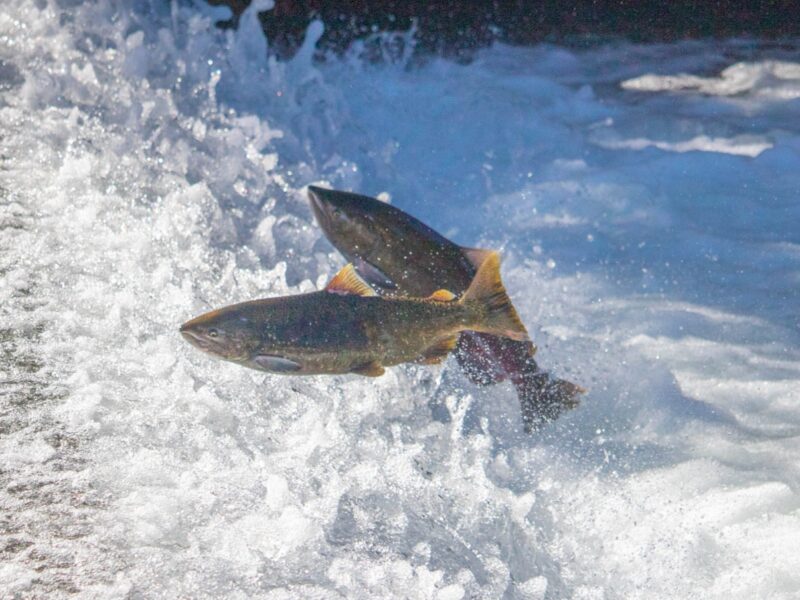
Winter-run Chinook salmon rely on cooler waters for survival, something that may be hard to come by in dry years.(CN) — For California’s most endangered salmon, the difference between surviving and dying may come down to just 15 days.In a study published Friday in Science Advances, researchers say the chance of juveniles surviving fell by about 73% for every 1.8-degree Fahrenheit increase in average river temperature during those first 15 days.Sacramento River winter-run Chinook have only one surviving population, with an average of a few thousand fish returning in recent decades.Shasta Dam keeps the salmon from returning to their original cold-water habitat around Mount Shasta in Northern California. Instead, they spawn in the Sacramento River, where warmer summer water can threaten their developing eggs.Cold water is released from Shasta Reservoir to keep the river cool enough for salmon eggs to survive, but that water is also needed by farms and cities.The balance becomes harder in dry years, when there’s less water to go around.Kohma Arai, who conducted the research as a postdoctoral scholar at UC Davis, said a full summer of spawning doesn’t necessarily mean a successful season.“Salmon may spawn throughout the summer season, but our results suggest that only a small fraction of those spawning events ultimately produced the juveniles that survived,” Arai said in a statement.Scientists have traditionally measured the population’s annual success by counting the adults that return to spawn, assuming many successfully reproduced. But the new research found that far fewer may actually produce young that survive.“We learned that even when surveys show many salmon spawning over an extended season, only those eggs that experience the right temperatures are likely to survive,” Rachel Johnson, a research scientist at NOAA’s Southwest Fisheries Science Center and UC Davis who helped lead the research, said in a statement.“In some years, that number can be shockingly small. It’s this number of successful spawners that we need to track to assess the true risk of extinction and goals towards recovery," she said.To determine which fish survived and what conditions they experienced, researchers combined spawning surveys and river temperature models with an analysis of otoliths, tiny structures in the inner ear that grow throughout a fish’s life.A slice of an ear bone, or otolith, from a juvenile winter-run Chinook salmon. The otolith measures about the size of the eye of a needle, with daily growth increments that resemble tree rings indicating when the fish hatched. White circles indicate where an ion microprobe measured oxygen isotopes to reconstruct temperatures the fish experienced just before emerging from their gravel nests, called redds. (George Whitman/UC Davis Center for Watershed Sciences)Using an ion microprobe, the team measured oxygen isotopes in the otoliths that indicate the temperatures salmon experienced.They combined those records with estimated hatch dates, river temperatures and spawning locations to identify which nests, known as “redds,” likely produced surviving juveniles.The surviving juveniles consistently experienced cooler water during their earliest stages of development.“The juveniles that survived had experienced cooler incubation temperatures during their earliest stages of development, whereas unsuccessful locations were consistently associated with warmer temperatures over the same developmental period,” Arai said.Fish that survived the first 15 days appeared better able to handle warmer water later on. Researchers say that suggests the timing of cold water may be just as important as the temperature itself.They do caution, however, against using limited cold water to protect only certain nests or parts of the spawning season. Doing so could favor some salmon over others and reduce the population’s diversity.Instead, researchers say returning salmon to their historical habitat could give the fish more options for survival.“For endangered species, we have removed so many options, we don’t have the luxury of further selecting certain survivors,” Johnson said.Subscribe to our free newslettersOur weekly newsletter Closing Arguments offers the latest about ongoing trials, major litigation and rulings in courthouses around the U.S. and the world, while the monthly Under the Lights dishes the legal dirt from Hollywood, sports, Big Tech and the arts.Additional Reads
California’s rarest salmon face a narrow window for survival
Full Article
Original Source
Read the full article at Courthousenews →KhanList aggregates and links to publicly available news content. We do not host full articles from third-party sources. Always verify important information with original sources.