
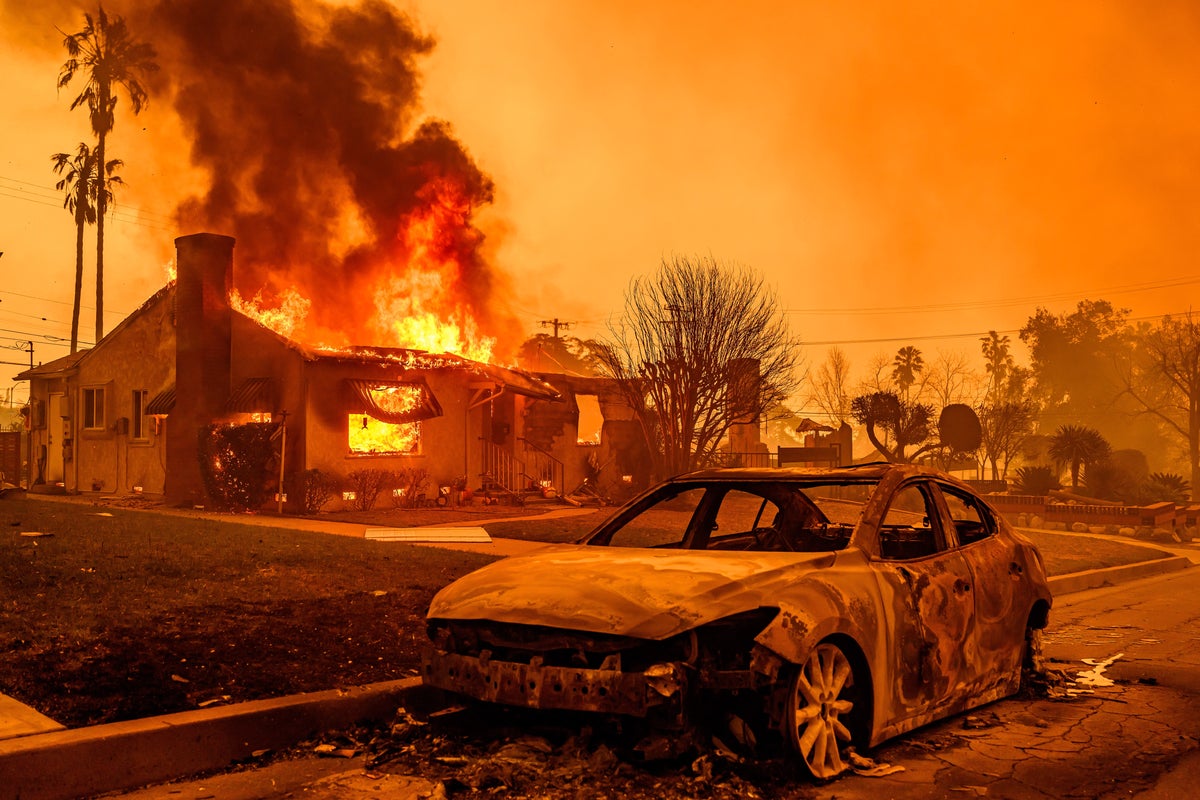
The election of progressive Jane Kim to one of California's key yet frequently overlooked state offices could fundamentally reshape how residential properties are protected against worsening wildfire disasters.Endorsed by Vermont Sen. Bernie Sanders, the former San Francisco County supervisor won the race for insurance commissioner in November on a platform promising to reform the state's struggling housing insurance sector. Her proposed publicly managed wildfire coverage system seeks to ensure universal property coverage across America's most populous state, where commercial providers are increasingly non-renewing policies or pulling out entirely."We are going to take on this trillion-dollar industry because they have been profiting for way too long by raising our premiums, canceling our coverage and fighting our claims, and we are going to make it again a system that protects us," Kim said in her victory speech.Rebuilding communities and hardening properties against fire damage have emerged as critical political priorities across California, following a series of devastating fire seasons. In January 2025 alone, twin blazes in the Los Angeles region leveled roughly 17,000 buildings, generating nearly $4 billion in damages. With leading firms such as State Farm and Allstate halting new policy sales, homeowners have increasingly turned to the state's insurer of last resort, driving its enrollment figures upward.Policyholders under both private and last-resort plans have faced challenges receiving payouts, while an official state probe revealed State Farm mismanaged hundreds of claims by underpaying, rejecting smoke-related damages, and delaying responses.As the Palisades and Eaton fires raged through Southern California in January 2025, people reportedly spent $1.2 million on Polymarket betting on them (Getty)Under Kim's proposal, commercial insurers would retain a role, but the portion of premiums designated for wildfire risk would be directed to a publicly administered fund valued between $3 billion and $6 billion. A share of these funds would assist residents with structural retrofits, such as installing fire-resistant roofing materials."Everyone agrees that this is the only way to make insurance more affordable and more available in the long run," Kim said of her plan to spend more money on prevention.While publicly run insurance initiatives operate elsewhere in the country and globally, analysts note that implementing one in California presents complex structural challenges. Doubts have been raised by both insurance industry organizations and consumer rights groups regarding the source of initial funding.Homeowners across California currently spend an estimated $18 billion collectively on property policies, with approximately $3 billion to $6 billion of that total dedicated specifically to wildfire protections.According to Kim, day-to-day transactions for consumers would remain largely unchanged under a public framework; policyholders would buy coverage as usual, but commercial insurers would transfer that $3 billion to $6 billion in wildfire allocations to the state.Premium calculations under the program would mirror existing market standards by assessing property values and local wildfire exposure. Consequently, residents in elevated risk zones, including properties adjacent to brushland or forests, would continue facing high rates, though coverage would be guaranteed.Commercial insurers in the U.S. presently maintain billions of dollars in fossil fuel investments, a sector Kim argues accelerates the climate-driven events driving up claims."We would invest it all back in fireproofing our communities because what we actually want is less claims to pay out in the future," Kim said.Kim drew ideas from New Zealand’s Natural Hazards system, which delivers primary protection against disasters such as earthquakes, landslides, tsunamis, volcanic eruptions, and geothermal activity. New Zealand homeowners contribute a compulsory levy into a state-managed pool dedicated to claim settlements, climate studies, and reinsurance.Within the U.S., the most prominent public alternative is the National Flood Insurance Program, created in 1968 to manage flood-related losses.For decades, congressional mandates forced the flood program to offer subsidized premiums, generating significant financial deficits. Massive claims from events like Hurricanes Katrina and Sandy compelled the program to borrow heavily, leaving it with $25 billion in debt by August 2017 before it began shifting toward risk-adjusted pricing in recent years.Industry observers contend that any California wildfire framework must avoid subsidizing premium costs to remain financially sound.California already operates a hybrid model for seismic risk through the California Earthquake Authority. Created following the 1994 Northridge earthquake near Los Angeles—one of America's costliest disasters, causing up to $20 billion in structural damages and $40 billion in overall economic losses—the authority combines public administration with private involvement.Private carriers handle policy sales while the overall fund remains under public management. Accounting for just over 60 percent of California's residential earthquake coverage, the program depends significantly on private reinsurance—specialized coverage for insurance companies—costing over $8 billion annually.Lloyd Dixon, a senior economist at the RAND Corp. and a member of the CEA governing board, noted that public models carry benefits such as eliminating profit margins and securing lower borrowing rates."It really depends on how it’s structured. I think they can be implemented well, and they could be implemented poorly," Dixon said of public insurance programs.A state-commissioned study published in April evaluating a public wildfire insurer estimated the plan would require approximately $25 billion in upfront capital, or $6 billion if paired with annual reinsurance purchases of $2 billion to $3 billion—a step that could, however, raise consumer rates.Kim indicated she intends to investigate mandating setup contributions from private insurers while seeking additional funding from utility providers and municipal governments.Insurance firms have attributed California's market crisis to Proposition 103, a 1988 ballot measure mandating rate increase approvals by the insurance commissioner. Companies maintained the law prevented them from pricing premiums high enough to offset claims, prompting market withdrawals.Recent regulatory changes have permitted insurers to incorporate climate change modeling into risk evaluations and pass reinsurance expenditures onto customers, leading some companies to resume offering policies in the state.Rex Frasier, president of the Personal Insurance Federation of California, expressed hope that any new system would permit private carriers to participate voluntarily in wildfire coverage rather than being pushed out."We have lots of thoughts about how we can make things work, and we haven’t really been consulted," he said.Joy Chen, executive director of the Every Fire Survivor Network, who was displaced from her home for months after the January 2025 Los Angeles blazes, stated that California's existing framework is "impeding the entire Los Angeles recovery and putting every Californian at risk."Chen explained that numerous survivors within her organization had maintained private insurance for decades prior to being pushed onto the state's plan of last resort shortly before the Los Angeles fires occurred. As a result, the private insurers that collected their premiums for years bore no financial obligation to assist them once their residences were damaged or lost."The fact that Jane Kim wants to overhaul the system, come up with something completely new and better … we’re open to it," she said.
California’s new insurance commissioner has radical plan to overhaul wildfire insurance for homeowners
Full Article
Original Source
Read the full article at Independent →KhanList aggregates and links to publicly available news content. We do not host full articles from third-party sources. Always verify important information with original sources.