
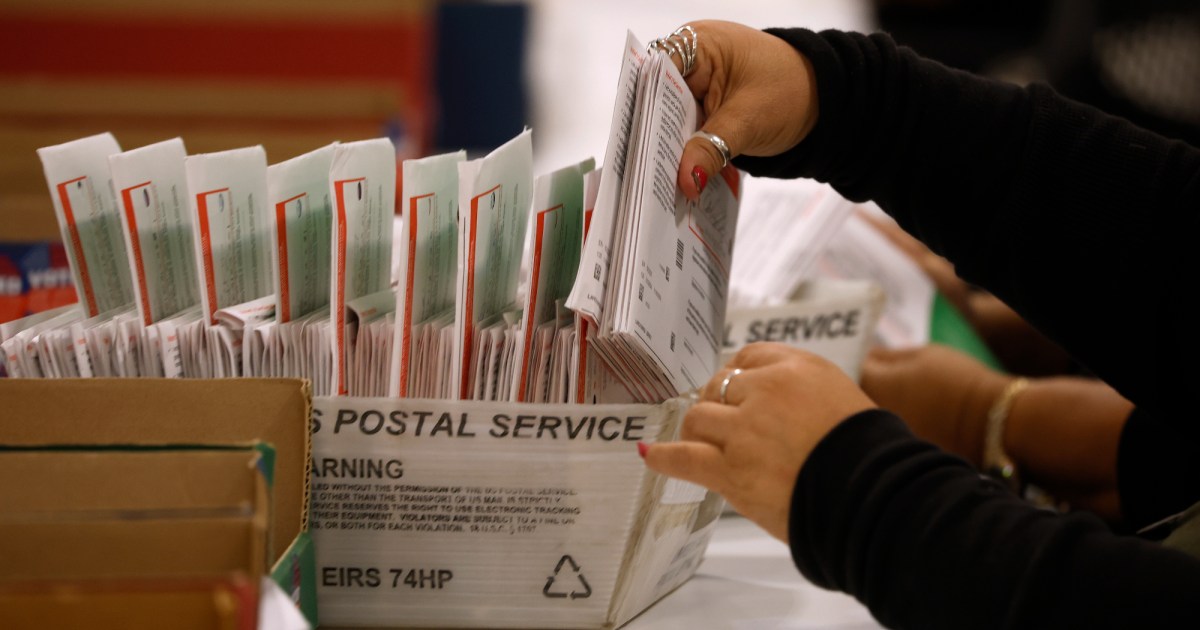
An election worker processes mail-in ballots for the California state primary election at the Los Angeles County Ballot Processing Center on June 05, 2026 in City of Industry, California.Justin Sullivan/Getty Get your news from a source that’s not owned and controlled by oligarchs. Sign up for the free Mother Jones Daily. A federal court struck down a California rule that required voters to sign and return vote-by-mail ballots on paper, rather than doing so electronically. The ruling in California Council of the Blind v. Weber, announced October 3, is a victory for disabled voters—but it probably won’t change things much until the next election cycle. Since 2021, California has mailed ballots to all registered voters for all statewide and local elections. Voters with print disabilities—those who are blind or low-vision, or whose physical disabilities prevent them from marking a paper ballot—can request a link to vote electronically. After filling out their ballot on a computer, they must print it, put it in an envelope, seal the envelope, and return it “through non-electronic means.” This is complicated by the fact that many blind people don’t own printers, because they have no use for them. And that’s only one of the obstacles they might face under the current vote-by-mail rules. Christopher Gray, a resident of San Francisco County and a plaintiff in the lawsuit, is blind. Under the current system, as he wrote in a 2024 court declaration, he is unable to vote without assistance. He could theoretically vote using a virtual vote-by-mail ballot, which he can fill out unassisted using his own assistive technology, including a Braille-equipped computer. But printing the ballot, finding where to sign it, signing it, putting it in an envelope, sealing it, and returning it without assistance is not possible for him. “Because of the lack of an accessible method of returning my ballot by mail, when I vote I must forgo my right to vote confidentially and privately,” Gray wrote. During the 2022 general elections, Gray ended up paying an assistant to help him fill out his ballot—but in doing so, he was forced to give up that privacy and independence. He also gave up his certainty that his ballot had been submitted at all. “Though I trusted my reader, I could not independently confirm they accurately marked my ballot and mailed it on my behalf,” he said. The vote-by-mail program, as it stands, discriminates against voters who cannot return their ballots without assistance, he and the other plaintiffs argued. “I want to vote in a private and independent manner just as voters without print disabilities are able to do in my state,” Gray wrote. “I will be able to do so only if alternative accessible options for returning a vote-by-mail ballot are available to me.” The court ruled that the current vote-by-mail system does exclude some disabled voters, and “denies them meaningful access to the vote by mail program,” as Magistrate Judge Sallie Kim wrote. The court, however, did not specify a resolution. The state of California now has until October 19 to propose a new vote-by-mail protocol, and since California ballots have already been mailed out, any changes made likely will not take effect until the next election cycle. As Democracy Docket has reported, “32 states allow for electronic absentee ballot return for certain voters, with 13 of these states providing a specific carveout for voters with disabilities.”
California’s Mail Ballot System Excludes Disabled Voters, Court Rules
Full Article
Original Source
Read the full article at Motherjones →KhanList aggregates and links to publicly available news content. We do not host full articles from third-party sources. Always verify important information with original sources.