
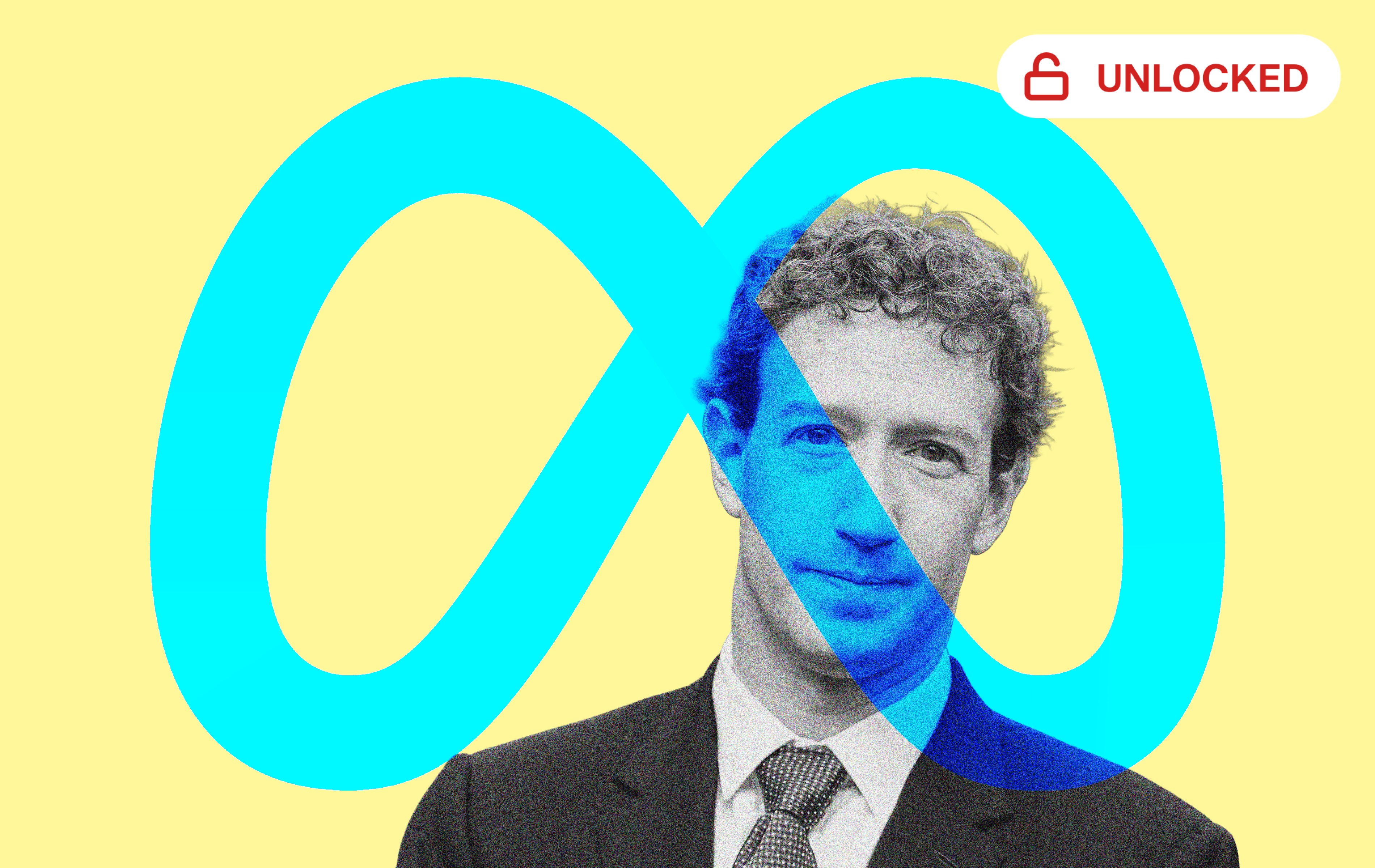
Turn any article into a podcast. Upgrade now to start listening. Members can share articles with friends & family to bypass the paywall. You’re reading Dispatch Markets, a weekly dive into the forces driving economic growth—and those holding it back—featuring Scott Lincicome, Kyla Scanlon, Karl Smith, Marian Tupy, and Adam Ozimek. On October 21, Meta announced a 2-for-1 stock split, meaning that every Meta shareholder gets a second share for each one that they own. Companies do this all the time, usually as a way to make a stock that trades at a lofty price feel a bit more approachable. A stock split doesn’t mean that everyone gets twice as rich (unfortunately!): It’s more like breaking a $20 bill into two $10s. But if you read the 109-page filing, you’ll find that the split wasn’t really about the share price (or pursuing acquisitions, etc., as the company stated), but was rather the end result of a monthslong negotiation between Mark Zuckerberg and his own board over two things: 1) how to fund the company’s AI investments, and 2) a California ballot measure that would impose a wealth tax on billionaires. The way that they settled things could change who controls Meta for years to come, and it gives us a lot of information on the future of taxation in the United States. Taking Stock Illustration by Noah Hickey/The Dispatch (Photo via Getty Images). What the tax would do. California’s Proposition 40 would impose a one-time 5 percent tax on the net worth of anyone who was a California resident on January 1, 2026, and is worth at least $1 billion when the state measures their wealth on December 31, 2026. The tax hits about 200 people. If the measure passes—a result we might not know for weeks, though it’s currently losing by a decent margin—these 200 billionaires can pay their whole tax bill in April 2027 or spread it over five years (with interest). The proposed tax is a tax on ownership, not on income, which makes it tricky. Most of the taxes that we pay are on money that comes in (income tax) or goes out (sales tax), and this is a wealth tax, so it’s a tax on money that’s just sitting there (like a property tax on your house). For most of the 200 people on that list, their wealth is in shares of a company they founded. Zuckerberg’s net worth is somewhere around $240 billion—depending on the day and the index you use—and more than 90 percent of his wealth is Meta stock. The tax on his $240 billion would come out to about $12 billion. As the fifth-richest person in the entire world, he can certainly afford it: A tax of 5 percent on someone who owns $100,000 worth of assets would be about $5,000, for context. It’s nothing to sneeze at, but Zuckerberg would have to sell Meta shares to pay it. That could end up costing him more than just the $12 billion: It also threatens his control over the company. Zuckerberg has never been willing to run a company he could lose. He has always been in charge and has always voted down one-share-one-vote proposals. The company’s whole structure exists seemingly to make him unfireable. Zuck’s problem. Meta has two kinds of stock—Class A is what you and I can buy, and it has one vote per share. Class B gets 10 votes per share, and Zuckerberg owns most of them. It’s how he controls Meta: He owns only about 13 percent of the company while controlling about 61 percent of the votes through super-voting shares. Votes matter a lot. Votes pick the board, and the board, of course, picks the CEO. If you hold the majority of the votes, no one can fire you, ever. Zuckerberg has been untouchable since Facebook went public. And he wants to keep it that way. The Meta board has had a problem for a while. In February, it created a special committee to figure out how to pay for the AI buildout. Management had presented three forecasts, and in each, Meta needed to raise hundreds of billions of dollars, starting within months. The obvious way to raise billions is to sell stock. But every new voting share created dilutes Zuckerberg’s majority (if there are 100 shares and you own 10, you own 10 percent, but if the company sells 100 more to raise money, you would now own 5 percent), and he told the board he would not support an equity raise that did so. On July 8, according to the recent filing about the new share class, Zuckerberg told the chair of a committee that paying Prop 40 could force him to sell enough Class B to drop his voting stake to about 53 percent. Still a majority! But one more tax hike or big AI fundraise could push him under it. Within weeks, his lawyers were saying he was considering leaving California. Leaving wouldn’t have changed much, as Prop 40 would apply to anyone who lived in California on January 1, 2026. What a move would have done is spared him California’s 13.3 percent income tax on shares he’d have to sell to pay the Prop 40 tax, and protect him if the “one-time” tax turned out not to be one-time. Nothing really happened. A few months later, Zuckerberg said he was listing his Palo Alto house in four days and reminded everyone that such a listing is public. Within days, he and the board (of course) had a deal. As the Financial Times reported, the filing calls the negotiation “protracted and at several points, contentious.” It’s the whole wealth-tax debate distilled into one moment. A tax on ownership is painful if you have to sell what you own, and for Zuckerberg, selling is losing control. Something in the waters has to shift here in order to bring some semblance of equality, but we can see how complicated this form of taxation can get. The American tax system is built around taxing income. The biggest fortunes that we currently have in this country aren’t based on income. Zuckerberg pays himself $1 a year and borrows against his shares to fund his lifestyle, and when he dies, his heirs will inherit those shares, so the gains are never taxed. Zuckerberg’s $240 billion has never been taxed because he has never sold it, and under our current rules, even into death, he never has to. Tax people call this “buy, borrow, die.” By one estimate from Berkeley economists, the 400 richest Americans paid an overall tax rate of 24 percent from 2018 to 2020, far lower than everyone else’s 30 percent. So something does need to shift if we want a tax code that reaches the wealthy at all. Prop 40 is one answer—and it could unintentionally reshape how our biggest companies operate. The deal. The board’s solution was to invent a third kind of stock. Class C shares have the same economic rights as Class A, so they go up and down with the company’s share price and collect dividends, but they carry no vote at all. All the money, but no say in what the company you own a little bit of does. Every shareholder gets one Class C share per share they already hold of Class A and Class B, which is the “split.” The new shares start trading on January 19, 2027. Zuckerberg gets the same dividend as everyone else, but he can sell 20 percent of his new Class C shares immediately. That’s about 10 percent of his total economic stake, “for any reason, including so that he may pay his potential tax liability under California Proposition 40.” The other 80 percent is stapled to his voting stock, so for every one of those he sells, he has to sell or convert a voting share, too, and they’re released to him gradually over eight years. In exchange, he agreed to remain a California resident, or a resident of wherever Meta’s headquarters is, for eight years, unless “material unforeseen circumstances” intervene. Zuckerberg takes a $1 salary, so if the tax passes and he pays it, in the company’s words, he would be “effectively paying to serve as the Company’s chief executive officer while residing in California.” The committee concluded that having him physically near Menlo Park and the superintelligence lab was “critically important” and cited the difficulty of running the company when he was away during the pandemic. Zuckerberg spent much of 2020 on Kauai, where he (somewhat notoriously) feeds his cows macadamia nuts and beer. Initially, he requested a 20-to-1 Class C dividend, not 1-to-1, along with a new equity compensation package comparable to what other founders had recently gotten. He withdrew that request. What everyone else gets. So why does this matter to you? Once a nonvoting share class exists, the company can print more of it. There are hundreds of billions of dollars to raise, after all. On October 26, five days after this announcement, Meta announced a financing plan of roughly $98 billion. It would issue $22.5 billion of Class A stock, $12.5 billion of preferred shares that convert into Class C (preferred shares are stock-bond hybrids that pay a fixed dividend for a few years until they turn into regular stock), and a $60 billion program to sell Class C shares into the open market starting next quarter. The last piece of that is an “at-the-market” program, which means Meta can sell a little whenever it wants. Nvidia, AMD, and Broadcom, the companies Meta buys chips from, all indicated interest in buying up to $5 billion, according to Bloomberg. So Meta buys chips from those companies, they buy Meta stock, and Meta uses the money to buy more chips. Circular financing by any other name. And Meta does need the money. The same day it announced the new stock, it reported $64.6 billion in revenue, up 26 percent. Running Meta costs money—lots of employees and lawyers, as we’ve seen—and after paying for all of that, the business generated about $32.8 billion in cash. Then it spent $34.9 billion on data centers and chips in a single quarter. Spend more than you bring in, and your free cash flow goes negative, which Meta’s did for the first time in at least a decade. Interestingly, the company also bought back no stock. A year ago it spent $3.3 billion on buybacks, which is what companies do when they have more cash than they need. Meta is selling stock instead, so it’s just a sign of the changing times. Meta expects to spend up to $145 billion this year, and future spending commitments for data center leases and computing capacity and power now total a cool $825 billion. Why sell stock instead of borrowing? Because debt on that scale threatens credit ratings. Recently, the market has started to punish companies like Oracle and CoreWeave for trying—across the board, credit risk is reaching all-time highs. And it’s the same for Meta. The day after Meta announced the plan, the cost of insuring its own debt reached a record high. Meta also noted that this new share class will let it work with sovereign wealth funds. But despite best efforts to avoid punishment, Meta’s stock fell 6 percent the day after the split and the new share class were announced. So if you own Meta, your new Class C shares aren’t free Zuckerbucks but are instead shares that can be diluted by $60 billion of new issuance to start, and nobody who buys those shares will ever get a vote on how future money is spent. This has happened before, and it’s always controversial. Nonvoting shares usually trade for a little less than voting ones because a vote is more valuable than a nonvote. Google is an example here, as it did the same thing in 2014. The company had promised to make up the difference if the gap between voting and nonvoting shares got too wide, and it did. It had to pay Class C shareholders $522 million a year later because the nonvoting shares traded at a discount to the voting ones. Every time a company has tried this, three things have happened: The nonvoting shares traded for less Somebody sued A court had to decide if the board was strong enough to negotiate Facebook itself tried this in 2016 and scrapped it in 2017, days before Zuckerberg was supposed to testify in a trial brought by minority shareholders. As Bloomberg notes, Facebook’s market cap was a mere $500 billion then. Now, it’s a $1.8 trillion behemoth named Meta. This time is interesting: On October 16, a Delaware judge blocked a similar reshuffling at Cloudflare, but that ended up being a debate more about whether the board committee was too intimidated by its founder to negotiate in good faith. Meta’s board approved its deal on October 19, just a few days after that. On October 27, a union pension fund sued to block Meta’s plan before January, stating the committee wasn’t independent (DoorDash CEO Tony Xu is on the committee and has funded a campaign against the billionaire wealth tax) and that its terms were unfair. The lawsuit stated, according to Bloomberg reporting: “Zuckerberg has always been fixated with his control over Meta. Time and time again, he has squeezed and bent Meta’s capital structure to increase his grip and perpetuate his control. Zuckerberg’s latest gambit is his most aggressive attempt yet, while also using the company as his own piggybank to fund his anticipated tax bill.” Meta says the plan serves all shareholders, but does it? Did the wealth tax proposal work or fail? Both sides claimed the Meta deal as a win, which tells you a lot! Rep. Ro Khanna argued that it proved billionaires don’t actually leave over the tax. Zuckerberg stayed because his company paid to keep him, whereas Google co-founders Sergey Brin and Larry Page left. Brin put in more than $100 million to try to defeat the measure. The tax threat prompted people who couldn’t make a deal to move, and they are still spending money to try to defeat it. Exactly how much revenue the tax might generate was a source of conflict ahead of the vote. Economists who support the measure, like Emmanuel Saez, put it at $100 billion. Two Hoover Institution economists, Ben Jaros and Joshua Rauh, estimate that the tax would collect $30 billion but cost the state a net $39 billion once departing billionaires stop paying income tax—an update of a paper Marian Tupy wrote about here in August, when the loss was pegged at $25 billion. The number keeps getting worse as billionaires continue to leave (six have left, taking 30 percent of the tax base with them). That’s why this is so divisive and so confusing. Other states are starting to tax the rich harder—Washington state enacted a 9.9 percent tax on income of more than $1 million this spring. Half a dozen other states are exploring the same thing. They will all likely run into the same problem. A tax on things that don’t really have a price (like fluctuating wealth) is a negotiation, and people with the most leverage usually win. Final thoughts. So there are two outcomes here: The tax passes: Zuckerberg will pay, in cash, from shares that cost him really nothing to lose. It’s a bit of a strange victory for a measure that was premised on making the rich feel it. But it will generate some money. The tax fails: Zuckerberg won’t owe a dime. The new share class, the eight-year contract, and the $60 billion of nonvoting stock due to hit the market all outlive the measure that caused them. The vote here was about taxing 200 people once, and the response permanently rearranged one of our biggest companies. There is always a way to navigate a new tax. And none of this is new! The New York Stock Exchange banned nonvoting stock in 1926 because the Dodge brothers (of car company fame) did exactly this. The 1980s were all about letting this back in. Europe has tried wealth taxes, and mostly quit, because the money they were chasing simply left. The response to taxing the rich is always the same: They just reorganize. Markets FTW Take a guess at the best-performing consumer stock in October. It’s a toy company: Hasbro reported third-quarter revenue of $1.6 billion, up 15 percent year over year, and it’s because of one of my favorite games: Magic: The Gathering. This is a trading card game that came out in 1993, and it’s grown 34 percent year over year to $616 million in revenue. That means a card game is generating nearly 40 percent of the revenue for a company also responsible for such stalwart brands as Play-Doh, Nerf, Monopoly, and Transformers. The actual toy division grew 4 percent and Hasbro raised its outlook for the year. This is definitely a sign of the toys for kids vs. toys for adults split—toys for kids are up 4 percent, whereas toys for adults are up 34 percent. Lots to unpack there. Chart of the Week People are quitting their jobs again. This chart, shared by Heather Long, shows that almost 3.4 million Americans quit their jobs in September, which is the most since 2025. The quits rate ticked up to 2.1 percent from 1.9 percent. Quitting is one of the main ways we measure confidence in the labor market. People don’t leave a job unless they think they can get another one pretty easily (and quickly). So when the quits rate falls, as it has continuously since 2022, it tells you that people are more nervous about the labor market. This is what Austan Goolsbee, president of the Chicago Federal Reserve, has called a low-fire, low-hire labor market. Nobody’s getting laid off, nobody’s getting hired, and everybody is more or less frozen—and September is the first month in a while where we’ve seen some movement. Job openings rose, layoffs fell, and people started leaving voluntarily. This is a good sign for a labor market that has been having a pretty tough time. What I’m Watching November 6: October jobs report November 10: October CPI November 18: Minutes from the Fed’s October meeting December 8-9: The Fed’s last meeting of the year December 31: Prop 40’s valuation date, if it makes it January 19, 2027: Meta’s Class C shares start trading on the Nasdaq Disclaimer: The opinions expressed above do not necessarily reflect those of the presenting sponsor. Want to see more of The Dispatch in Google search? Add Us as a Preferred Source
California’s Billionaire Tax Is Changing the World
Full Article
Original Source
Read the full article at Thedispatch →KhanList aggregates and links to publicly available news content. We do not host full articles from third-party sources. Always verify important information with original sources.