
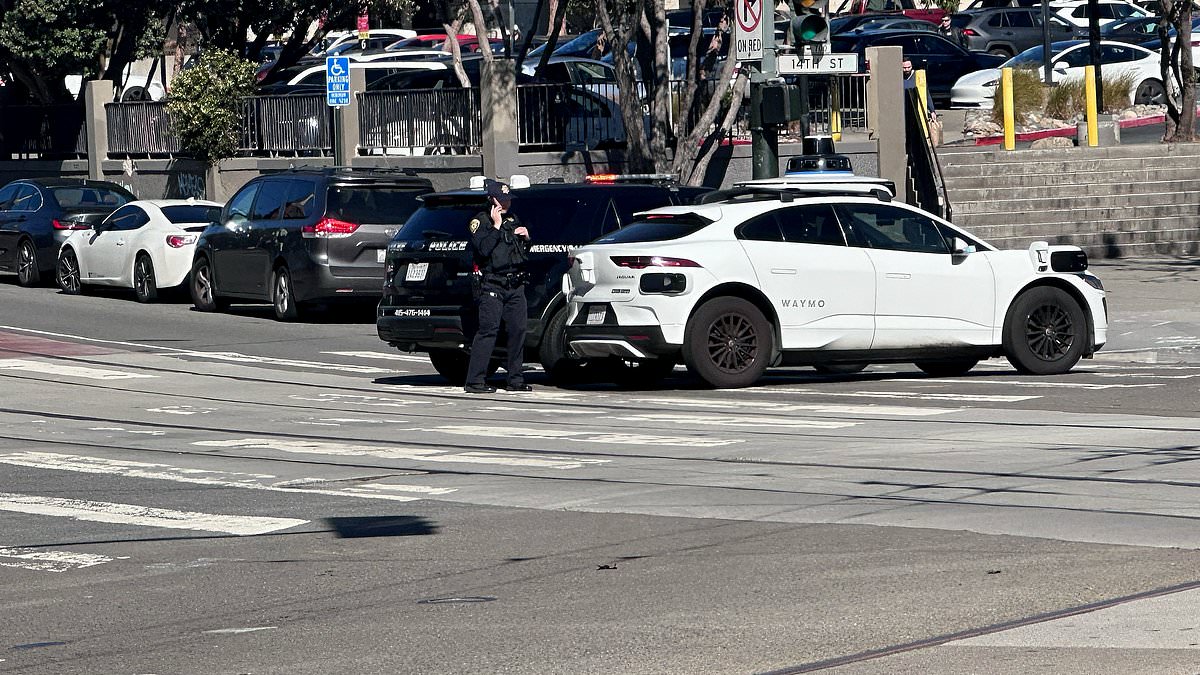
Officials in California have labeled Waymos and other self-driving cars an 'imminent hazard to public safety' as they banned the vehicles from state freeways following recent traffic incidents.The Golden State's Department of Motor Vehicles ordered Waymo's driverless vehicles to stop operating and testing on all the state's freeways on November 11, citing an 'imminent hazard to public safety.'It cited an incident in which three Waymo vehicles entered a construction closure on Highway 101 and a separate incident involving California Highway Patrol vehicles on Interstate 280 in San Francisco. The construction zone incident occurred on November 5 and the second incident, which involved California Highway Patrol vehicles, occurred the next day on a highway in San Francisco, Jonathan Groveman, a department spokesperson, said in a statement.Video of the November 6 incident circulated widely on social media last week. In the footage, a Waymo vehicle can be seen trying to bypass California Highway Patrol vehicles conducting a traffic break.'The Department determined that Waymo´s driverless freeway operations pose an imminent hazard to public safety due to recurring incursions by its vehicles into active construction zones where construction workers, vehicles and equipment are present,' Groveman said.Groveman added that 'similar incidents' previously occurred on May 18.Waymo had allowed riders to hail its robotaxis for freeway rides in the San Francisco Bay Area, Los Angeles, Phoenix, Miami and Austin. A Waymo vehicle was left stuck in a crosswalk in San Francisco on November 4 Waymo had allowed riders to hail its robotaxis for freeway rides in the San Francisco Bay Area, Los Angeles, Phoenix, Miami and AustinThe California-based company offers rides on city streets in many other areas including Las Vegas, Dallas and Denver.But when the state banned the vehicles from its freeways, Waymo said it decided to withdraw its vehicles from highways across the country the same day.'In alignment with our safety-first principles, we have also temporarily restricted freeway operations across our other operating markets to evaluate our performance,' spokesman Chris Pappas told The New York Times. The suspension was implemented last Wednesday, Pappas said, but he didn't say how long it would last.Pappas also noted that the 'recent freeway construction zone encounters on US 101 in California' did not 'involve any injuries or collisions.'California's restrictions bar Waymo from operating and testing its driverless vehicles on California freeways, according to Groveman.He said the restrictions will remain in effect until 'Waymo demonstrates to the Department that it has taken effective corrective actions to address the deficiencies that precipitated the restriction.'The company must now demonstrate that its vehicles can safely detect and respond to construction zones, emergency vehicles and other roadway hazards, the DMV said. California's ban will remain in effect until 'Waymo demonstrates to the Department that it has taken effective corrective actions to address the deficiencies that precipitated the restriction,' state officials saidThe new ban comes months after Waymo was forced to update its software in thousands of its robotaxis after several drove into flooded roadways. In a notice posted on the National Highway Traffic Safety Administration (NHTSA) website back in May, the company announced it would begin a 'voluntary recall' of nearly 3,800 robotaxis using Waymo's fifth and sixth generation self-driving vehicles.Waymo said the affected cars have a software issue that allows them to drive onto flooded roads.The update came after an incident in San Antonio, Texas, on April 20, in which a Waymo drove into a flooded road and was swept away by the waters.While no one was on board the vehicle at the time, and no injuries occurred, the company warns that this unexpected behavior could lead to 'a loss of vehicle control, increasing the risk of a crash or injury.'Waymo, which is owned by Google's parent company Alphabet, said that a solution was 'under development' to prevent the self-driving cars from accessing waterlogged areas.Waymo was been forced to recall almost 3,800 robotaxis in May after one drove into a flood and was swept into a creek. Pictured: A Waymo autonomous vehicle caught attempting to cross deep water in Arizona during flooding in 2025Then in June, the company announced another recall of nearly 3,900 robotaxis across the US – saying a software flaw sent self-driving vehicles straight into active construction zones.Waymo's parent company Alphabet has issued an urgent recall of nearly 3,900 robotaxis across the US after a software flaw sent self-driving vehicles straight into active highway construction zones.According to documents filed with the NHTSA, more than a dozen incidents were recorded in California and Arizona since early April as Waymo vehicles failed to recognize highway ramp closure signs. As a result, the self-driving cars proceeded straight into construction areas and lanes where construction was underway.The company temporarily restricted highway driving for its robotaxis while engineers worked on a fix, and planned to roll out a software update designed to improve the vehicles' ability to detect closed roads.'We identified an area of improvement regarding performance around freeway construction zones,' Waymo said in a statement. 'We voluntarily restricted freeway operations last month while making improvements,' it said at the time.The NHTSA is now also investigating reports that Waymo vehicles illegally passed stopped school buses. The probe concerns nearly 3,000 robotaxis and examines whether software changes introduced by the company adequately addressed the problem.Supporters of autonomous vehicles argue that they represent the future of transport, with the potential to reduce dangerous driving, distraction and human error.Critics, however, question whether artificial intelligence can reliably handle every unpredictable situation on increasingly congested roads.
California warns of 'imminent hazard to public safety' as it bars driverless cars from freeways
Full Article
Original Source
Read the full article at Dailymail →KhanList aggregates and links to publicly available news content. We do not host full articles from third-party sources. Always verify important information with original sources.