
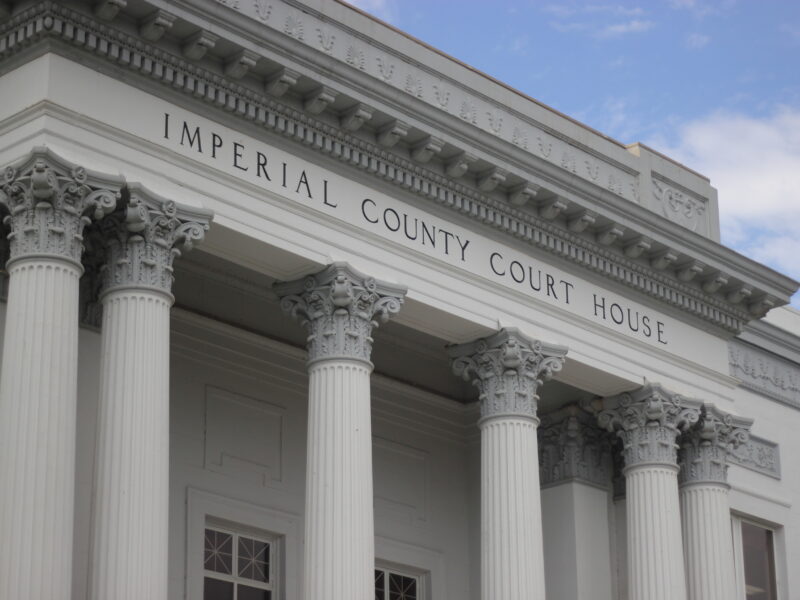
An Imperial County judge determined the data center must undergo a full environmental review, finding the project could have significant impacts on water, energy, air quality and other resources.EL CENTRO, Calif. (CN) — A judge in California’s Imperial County halted what would be the biggest data center in the state over potential environmental concerns brought by the city of Imperial.Imperial County Superior Court Judge Brooks Anderholt determined Wednesday that the nearly 1 million-square-foot Imperial Valley Data Center project needed to be analyzed as a whole under the requirements in the California Environmental Quality Act, or CEQA.Although the proposed project was slated for an area zoned for data centers just south of the city of Imperial in 2017, the judge ruled zoning was not enough to bypass a more strenuous environmental review.“Because the record supports a fair argument that the whole project may cause significant environmental effects, an environmental impact report is required for the project presently before the court,” he wrote. “The county remains free to consider lawful project revisions and relevant information from prior environmental documents during that process.”Imperial Valley Computer Manufacturing intends to use the 330-megawatt data center to support the growing demand for artificial intelligence infrastructure and, potentially provide millions in annual tax revenue to the economically stagnant region. But the project also requires complicated infrastructure demands, including an electrical substation, battery backup, natural gas generators, cooling and water treatment facilities, and would consume about 750,000 gallons of water per day.A lot merger for the proposed facility was originally approved by the Imperial County Board of Supervisors in April, but has since fallen into legal limbo and become the focal point of multiple lawsuits. The city of Imperial and the Sierra Club filed a lawsuit against Imperial County following the lot merger.“Communities have a right to understand the impacts of proposed projects and provide meaningful input to their elected officials,” Sierra Club San Diego Chapter Director Mark West said in a statement after the judge’s decision. “The community’s concerns are entirely justified given that this project was moving forward without adequate environmental review. The current proposal relies on gas-fired power generation that would worsen local air pollution while consuming and storing water drawn from the already-strained Colorado River watershed.”In his ruling, Anderholt said Imperial County’s piecemeal approval process of the data center’s component projects was inappropriate. All of the components — grading, road vacation and electrical systems, to name a few — culminated in the larger objective of constructing and operating the facility.“Before classifying individual permits, the agency must identify the CEQA project,” he wrote. “Agencies may not divide one integrated development into smaller pieces to avoid environmental review.”The merger of the lots, which included a public hearing and hours of testimony, was itself confirmation that the project needed to be analyzed as a whole, Anderholt ruled.“The court finds that the county prejudicially abused its discretion by approving the lot merger without first completing the CEQA review required for the whole project,” he wrote. “The project requires project-specific governmental decisions and includes components and infrastructure materially more detailed than the generalized land use amendment."The judge’s decision does not ban the data center altogether, but instead requires a more detailed environmental analysis.Dennis Morita, Imperial’s city manager, told Courthouse News he did not believe the proposed project site was appropriate for a data center.“The Imperial City Council felt that a project of this magnitude — almost a million square feet, 330 megawatts of energy, 750,000 gallons a day of water and battery storage, natural gas generators — all of those things were of some concern with the council to be installed right next door to houses without any formal kind of process that would impose appropriate conditions to address whatever the impacts were,” Morita said. “If there was a legitimate objective environmental review done for this project — for the water, energy, cooling towers, transmission lines — if there was an objective study for all of that, there might be an appropriate place.”Morita said the project has caused sharp divisions among the residents and leadership in Imperial Valley.“It’s unfortunate how this all unfolded because the city is spending resources it could certainly use elsewhere,” he said of the lawsuit. “It’s unfortunate in a small community like this, filing lawsuits against people I have known on the board for decades is not a pleasant experience. We’re a small community.”Imperial County is also engaged in its own lawsuit against Imperial Valley Computer Manufacturing over a moratorium on data centers. The company is also suing the Imperial Irrigation District over the district’s rejection of its request for nearly 300 million gallons of water.Sebastian Rucci, the project’s developer, engineer and legal representative, said that he would file a motion seeking a new trial or to vacate the judgment. If unsuccessful, he will appeal the decision, he said.“The same people demanding CEQA review have declined to engage meaningfully on mitigation from the outset,” Rucci said in an email to Courthouse News on Thursday morning. “In our view, that points to an effort to stop the project rather than improve it. Nevertheless, we are evaluating alternative sites with no nearby homes and remain committed to moving the data center forward.”Rucci stressed the economic benefits of the project, including an estimated $2.94 billion in economic regional benefits over 30 years — or about $100 million per year — according to an Imperial County study. He added the judge’s ruling could have far-reaching impacts on CEQA requirements for other projects, particularly in Lithium Valley.“Data centers will be built. The question is whether Imperial County will attract that investment and share in the jobs, educational funding, and economic opportunity it creates — or see those benefits go elsewhere,” Rucci wrote. “We are disappointed by the ruling, but undeterred in our commitment to bringing jobs and investment to Imperial County.”Subscribe to our free newslettersOur weekly newsletter Closing Arguments offers the latest about ongoing trials, major litigation and rulings in courthouses around the U.S. and the world, while the monthly Under the Lights dishes the legal dirt from Hollywood, sports, Big Tech and the arts.Additional Reads
California judge halts state’s largest data center
Full Article
Original Source
Read the full article at Courthousenews →KhanList aggregates and links to publicly available news content. We do not host full articles from third-party sources. Always verify important information with original sources.