
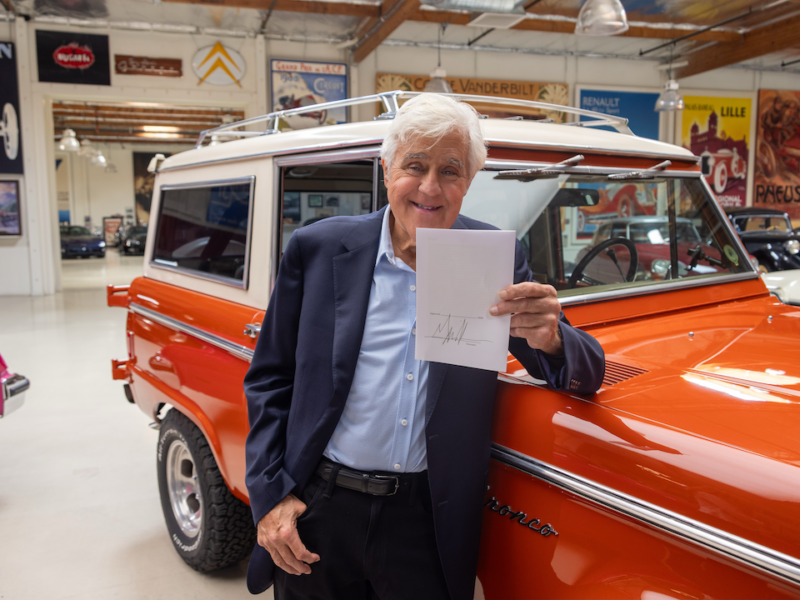
Governor Gavin Newsom also signed a bill creating a lowrider license plate program honoring Latino culture.BURBANK, Calif. (CN) — Leno’s Law took the scenic route, but it finally reached its destination Wednesday.Senate Bill 1392 — written by state Senators Dave Cortese, a San Jose Democrat, and Shannon Grove, a Bakersfield Republican — exempts certain collector vehicles from smog checks.The law, championed by former late-night show host and classic car enthusiast Jay Leno, exempts collector motor vehicles from model years 1976 to 1985. The vehicle must be insured as a collector vehicle with proof of insurance or driven fewer than 1,000 miles a year.The law becomes effective Jan. 1, 2028.“The governor stuck with this legislation through the last couple of years to preserve California’s classic car heritage, and that’s rare,” Leno said in a statement. “The car community has been waiting on this for a long time, and they notice when someone follows through."Leno testified last year before the Senate Transportation Committee on an earlier version of the bill, joking he put more miles on a classic vehicle searching for a smog station that could service his car than when driving it recreationally.That issue helped drive last year’s proposed law, though it became snared in the Assembly Appropriations Committee, leading to Cortese and Grove’s refurbished bill this year.“California can protect clean air while also recognizing the historic and cultural value of collector vehicles,” Cortese said in a statement. “SB 1392 establishes a carefully limited exemption for cars that are preserved, driven sparingly, and maintained as part of California’s automotive heritage.”Grove was the driving force behind last year’s version of Leno’s Law. She said in a statement that the governor’s signature is a profound step, as it exempts 10 additional model years of classic vehicles from smog checks.“We have worked for two years to get this law to the finish line,” Grove said. “It was only made possible by the overwhelming support of car enthusiasts, mechanics, and families across the state who have passed these vehicles down from generation to generation.”The bill had some detractors, who opposed a law that would lead to more emissions. Last year, state Senator Catherine Blakespear, an Encinitas Democrat, worried the bill wouldn’t pass through the Senate Environmental Quality Committee, which she currently chairs. She opposed both versions of the bill in Senate floor votes.The governor’s office said Leno’s Law is restricted to a small number of qualifying vehicles its drivers use sparingly. The new law enables the state to highlight its status as a beacon of American classic car heritage while working toward a cleaner transportation future.It’s also one of two bills signed by Newsom that support classic and lowrider vehicles in the Golden State.The governor on Wednesday also signed Assembly Bill 2541 by Assemblymember Mark González, a Los Angeles Democrat. It creates a lowrider license plate program that supporters say honors the state’s tradition of Latino art, identity and civic pride.González in a statement said some people have perceived lowriders as a problem to be policed instead of part of a culture that should be celebrated.“Lowriding is more than a car; it is cultura, it is art, it’s family, and it is a powerful expression of Chicano and Latino pride,” González said. “For generations, our communities have used lowriders to tell our stories, celebrate our heritage, and create something beautiful out of the streets we call home.”Subscribe to our free newslettersOur weekly newsletter Closing Arguments offers the latest about ongoing trials, major litigation and rulings in courthouses around the U.S. and the world, while the monthly Under the Lights dishes the legal dirt from Hollywood, sports, Big Tech and the arts.Additional Reads
California governor hits the gas on classic car legislation
Full Article
Original Source
Read the full article at Courthousenews →KhanList aggregates and links to publicly available news content. We do not host full articles from third-party sources. Always verify important information with original sources.