
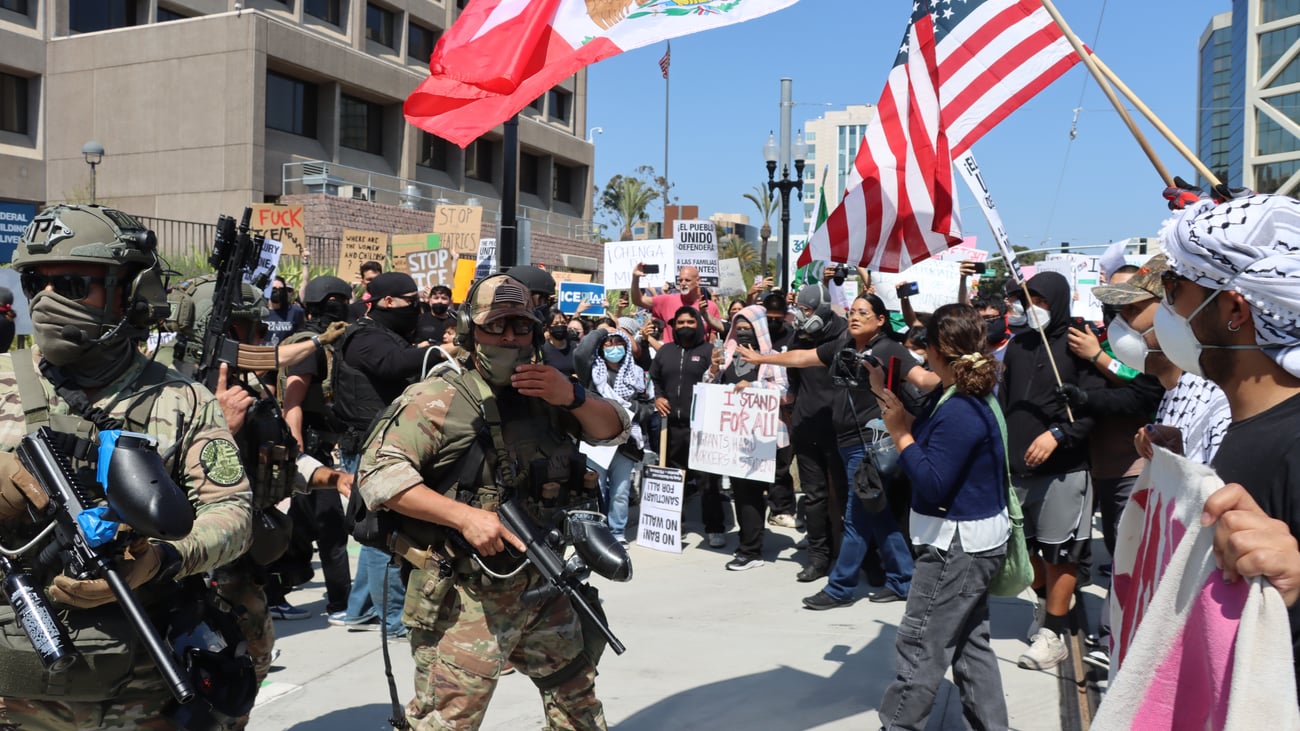
A Ninth Circuit panel heard arguments Tuesday about a law that would require nonuniformed federal officers to have a form of ID on them.PASADENA, Calif. (CN) — Ninth Circuit judges told the attorney for California on Tuesday that she had a tough job arguing in favor of the No Vigilantes Act.It’s because Deputy Solicitor General Mica Moore had made her arguments before, and a Ninth Circuit panel in April had hit pause on a portion of the state law requiring federal officers who aren’t in uniform to wear identifying badges.The federal government successfully argued the supremacy clause forbids states from passing laws that regulate it. U.S. Department of Justice attorneys said in court filings the appeal panel’s April 22 decision should end the legal action. They asked the three-judge panel to reverse a lower court’s decision denying a preliminary injunction, and issue its own injunction stopping the enforcement of that section of the No Vigilantes Act.The panel made no decision Tuesday.“You’ve got a tough job, Ms. Moore,” said U.S. Circuit Judge Jacqueline Nguyen, a Barack Obama appointee.Moore pushed the judges to consider the degree of regulation when determining whether the state law interferes with federal authorities doing their jobs. Requiring an officer to wear an identifying badge doesn’t affect their performance. Moore said federal authorities instead were concerned about people doxing them.A law requiring federal officers to provide an agency name and badge number passed constitutional muster, Moore added.“You are in a tough position,” said U.S. Circuit Judge Mark Bennett, a Donald Trump appointee.Moore pointed to the 1920 U.S. Supreme Court case of* Johnson v. Maryland*, which decided that a federal postal worker needed no state driver’s license to perform his duties. That decision also stated that a local law regulating how a driver navigated a street corner potentially could apply to a federal employee.“This is not incidental,” said U.S. Circuit Judge Daniel Collins, another Trump appointee, of the No Vigilantes Act. “This is regulating government activity.”Justice Department attorney Andrew Bernie said three other federal courts have agreed with the Ninth Circuit’s April decision since it was handed down. He added nothing had changed since that decision, except for the other courts siding with the Ninth Circuit.“States are prohibited from directing the operations of the federal government,” Bernie said, adding: “We think it’s purely a legal issue.”A state law regulating federal agents as they perform their jobs should make the panel’s decision easy, Bernie said, as it’s a direct regulation of an inherently sovereign function.Bennett referenced the “turning at the corners” phrase in the Johnson decision, asking whether it applied to this case. Bernie said that regulation lay far afield from what California wanted in its No Vigilantes Act.“This is contrary to the public interest,” he added.The No Vigilantes Act, and its legislative partner the No Secret Police Act, stemmed from sweeping federal immigration enforcement actions taken last year. California lawmakers responded with the bills.Legislators have pointed to people like Daniel Rascon, who’s said four armed, masked men approached his stopped car, pounded on the windows and wouldn’t show their ID. As his father-in-law drove away, Rascon, an American citizen, said one of the men fired a gun at them.The No Vigilantes Act, among other requirements, forced nonuniformed officers to have identification listing their name or badge number. The No Secret Police Act targeted federal immigration agents who have worn masks while detaining people suspected of being in the country without authorization. It prohibited federal law enforcement from wearing masks, with some exceptions.A federal judge stopped enforcement of the No Secret Police Act earlier this year, as state law enforcement was exempt. Its author — San Francisco Democratic state Senator Scott Wiener — wrote an update to the law this year removing that state exemption.That update remains pending in the Legislature.Subscribe to our free newslettersOur weekly newsletter Closing Arguments offers the latest about ongoing trials, major litigation and rulings in courthouses around the U.S. and the world, while the monthly Under the Lights dishes the legal dirt from Hollywood, sports, Big Tech and the arts.Additional Reads
California faces uphill battle to keep No Vigilantes Act intact
Full Article
Original Source
Read the full article at Courthousenews →KhanList aggregates and links to publicly available news content. We do not host full articles from third-party sources. Always verify important information with original sources.