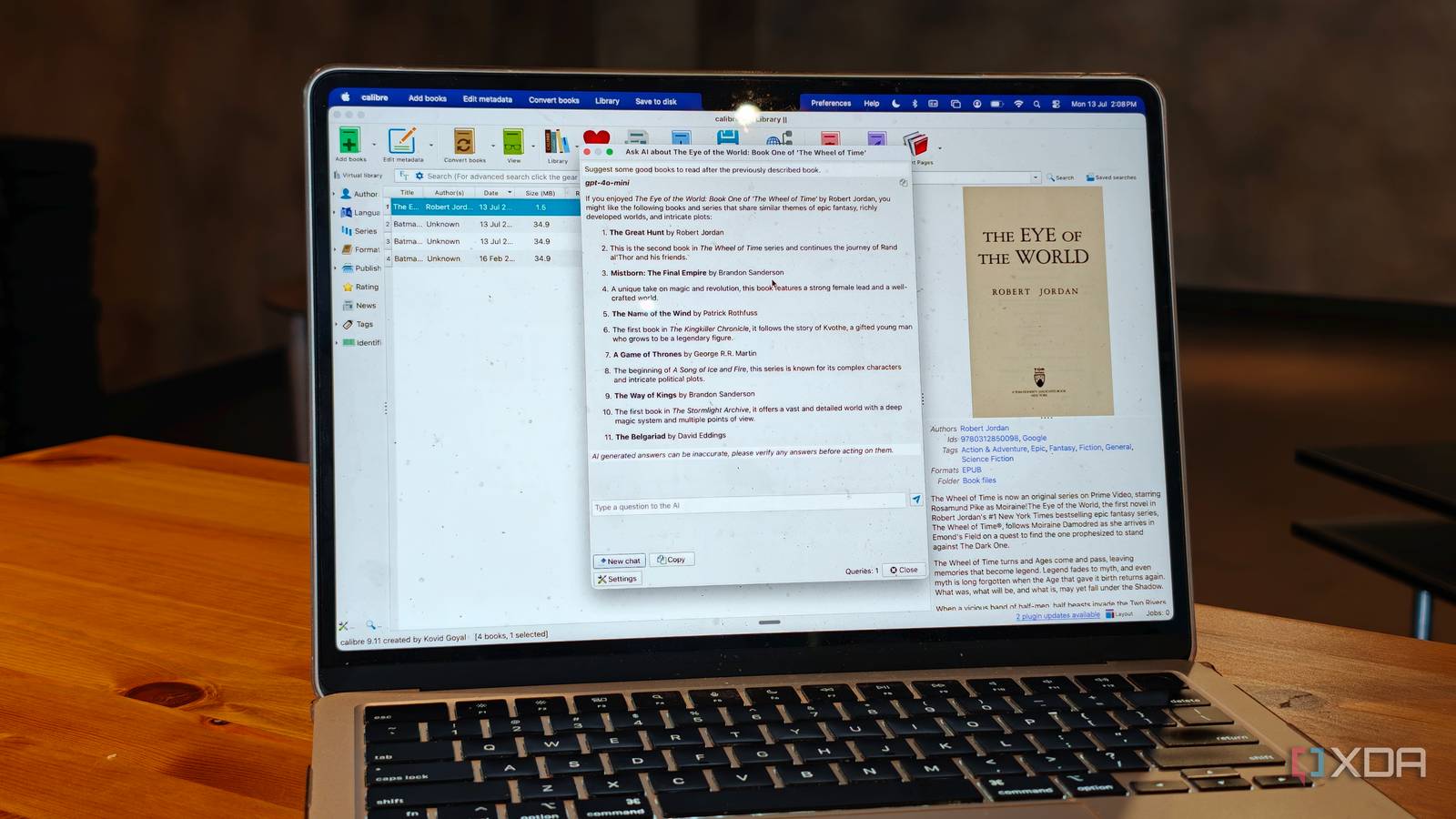
Published Jul 19, 2026, 7:30 AM EDT Dhruv Bhutani has been writing about consumer technology since 2008, offering deep insights into the personal technology landscape through features and opinion pieces. He writes for XDA-Developers, where he focuses on topics like productivity, networking, self-hosting, and more. Over the years, his work has also appeared in leading publications such as Android Police, Android Authority, CNET, PCMag, and more. Outside of his professional work, Dhruv is an avid fan of horror media spanning films and literature, enjoys fitness activities, collects vinyl records, and plays the guitar. I'm loyal to my Kindle but suffice it to say that the software has been languishing. Amazon has spent years talking about AI features that would potentially make the reading experience more interactive, but at the end of the day, you're still living in Amazon's world. However, my ebook library isn't. Over the years, I've spent a lot of time moving to a DRM-free ebook collection — all powered by Calibre. That makes Calibre's recent AI-packed update way more exciting and useful than Amazon could do. If you haven't updated your Calibre instance in a while, here's what you need to know. With Calibre 9.8, the developer has added support for connecting basically any AI service that exposes an OpenAI-compatible API to Calibre. That might sound like a nothingburger until you get around to seeing what it can actually do. We're talking about a full-blown reading assistant that can do everything from explaining to summarization and even recommendations right inside your personal library. And the best part is, you're not tied to cloud LLMs. Calibre's AI integration can speak to local models just as well. It's all the good parts of LLMs, built into the reading app you already use. Here's everything you need to know. No more digging through hundreds of pages for information AI fills in the gaps for me Every few months, I get into a deep dive of research papers and technical journals about a topic that's caught my attention. Additionally, my reading interests include long-running fiction series. Both these types of books have one thing in common: dense writing. Two weeks later, when I pick up the 1000-word tome again, I have very little recollection of what I was reading. That's where Calibre's new AI tools start making sense. Instead of manually searching through chapters or flipping between bookmarks, I can just ask Calibre a question. It automatically scans through your ebook and pulls up exact information from the ebook to answer it. If a concept references something introduced earlier in the book, I can ask Calibre to explain it to me again, right there from within the book. If you read directly within Calibre, instead of using it just for library management, you effectively just got your own version of NotebookLM. I've found it particularly handy when reading history books, or even fiction. Books like the Wheel of Time that I've been going through slowly and steadily have hundreds of characters, events, and locations. It is borderline impossible to remember all of them, so I don't. I just ask Calibre's AI assistant to remind me of specific locations, characters, and more. It can pull the information from the book in hand and get me up to speed. I choose the AI model and Calibre handles the rest From Gemini and OpenAI to local AI models, the choice is mine My favorite feature of Calibre's AI integration is the fact that it doesn't lock you into any specific AI provider. You can opt for local or cloud-based LLMs. Even with cloud LLMs, there are plenty of options to choose from, including popular models like Gemini and OpenAI's models. Once you add in your API key, you can select the exact specific model you want to use. Since the tasks at hand are relatively simple, I'd recommend sticking to a basic, lower-cost model. Elsewhere, I suffer from a lot of decision paralysis when it comes to reading books. There are too many to read, and too little time. On the flip side, when I'm in a certain mood, I tend to read a few books with similar themes before moving on to the next. Last year was horror. This year is high fantasy. All that to say, that come time to pick up the next book, I find myself struggling. Calibre's new AI assistant can scan through exactly what you've been reading and recommend a series of books that you should read next. The best part of all this is that it works natively within the Calibre interface, something I already use. I don't have to bother with uploading files to third-party tools. The aforementioned local model support also means that when I want to summarize a private document, I can just check it in Calibre and point it to a local LLM. That flexibility is something most tools don't offer. Calibre's new AI integration is revolutionary because it focuses on practicality. It doesn't try to reinvent reading. It just removes the friction around understanding what you're reading. There's room for AI to complement reading, not to replace it Look, as an avid reader, there's no way I support reading AI-generated Cliff Notes of books. You miss out on too much subtext. But there is room to subtly integrate AI into reading without diminishing the hobby altogether. Summarization, and being able to answer important questions about the book that you're reading certainly fit into that mold. If it can help you understand a topic better, it's good in my books. That's the real promise of AI in reading. Amazon has spent years hinting towards it; meanwhile, Calibre just shipped the feature without so much as a shout. calibre A free and open source ebook management software that lets users organize, filter, and convert their ebooks.
Calibre 9.8 finally gave me the AI-powered reading assistant Amazon promised but never delivered
Full Article
📰 Original Source
Read full article at Xda-developers →KhanList aggregates and links to publicly available news content. We do not host full articles from third-party sources. Always verify important information with original sources.