
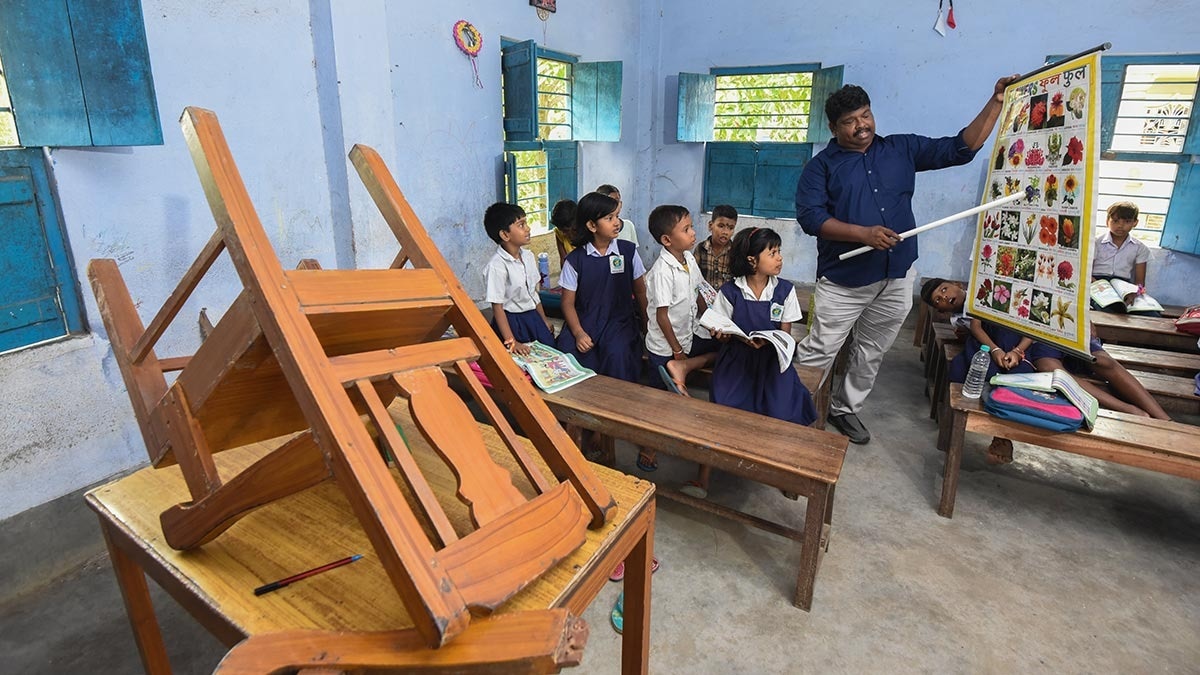
West Bengal’s implementation of the Centre-sponsored Samagra Shiksha programme was marked by a striking gap between funds allocated, infrastructure promised and educational outcomes delivered, with the Comptroller and Auditor General (CAG) of India flagging weak planning, poor fund utilisation, large teacher shortages, inadequate facilities for children with special needs, and weak monitoring.The audit, covering 2019-20 to 2023-24 (Trinamool Congress rule), was conducted between July 2024 and March 2025. It examined records at the state, district and block levels and test-checked six districts—Bankura, Purulia, Dakshin Dinajpur, Uttar Dinajpur, Paschim Medinipur and Murshidabad—besides randomly examining 72 schools across 18 blocks.The report is particularly significant because Samagra Shiksha covers virtually the entire school education spectrum, from pre-primary to senior secondary, and is intended to improve access, equity, infrastructure, teacher quality, vocational education and learning outcomes.West Bengal had 93,865 schools and 17.6 million school students as of March 2024, with government-managed institutions accounting for 89 per cent of schools and 93 per cent of enrolment. FUNDS UNSPENT, ACCOUNTS POORLY TRACKEDThe CAG’s findings suggest that the central problem was not simply a shortage of resources. In several areas, resources remained unused or were not deployed where most needed. The state’s utilisation of Samagra Shiksha funds ranged between just 46 per cent and 65 per cent during 2019-24. The state received Rs 6,030.68 crore as the Centre’s share and Rs 4,355.71 crore as its matching share during the period. Yet substantial balances remained unspent at the end of successive financial years.The audit found that delays occurred at multiple levels. The state took up to 85 days to release the Centre’s funds to the Paschim Banga Samagra Shiksha Mission (PBSSM) while the release of the state’s own share was delayed by up to 139 days. Utilisation certificates were also submitted to the Centre nine to 11 months late.The result was a particularly damaging cycle: low utilisation led to lower subsequent releases. The CAG calculated a total shortfall of Rs 2,427.87 crore between the committed central and state shares and the amounts actually received during 2019-24. Of this, the central shortfall was Rs 1,657.88 crore and the state’s Rs 769.99 crore. The audit attributed this largely to non-utilisation of central recurring grants within the stipulated period.The problem extended to infrastructure. As many as 4,034 civil works sanctioned between 2004-05 and 2009-10, including classrooms, toilets and ramps, had not even been started by March 2019. The state subsequently surrendered Rs 395.34 crore allocated for these works.The audit also found instances of expenditure that were not permissible under Samagra Shiksha. A total of Rs 6.13 crore was spent by PBSSM and district Samagra Shiksha authorities on activities not approved under the scheme. This included Rs 3.78 crore on advertisements relating to programmes such as tablet distribution, topper felicitation and student events. Another Rs 2.35 crore was spent in four districts on Taruner Swapna, a separate state government scheme providing financial assistance to Class 12 students to purchase digital devices.The CAG did not accept the state’s justification that the expenditure was related to education, pointing out that advertisement expenditure was not linked to Samagra Shiksha interventions.There were other financial-control concerns. Rs 682 crore remained unadjusted at the state and district levels as of 2023-24, including Rs 95.14 crore in the six test-checked districts. The absence of utilisation certificates and advance registers made it difficult to track how advances had been used and, the audit said, created a risk of misutilisation or misappropriation.In one older case in Purulia, an inquiry had found that out of Rs 44.54 lakh withdrawn for civil works, only Rs 21.63 lakh had been accounted for, leaving Rs 22.91 lakh unaccounted for. Despite the finding, the district authorities did not take action against the concerned executing agencies.TEACHER SHORTAGES EXPOSE A DEEPER CRISISPerhaps the clearest indication of an administrative failure is the state’s teacher distribution. In primary education, 19,165 schools—29 per cent of the primary schools—had an adverse pupil-teacher ratio (PTR), requiring another 31,684 teachers to meet norms. At the same time, 21,679 primary schools, or 32 per cent, had 32,840 teachers in excess of norms.The extremes are striking: 5,152 primary schools had only one teacher, affecting 176,000 students while 520 schools had no teacher at all, affecting 8,596 children. In Murshidabad, the PTR in some schools went as high as 432:1.The imbalance continued at the higher secondary level. Twenty per cent of schools in the state lacked a headmaster or principal while 1,562 schools had no work education teacher and 2,061 had no physical education teacher. Yet some other schools had more than one such teacher. In the 34 higher secondary schools examined, 32 had PTRs above 30:1, going as high as 233:1.Even teacher training was largely left undone. Against Rs 56.26 lakh earmarked for in-service teacher and head-teacher training in the six test-checked districts, only Rs 0.67 lakh—1.19 per cent—was spent. The teacher problem was particularly acute in Shishu Shiksha Kendras (SSKs) and Madhyamik Shiksha Kendras (MSKs). The transfer of their administrative control to the school education department did not resolve the basic problem of teacher recruitment.In 2023-24, 3,879 SSKs (25 per cent) had only one teacher while 765 MSKs, or 40 per cent, had fewer than four teachers. The state had 520 SSKs/MSKs with adverse PTRs exceeding the 40:1 norm. The department itself acknowledged that teachers had not been recruited for these institutions since 2010 and that several had closed because of the shortage.The child-labour rehabilitation system was also found wanting. In Bankura, a 2019-20 survey identified 1,477 child labourers, but 1,070 had never enrolled in school and another 354 had dropped out. No action was taken to enrol these 1,424 children in age-appropriate classes. In Murshidabad, no child-labour survey had been conducted after April 2015.The audit paints an especially troubling picture of inclusive education. In five test-checked districts, 17,008 eligible children with special needs were denied transport allowance and 24,919 were denied escort allowance during 2019-24. Depending on the district, 30-56 per cent of eligible children missed transport assistance and 35-49 per cent missed escort assistance.Among CwSN (children with special needs) girls, 15,593 of 72,267 eligible beneficiaries (22 per cent) did not receive the stipulated stipend. In Dakshin Dinajpur, the deprivation rate was 61 per cent. The physical infrastructure was no better. Of 83,373 government-managed schools, 12,503 had no ramp and 60,084 (72 per cent) had no CwSN-friendly toilet as of March 2024. Three resource rooms inspected by auditors were being used as godowns.Most starkly, the state had 315,411 CwSN enrolled in 35,557 schools but only 1,722 special educators, leaving a shortage of 33,835.MORE CHILDREN, BUT LEARNING A CHALLENGEThere is an important nuance in the report. West Bengal’s enrolment indicators were generally better than the national averages. The gross enrolment ratio (GER) in 2023-24 stood at 109.6 per cent in primary, 102.2 per cent in upper primary, 101.3 per cent in secondary and 66.1 per cent in higher secondary.But the gains became considerably weaker higher up the education ladder. The audit found a 28-42 per cent transition loss/dropout at the higher-secondary level compared with upper primary. Between 2019 and 2023, enrolment fell from 1.15 million in Class 7 to 666,000 in Class 9 (a 42 per cent decline).A survey of 581 children who had left school found that 53 per cent cited poverty or financial constraints. Another 13 per cent of boys had gone elsewhere to earn, 12 per cent had discontinued education because of marriage and 4 per cent had started working, mostly as labourers, to support their families.The state’s 60 Model Schools were another weak spot. None achieved the projected enrolment of 640 students. Their combined enrolment was only 7,092, averaging 118 students per school—just 18 per cent of the target. One had no students.Teacher deployment was equally problematic: of 299 teachers in the 60 schools, 170 were guest teachers. Five schools in Uttar Dinajpur and Dakshin Dinajpur had no regular teachers at all. In the test-checked schools, enrolment fell by 56-93 per cent between 2019 and 2024 amidst severe teacher shortages.The audit found overcrowding at multiple levels. While the prescribed student-classroom ratio was 40:1, 12 per cent of primary and upper-primary schools had adverse ratios; the figure rose to 33 per cent at secondary and 66 per cent at higher secondary level. In one inspected school, different sections of Classes 6 and 7 were made to attend on alternate days because of shortages of classrooms and teachers.Digital education also remained far from universal: among 16,570 upper-primary, secondary and higher-secondary schools, 42 per cent lacked ICT (information and communications technology) facilities, 47 per cent had no computer laboratory and 70 per cent had no ICT teacher.Ultimately, the audit found that deficiencies in inputs were translating into weak educational outcomes. Between 2019 and 2024, 506,000 students failed the Class 10 examination, with the annual failure rate ranging from 10 to 13 per cent, except in 2021 when there was no conventional examination because of Covid-19.At Class 12 level, 12-17 per cent of students failed in the years examined. Only 16-38 per cent of those who passed secured first division.More revealing was the CAG’s own assessment of 1,145 students in the 72 sampled schools. Around 404 students scored below 40 per cent across the subjects tested. Mathematics was particularly weak: 57 per cent of Class 3 students, 36 per cent of Class 5, 35 per cent of Class 8 and 62 per cent of Class 10 students scored below 40 per cent in the subject.Vocational education, meanwhile, had reached only 7.92 per cent of schools, against the National Education Policy 2020 target of 50 per cent. Of the 1,452 schools providing vocational education, 345 had no functional laboratories, while linkages with ITIs and polytechnics were absent. The state had no system to track the placement or employability of students after completing vocational courses.Underlying many of these failures was a weak institutional monitoring structure. The Governing Council, meant to provide policy direction and Centre-state coordination, did not meet during the entire 2019-24 audit period; the CAG said PBSSM could not produce records of any meeting after April 2005. District-level monitoring committees were not constituted.School management committees, which were supposed to prepare school development plans and participate in school governance, were absent in 35-84 per cent of schools in the test-checked districts. None of the 72 sampled schools had prepared school development plans during 2019-24, while no annual household surveys were conducted for micro-planning despite the guidelines requiring them.This perhaps provides the clearest explanation for the audit’s overall findings: the state prepared annual plans, but often without the school-level information and community participation that were supposed to determine what those plans contained.HOW TO FIX ITThe CAG’s recommendations consequently focus less on creating new schemes and more on fixing implementation—long-term, bottom-up planning; timely utilisation of funds; targeted intervention in underperforming districts; recruitment and rational deployment of teachers; universal CwSN-friendly infrastructure; stronger vocational education; and the constitution of district and school-level monitoring bodies.West Bengal has a vast school network and, on several headline enrolment indicators, performs better than the national average. But beneath those aggregate numbers lie unspent funds, abandoned or defective infrastructure, glaring teacher imbalances, weak inclusion, high secondary-level attrition and poor foundational learning.The challenge identified by the CAG is therefore not merely getting children into school—it is ensuring that the money reaches the classroom, the teacher reaches the child and the child actually learns.Subscribe to India Today Magazine- EndsPublished On: Sep 2, 2026 19:09 IST
CAG shows how Bengal school system under Trinamool Congress failed children
Full Article
Original Source
Read the full article at Indiatoday →KhanList aggregates and links to publicly available news content. We do not host full articles from third-party sources. Always verify important information with original sources.