
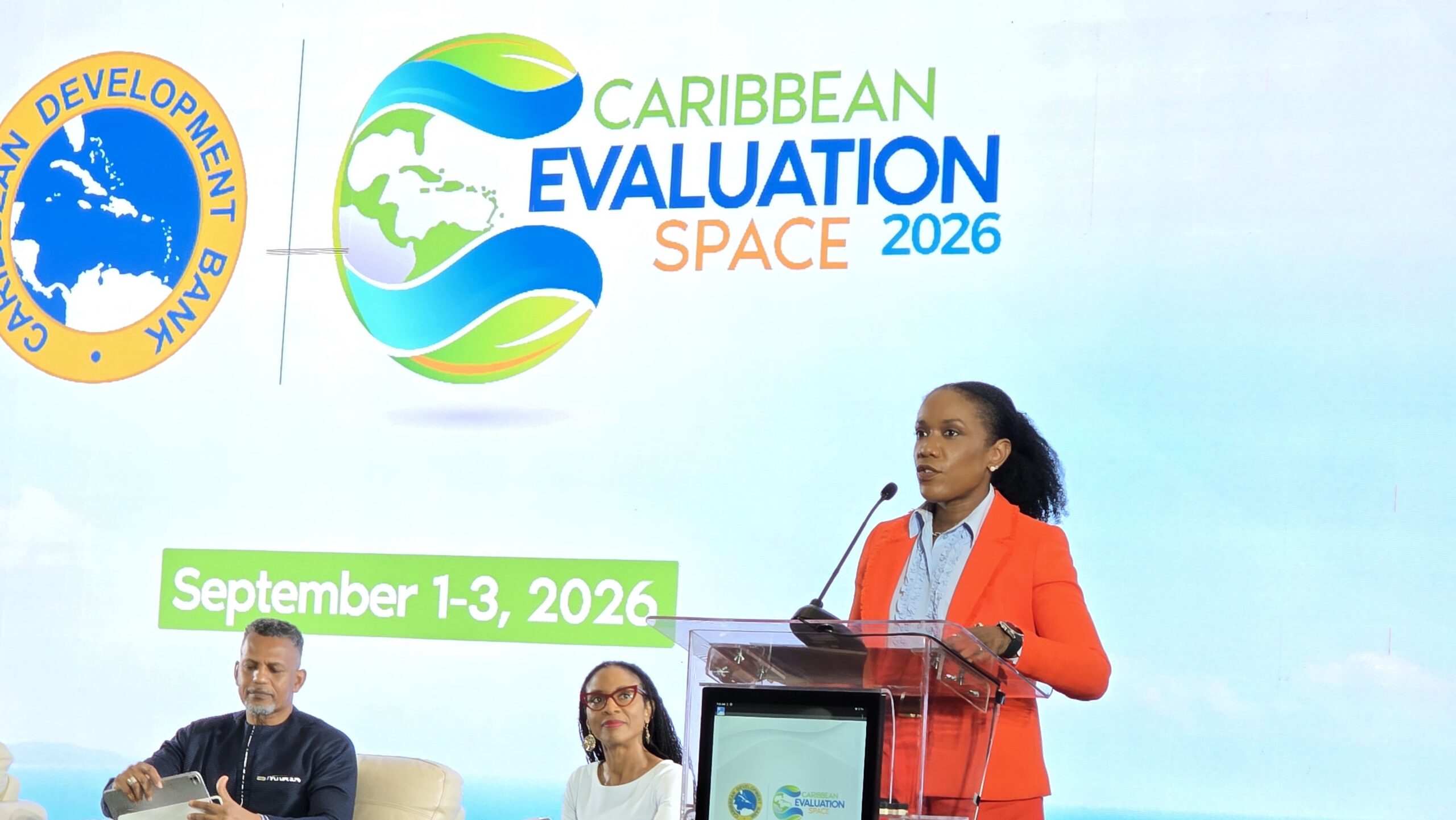
Marsha Caddle, Minister of Economic Affairs & Planning, Office of the Prime Minister. (Photo Credit: Lourianne Graham) The Caribbean needs to develop monitoring and evaluation systems tailored to its specific needs and circumstances, as measurements designed for larger economies do not reflect the realities of small island states, Minister of Economic Affairs & Planning Marsha Caddle said. Caddle highlighted the need to recognise the particular vulnerabilities of small island states, warning against importing evaluation frameworks designed for larger, wealthier countries, at the inaugural Caribbean Evaluation Space 2026 being held at the Wyndham Grand Barbados, Sam Lord’s Castle, on Tuesday. “A results framework copied wholesale from a G20 finance ministry is going to ask the wrong questions of our public service, of our size, of our history, serving populations that are as small, as interconnected, and as exposed as ours. We are entitled, and I would say that we are obligated, to build monitoring and evaluation systems that are honestly ours and not borrowed ones that we are quietly hoping will fit.” The monitoring and evaluation systems, she pointed out, needed to belong to the Caribbean. She argued that GDP per capita alone does not adequately capture the vulnerability of small island states, especially those exposed to natural disasters. “A GDP per capita test on its own tells the world almost nothing about how exposed a country like ours is to a single hurricane wiping out a quarter of GDP in an afternoon,” she said. You Might Be Interested In Caddle also said international measures do not adequately account for small states’ ability to adapt to technological change. The minister said Caribbean countries have spent years fighting to have their vulnerabilities recognised, including their exposure to natural disasters and other risks. “Small island states cannot allow our progress toward these goals to be measured entirely by indicators built for economies many times our size, with none of our exposure. We’ve had to fight for years, this [Caribbean Development] Bank has been one of those institutions fighting for years [for recognition of] our particular vulnerability to a single storm, to a narrow economic base, to a debt structure shaped by decades of borrowing to rebuild the same damaged infrastructure again.” The minister warned that Caribbean countries could continue to be measured and financed according to standards developed elsewhere if they do not establish and defend their own resilience measures. “If we don’t build and defend our own resilience metrics and demonstrate our own capacity to build resilience ourselves and to show the world how to do so, we are going to keep being measured and financed by somebody else’s definition of what counts as vulnerable or what counts as resilience, and reporting our own SDG progress against a yardstick that was never really meant to see us clearly,” she said. The minister called for an honest evaluation of progress towards the Sustainable Development Goals (SDGs), alongside better metrics designed for small, exposed economies. “As we approach 2030, I would ask this space to treat two tasks as equally urgent. First, the honest, rigorous evaluation of where we actually stand against these goals, wherever that evidence is uncomfortable, and second, the harder, longer work of making sure the instruments we use to measure ourselves were actually built with small, exposed, interconnected economies like ours in mind.” Caribbean states also need to build greater regional cooperation, said Caddle, warning against each country developing separate evaluation systems, data infrastructure and resilience indexes. “It is distinctly unhelpful to have a dozen or more small Caribbean states each trying to replicate the same institutional endeavour separately, when a shared one would serve us all better. I think that this also applies to evaluation and monitoring capacity, as much as it applies to any other function in a small state government. “We don’t each need to build from nothing our own fully independent school of evaluators. Even though we do all need to build into our work the practice of evaluation, but we don’t need to build our own fully separate data infrastructure, our own fully isolated resilience index.” She called instead for the development of a regional evaluation community. “We need a regional evaluation community that shares your methods, your people, and hard-won lessons the way this space is trying to do this week.” Caddle said the regional approach could allow successful monitoring frameworks and expertise to be adapted across countries rather than being recreated from scratch. “Where a monitoring framework that works in one jurisdiction gets adapted and not reinvented in the next, where an evaluator that has been trained in one island, one small state, can be useful, can work, can bring their knowledge and expertise to be in another, where the region itself becomes a unit of learning, and becomes a space where we demonstrate to the world what works well, not just the sum of a few countries’ separate national efforts.” She also stressed that evaluation should not only focus on whether individual projects achieve their intended results, but whether the systems behind them can deliver consistently. “Are the frameworks, the mechanisms, the systems that produce these projects and these results year after year actually built to work reliably? This goes back to one of your three core pillars of your strategy, which has to do with the strength of institutions and systems. So, do these systems actually work reliably? Were they built to work reliably, or did this project succeed in spite of a process that could just as easily fail on the next occasion?” “A results framework that only ever evaluates individual projects will keep telling you the same reassuring story about the ones that happen to go well, while the mechanism underneath them stays exactly as fragile as it was before.” The minister also stressed that data collection must lead to action, arguing that it’s pointless to measure a problem if there is no intention to respond to the findings. “Every indicator in a national evaluation framework should be able to answer the question: If this number comes back bad, what am I going to do about it? And if nobody can answer that, the indicator is decoration. It’s not evidence.” She identified four questions policymakers should consider: the public purpose of a programme; the public problem it is intended to correct; how technology and innovation can support it; and who benefits or suffers disproportionately if it fails. “An evaluation that only tells you whether a programme was delivered on time and on budget has told you almost nothing about whether it actually reached the woman in need, [or anyone] who needed it. “I would say to this space, plainly, that the results framework without an equity lens is not yet a complete results framework.” (LG)
Caddle: Don’t measure Caribbean by G20 standards
Full Article
Original Source
Read the full article at Barbadostoday →KhanList aggregates and links to publicly available news content. We do not host full articles from third-party sources. Always verify important information with original sources.