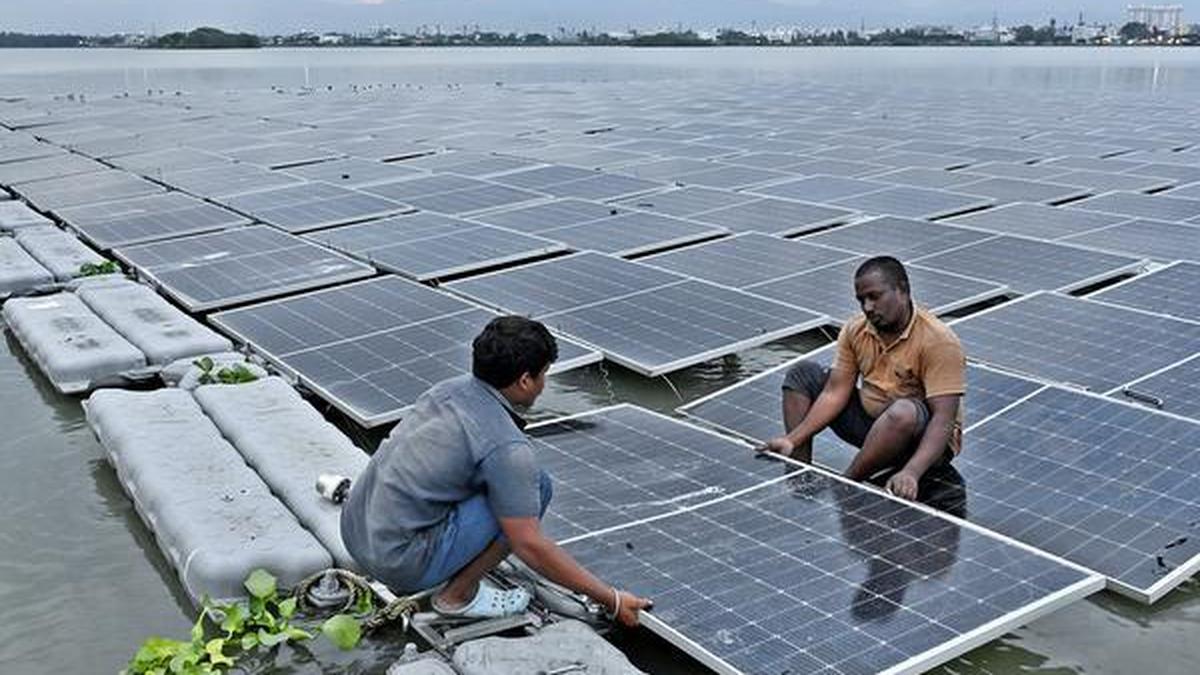
Workers engaged in maintenance work on the floating solar panel structures at Ukkadam Big Tank in Coimbatore city. | Photo Credit: M. PERIASAMY The Union Cabinet on Friday (July 31, 2026) approved the Pradhan Mantri Surya Sarovar Yojana (PM-SSY), a ₹5,070-crore scheme aimed at accelerating floating solar power by providing central financial assistance (CFA) of up to ₹1 crore per MW for projects installed on reservoirs and other water bodies. The programme targets 5,000 MW of floating solar capacity by 2030-31.The scheme, to be implemented by the Solar Energy Corporation of India (SECI), comes at a time when India has only about 0.7 GW of installed floating solar capacity despite an estimated technical potential of 102 GW.Projects receiving support under the scheme will have to include battery energy storage equivalent to at least two hours, amounting to 10,000 MWh across the programme, to help States meet peak demand and reduce the curtailment of renewable power during periods of excess generation. India’s flagship project, the Omkareshwar floating solar park, located on the Narmada in Madhya Pradesh’s Khandwa district is the country’s largest at 278 MW, with plans to scale to 600 MW output. However, it doesn’t have onsite battery storage.Officials said the financial support was intended as a “nudge” to the industry to develop an alternative stream of solar capacity rather than a permanent subsidy. Solar development in India has remained concentrated in Rajasthan and Gujarat because of their vast tracts of inexpensive land and high solar radiation.Reservoir-based projects are expected to “diversify” installations geographically, particularly in States with large water bodies but limited land availability.Land constraintsThe policy is also designed to address two of the biggest constraints facing ground-mounted solar projects: acquiring large contiguous parcels of land and the rising costs associated with rehabilitation and resettlement. Ground-mounted solar, which accounts for the overwhelming majority of India’s roughly 100 GW of installed solar capacity, typically requires three to four times more land per megawatt than the area the solar panels physically occupy.Land acquisition has increasingly emerged as a bottleneck as India pursues its target of 500 GW of non-fossil fuel electricity capacity by 2030.Potential and advantagesA recent assessment by the National Institute of Solar Energy (NISE) estimated that India could host 102.18 GW of floating solar after factoring in multiple variables including perennial water availability, suitable depth, adequate solar irradiation and proximity to roads and substations. Maharashtra, Madhya Pradesh, Karnataka, Odisha, and Telangana account for the largest share of this potential Floating solar offers several operational advantages over conventional ground-mounted systems. By using reservoirs and industrial ponds, it avoids competition for agricultural land while reducing water evaporation. Cooler operating conditions over water also reduce soiling losses and can improve panel efficiency. The Cabinet note says the scheme will also encourage domestic manufacturing of specialised components while generating an estimated 16,000-17,000 jobs.Cost and engineeringThe technology, however, comes at a premium. Government estimates place floating solar system costs at ₹4.9-5.2 crore per MW, about 25% higher than comparable ground-mounted projects due to the additional expenditure on floating platforms, anchoring and mooring systems. The mandatory battery storage further increases project costs. Developers have also reported engineering challenges at existing projects, including wear on floating structures and cable failures. The Centre nevertheless expects the higher upfront costs to be offset by the strategic value of creating a geographically diversified solar fleet with integrated storage reducing dependence on land-intensive projects while making renewable electricity more dispatchable. Published - July 31, 2026 10:12 pm IST
Cabinet approves scheme to promote ‘floating’ solar plants
Full Article
Original Source
Read the full article at Thehindu →KhanList aggregates and links to publicly available news content. We do not host full articles from third-party sources. Always verify important information with original sources.