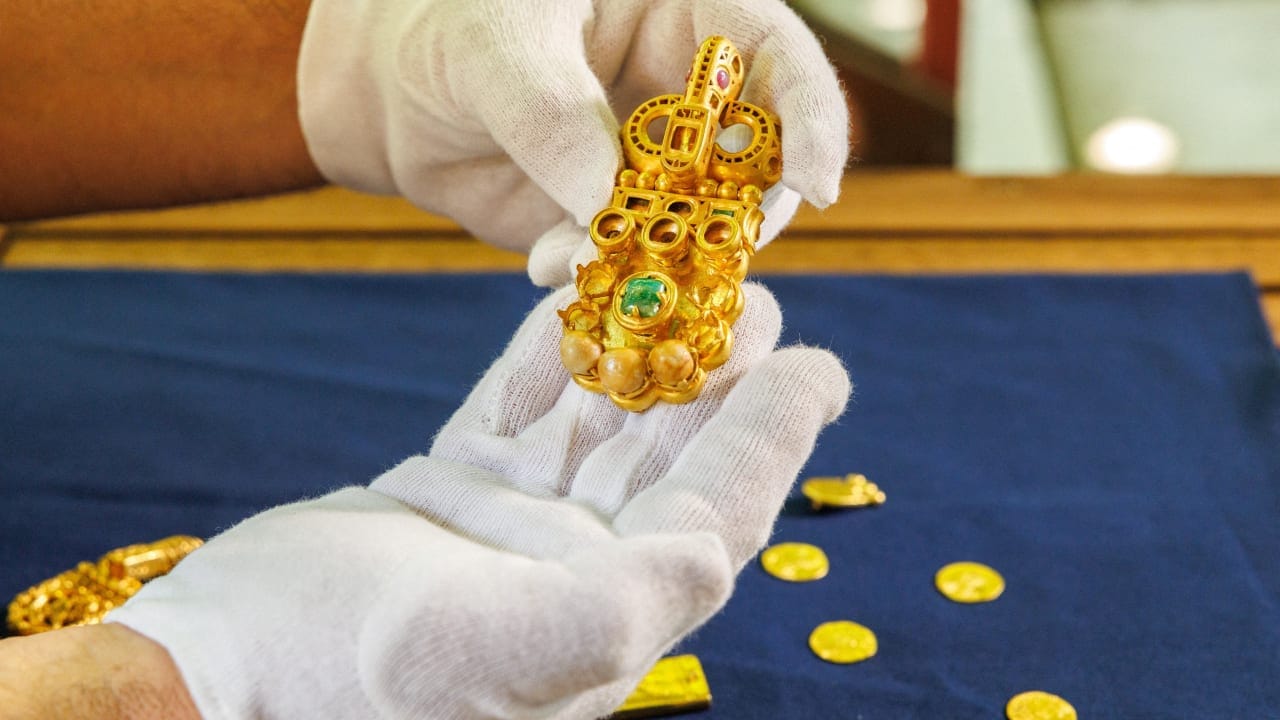
Jerusalem Post/ArchaeologyHis team, equipped with diving gear, has spent the past decade slowly uncovering the history of the ship, whose wreckage lies near the Adriatic island of Mljet.Follow us on GoogleIgor Miholjek, head of research, Croatian Conservation Institute, Department of Underwater Archaeology, shows the gold buckle decorated with rubies, emeralds, and pearls, which they found in a Byzantine shipwreck near Polace on the island of Mljet, Croatia, July 21, 2026.(photo credit: REUTERS/ANTONIO BRONIC)ByREUTERSJULY 24, 2026 16:51Updated: JULY 24, 2026 16:52A Byzantine-era ship discovered more than a decade ago on the seabed off Croatia's southern coast was probably carrying a high-ranking person and his entourage, judging by the gold jewelry found in the wreckage, according to archaeologists.Announcing for the first time on Thursday the results of their years-long underwater excavation, they said the shipwreck could be dated to the 7th or 8th century and that the artifacts on board indicated that this was no ordinary merchant vessel.These included gold coins dating to the Heraclius dynasty of four emperors, buckles decorated with rubies, emeralds and pearls, and a golden signet ring with a picture of the emperor "that certainly wouldn't be worn by just anyone," Pavle Dugonjic, head of the Department of Underwater Archaeology at the Croatian Conservation Institute, told Reuters.His team, equipped with diving gear, has spent the past decade slowly uncovering the history of the ship, whose wreckage lies near the Adriatic island of Mljet."This is an impressive amount of gold, the largest ever found on a shipwreck in the entire Mediterranean," said Igor Miholjek, the head of research at the Croatian Conservation Institute. "It weighs over 600 grams when weighed after cleaning and restoration."An underwater archaeologist works at a Byzantine shipwreck near Polace on the island of Mljet, Croatia, July 20, 2026. (credit: REUTERS/ANTONIO BRONIC)Most important shipwreck of its timeThe Byzantine Empire, successor to the Roman Empire and centered on Constantinople, now Istanbul in Turkey, once dominated the eastern Mediterranean but by the early 8th century was mired in turmoil and was losing territory."For me, it's the most important shipwreck of its period," said Justin Leidwanger, professor of archaeology at Stanford University."If you're studying the end of the late Roman Empire and the transformation into the medieval world, this is a critical site for us to understand and to gain insights into how the Mediterranean was held together by its sea routes, how it fragmented, how the empire fell apart."Follow us on Google
Byzantine gold artifacts help archaeologists uncover past of ship wrecked off Croatian coast
Full Article
Original Source
Read the full article at Jpost →KhanList aggregates and links to publicly available news content. We do not host full articles from third-party sources. Always verify important information with original sources.