
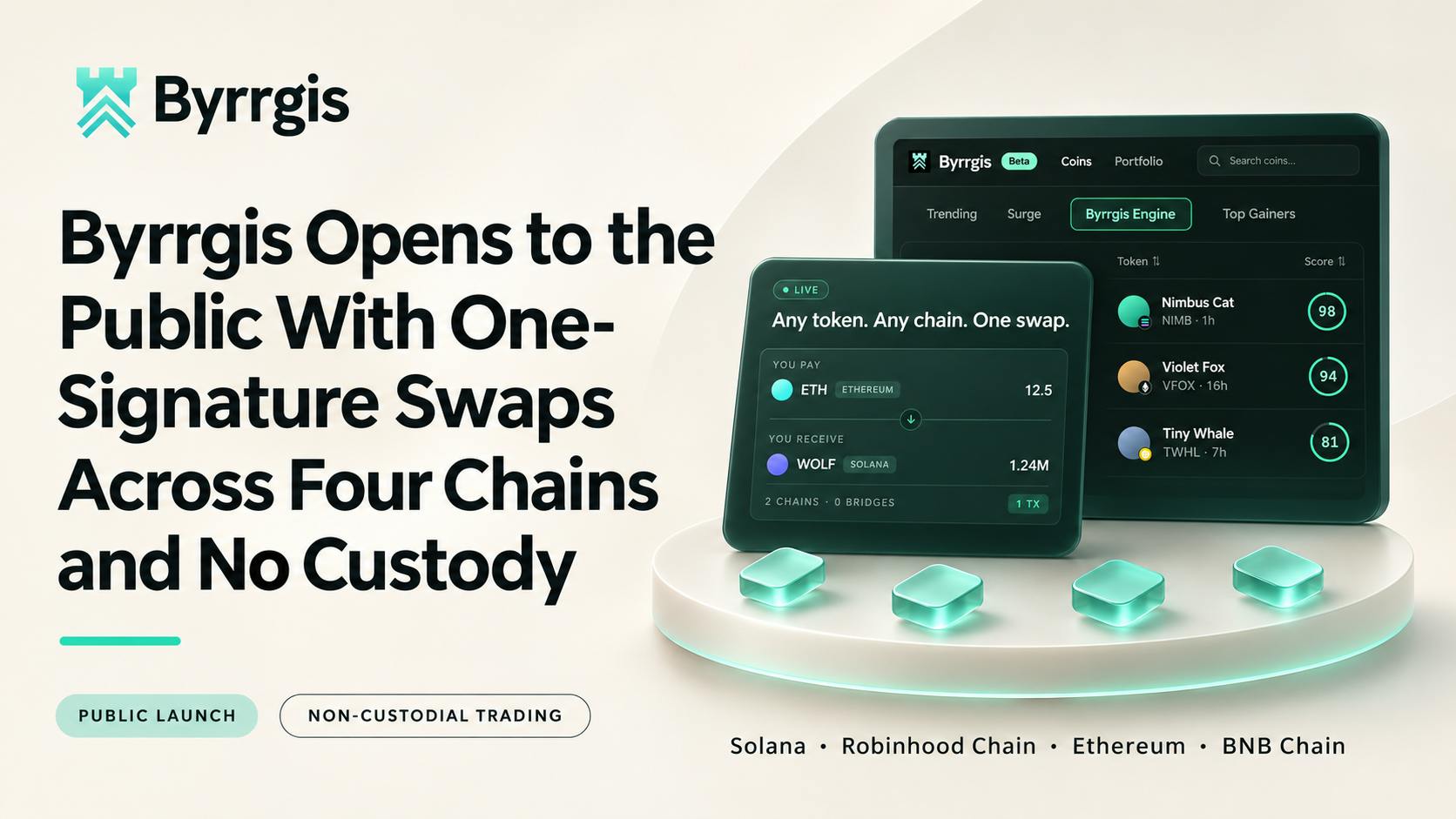
Thieves took $3.41 billion from crypto in 2025, with a single breach at the Bybit exchange accounted for $1.5 billion of it, about 44% of the year's total. Traders have been moving on-chain at the same time, with decentralized exchanges handling a record 24% of spot volume relative to centralized ones in July 2026, up from 17% a year earlier. Byrrgis, a London-based trading platform built on that shift, has opened its non-custodial multi-chain terminal to the public. Users trade from their own wallets across Solana, Ethereum, BNB Chain and the newly added Robinhood Chain, swapping between networks with one signature while a Scout Score rates each token from 0 to 100 before they trade.The Cost of Handing Over the Keys On a custodial exchange, traders deposit their coins into wallets the platform controls and rely on it to keep them safe and process withdrawals. That model is convenient, but it concentrates risk, since a breach of the platform's keys can reach every account at once. One exchange hack accounted for 44% of the crypto stolen in 2025. The 2025 numbers show how much rides on that single point. Chainalysis found that private-key breaches at centralized services made up 88% of stolen funds in the first quarter of 2025, while North Korea-linked hackers took a record $2.02 billion over the year. A non-custodial platform removes the exchange as a store of customer funds, because users keep their own private keys and sign each transaction themselves. Risks from smart contracts, wallet security and the blockchains themselves remain, so self-custody shifts responsibility to the user while taking away the largest single target.Trading Moves On-Chain Decentralized exchanges, or DEXs, let people swap tokens directly from their wallets through smart contracts, with no company holding the funds in between. Their spot volume reached a record 24% of centralized exchange volume in July 2026, up 7 points in a year, while centralized volumes sank to a 12-month low. On-chain exchanges now handle a record share of spot trading.Most of that activity sits on a handful of networks. Ethereum, BNB Chain and Solana together carried 76% of DEX volume at the end of July 2026, with Base a distant fourth at 14%. Those three were Byrrgis' first chains, which puts its terminal on the networks where most decentralized trading already happens.Robinhood Chain Joins the Lineup The public launch adds Robinhood Chain, an Ethereum layer 2 network built on Arbitrum technology that went live on mainnet on 1 July alongside tokenized stocks and perpetual futures. A layer 2 is a separate network that settles back to Ethereum, which keeps fees low while borrowing Ethereum's security. Robinhood brings nearly 28 million customers across 38 countries, which gives the chain a distribution channel few new networks have. Robinhood Chain reached $2.72 billion in daily DEX volume within weeks of launchTrading on the chain grew quickly. On 12 September its daily DEX volume reached $2.72 billion, about 84% of Solana's $3.25 billion that day, after it briefly passed Solana at several points over the summer. Adding it lets Byrrgis users reach that activity from the same wallet they use on the other three chains.How the Terminal Works Byrrgis lets users swap supported tokens across different blockchains with a single signature. The platform handles the routing underneath, so a trader does not have to bridge assets by hand or move between several apps to get from one network to another. Its Universal Gas feature removes the need to hold each chain's own fee token, such as ETH, SOL or BNB, before a trade. The website lists payment of gas in ETH, SOL, BNB, USDC, USDT or USDG, with a 0.8% fee on single-coin swaps.How a trade moves through Byrrgis. Every supported token gets a Scout Score between 0 and 100, which combines indicators of on-chain risk, market momentum and tradability into one number that updates as conditions change. The score sits alongside the platform's token discovery tools and is meant to inform a decision, not predict how a token will perform. The launch brings a redesigned login and wallet flow along with a fiat onramp, so users can buy crypto with a payment card inside the platform. Byrrgis has also reworked its swap infrastructure for faster execution across supported networks. A new cloud bar lets traders track up to 30 coins at once, while portfolio tools show holdings across all four chains in one view. Stop-loss and take-profit orders, which close a position automatically at a set price, are available for Solana trades, with support for Ethereum-compatible networks planned next.What Comes Next for Byrrgis Native iOS and Android apps have been built and are awaiting app store approval. The roadmap then adds social trading, including copy trading, profiles for key opinion leaders and shared investment theses, followed by referral tiers, community squads, leagues, quests and leaderboards with airdrop rewards. Byrrgis plans mobile apps, social trading and coin baskets.Further ahead, curated coin Packs will let users buy a basket of tokens in one transaction or build their own collections. The platform's Solana-based $WOLF token ties into that ecosystem: a portion of platform fees goes to open-market $WOLF buybacks, while the company says 69% of total supply is locked, with lock details published on Streamflow.The Road Ahead The public launch puts Byrrgis into a market that is moving its way. Trading volume keeps shifting toward on-chain venues, new networks such as Robinhood Chain are pulling in mainstream users while each large exchange breach reminds traders what custody costs when it fails. Its test now is whether it can keep the experience as simple as a centralized app while users hold their own keys. Mobile apps and social trading features will decide how far it reaches beyond experienced on-chain traders.Don’t forget to like and share the story!
Byrrgis Opens to the Public With One-Signature Swaps Across Four Chains and No Custody
Full Article
Original Source
Read the full article at Hackernoon →KhanList aggregates and links to publicly available news content. We do not host full articles from third-party sources. Always verify important information with original sources.