
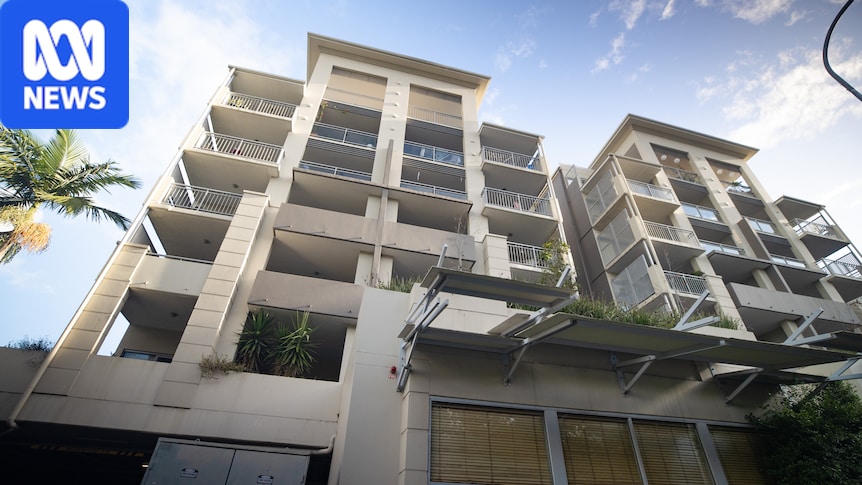
Australia's housing market looks very different than it did at the start of the year.After the Reserve Bank lifted the cash rate five times in 2026, raising borrowing costs, property values have come under increasing pressure.But not all housing types have been hit equally.Across most capital cities, unit prices have generally recorded smaller percentage declines than detached houses.The shift marks a reversal from last November, when houses were generally leading price growth in most markets.At a glance nationallyUnits underperformed houses for most of the pandemic period, but affordability constraints mean more Australians are trading backyards for balconies.This has helped apartment values hold up noticeably better than houses through this downturn.Across the combined capitals, house values have fallen 5.9 per cent since the end of January, while unit values are down 3.6 per cent.The gap highlights how the affordability crunch is reshaping buyer behaviour.The national median house value sits at about $1.1 million compared with $739,000 for units, a $361,000 gap that converts directly into demand when borrowing capacity is down.Canstar estimates the borrowing capacity of someone on an average full-time wage of $108,650 would be reduced by more than $58,000 following the latest rate rise. A couple, both on average wages, would see a reduction of nearly $117,000.Cotality research director Tim Lawless said more affordable segments of the market had generally been holding up better as serviceability pressures intensified.PRD chief economist Diaswati Mardiasmo said units were typically 25 to 35 per cent cheaper than houses, making them an increasingly attractive option."Many house buyers have re-routed their budget to units, propping up that part of the market," Dr Mardiasmo told the ABC."Less debt means a smaller mortgage and more manageable repayments, which has become increasingly important as interest rates have risen," she said.For India (surname withheld for privacy reasons), a 27-year-old first home buyer from Newcastle, that trade-off is becoming increasingly difficult to ignore.She and her partner have spent about a year searching for a home, but a series of interest rate rises has steadily eroded what they can afford."Every time that rates go up, our borrowing capacity changes," she said.India estimates the couple's borrowing power has fallen by $25,000 to $50,000 since they were first pre-approved."Another interest rate hike is going to start being like, 'Can we even still do this?'" she said.India says her dream of owning a house with a patch of grass is slipping away. (Supplied)The couple originally hoped to buy a house, but increasingly find themselves weighing up whether that goal remains realistic."For me, I'm at that point already," India said when asked if she was ready to focus solely on units."My partner still has hope to own a small patch of grass."But she said buying an apartment came with its own concerns, including strata costs, maintenance issues and the risk of expensive repairs in older buildings."I feel like I'm stuck between a rock and a hard place," India said."I'm just holding on to this tiny little bit of optimism, being like, don't worry, we'll find something."Capital city breakdownThe gap between house and unit performance has been most pronounced in Australia's two largest property markets.Sydney has recorded the largest divergence, with house values down 9.7 per cent since the end of January compared to a 5.2 per cent fall in units, while Melbourne houses are down 8.3 per cent versus a 4 per cent decline for units.Dr Mardiasmo said Sydney's "expensive, blue-chip housing market has been particularly sensitive to rising interest rates" because purchasers typically took on larger loans.But she said some housing markets were continuing to hold up better than others."Houses in residential suburbs in the outer ring of CBDs that are still reasonably priced, around 10 per cent extra on top of the median price, are performing better."Areas where there's very little new house supply are also continuing to hold up relatively well."In Brisbane, units have continued to edge higher, with values up 0.3 per cent ($2,891) since January while house values have slipped 2 per cent (-$23,664).Adelaide and Hobart were the only exceptions where house values have marginally outperformed units since the end of January, although the differences were comparatively modest.AMP chief economist Shane Oliver said he continued to expect a wide divergence between cities and property types."In terms of price-to-rent ratios adjusted for inflation as a rough guide to whether a market is over or undervalued, houses are 35 per cent overvalued nationally compared to units at just 8 per cent," Dr Oliver said."So, houses overall are far more vulnerable to a fall in prices than units are."Dr Oliver's analysis suggests Brisbane, Adelaide and Sydney houses are the most overvalued and vulnerable and so are likely to see bigger-than-average falls, in the range of 15-20 per cent.And in terms of units, Brisbane, Adelaide and Hobart are the most vulnerable.But despite recent weakness, houses continue to outperform over the longer term.Over the past decade, combined-capital house values have risen 64.6 per cent, compared with 24.2 per cent growth in unit values.Houses retain a stronger long-term capital growth story because of land scarcity. Land is a fixed resource, meaning it is difficult and expensive to create more of it for housing.Why are we seeing a drop in property values?Mortgage holders and prospective buyers have been hit with a triple whammy that has affected the property market.The components are:Higher cost of livingInterest rate risesChange in property taxesUnderwriting all of this is uncertainty."You just never know what the global situation is going to deliver next, and many people are choosing to save for a rainy day instead of spending," Dr Mardiasmo said."In the market, this means cautious buyers wanting to make sure they are getting the best bang for their buck."
Buyers ditch backyards for balconies as rates rise
Full Article
Original Source
Read the full article at Abc →KhanList aggregates and links to publicly available news content. We do not host full articles from third-party sources. Always verify important information with original sources.