
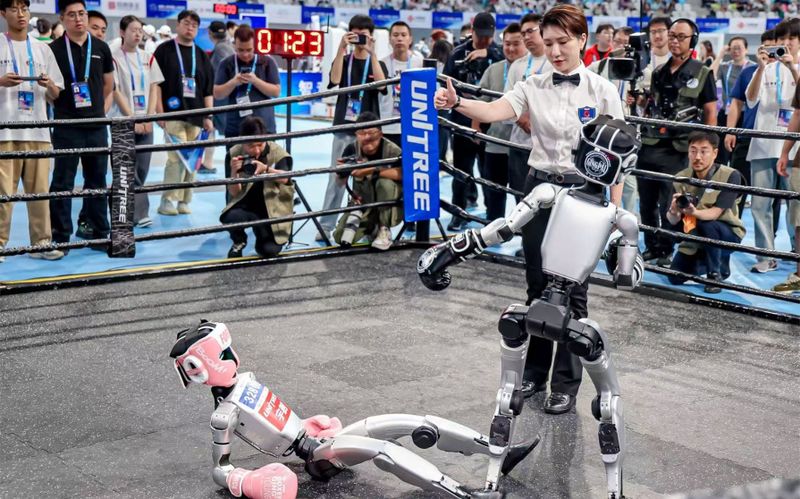
On 21 August a robot called Lightning broke Usain Bolt’s 100m record. You may have seen it on the news, it is everywhere. Me, I just got grumpy. Why? Stay with me. Over the past year or so there has been an uptick in videos showing humanoid robots doing all sorts of dazzling things. Running fast, jumping high, playing soccer, doing gymnastics. A recent one had robots competing in a kickboxing tournament, beating the actuators out of each other, with a worked-up human audience screaming in testosterone-fuelled glee. WTF? Is this what some of the smartest engineers in the world think is a productive use of their talents?For centuries, robots belonged to the realm of fiction rather than engineering. Long before the first humanoid machines began rolling off production lines at Tesla, Boston Dynamics and more than 200 Chinese robotics start-ups, it seemed entirely reasonable to imagine that intelligent machines would also look rather like us. They were portrayed with two arms, two legs, a head and usually a face expressive enough to reassure or terrify the audience.The humanoid robot became one of the great entertainment and literary devices of history. Hundreds of years of imagined automata. Isaac Asimov used them to explore morality through his Three Laws. Star Trek gave us Data, the machine forever trying to become more human. Blade Runner asked whether an artificial being could possess a soul. These stories worked because they were really about us. Giving intelligence a human shape allowed writers to examine consciousness, ethics and identity through a familiar mirror.But science fiction is under no obligation to obey the mechanics of either engineering or economics. Or even common sense.Now that robots are escaping the pages of novels and entering warehouses, hospitals and factories, one cannot help wondering whether the energy going into making them resemble people is just silly.The human body is not a piece of pre-planned engineering, a clever invention designed to efficiently perform a task. We are more akin to an evolutionary compromise. We stand precariously on two legs because our ancestors needed to walk long distances while freeing their hands to carry infants, throw spears and gather food. We possess extraordinarily dexterous fingers because we manipulate an almost infinite variety of objects. Our shoulders rotate through astonishing angles because millions of years of evolution demanded climbing, reaching, throwing and lifting. We can run, squat, crawl, bend, sit, lie down, kick, punch, push, hug, cradle a baby and drink tea. In other words, evolution optimised us for survival across an uncountable number of real-life scenarios and risk factors, but it did not optimise us for unloading shipping containers.Yet a large swathe of today’s robotics industry (including the ever-ubiquitous Elon Musk) appears determined to recreate this immensely complicated biological machine simply because it already exists, and there is lots of video footage to use for training via AI technologies.Because creepy images of humanoid robots seem to dominate the airwaves, I wanted to find out how they are doing against their less telegenic relatives. Industrial robotics is already one of the world’s great manufacturing success stories. More than 4.6 million robots weld cars, package food, assemble electronics, inspect factories and stack pallets. Almost none has a head, a face or legs. Meanwhile, humanoids number only in the tens of thousands, most of them still being evaluated in pilot projects, research programmes or demonstration centres.That’s less than one-hundredth of a percent.Musk, in an interview with Lex Fridman, talked about Tesla producing one million Optimus humanoid robots per year. It is always dangerous to bet against Musk, but this seems to me to be completely bonkers. He apparently sees billions of humanoid robots, preferably his, in most homes (in the fullness of time). Nope, no chance. At least not in my home. A vacuum pod maybe. But not a weird thing with two legs, googly eyes and a funny gait.The overwhelming majority of successful industrial robots never move at all. They are mostly bolted to the floor, or (in some cases) on wheels. Here is the list of the robot types that are most successfully deployed: articulated-arm robots, assembly robots, pick-and-place robots, gantry robots, palletisers, welding robots, painting robots, machine-loading robots, packaging robots.Exciting stuff, huh? Precisely. Humanoid robots attract eyeballs. Boring robots simplify repetitive, dangerous or complex physical tasks and save costs and (sometimes) lives, like the da Vinci surgical system, which had performed more than 20 million surgeries by the end of 2025.I suspect I am too grumpy about this, because a light reading of other cultures (particularly China, where 90% of humanoid robots are made) shows that my view is probably in the minority. In any event, I found this generally easy definition of a robot: “A robot is a programmable machine that senses its environment and performs physical actions with some degree of autonomous decision-making.” The key adjective is “some” (degree of autonomous decision-making). If there is no autonomy at all, it is just a machine. If there is a showy amount of autonomy, like being able to kickbox and talk, then it is headline fodder. Somewhere in between those two is where the economic sweet spot lies – in task engineering (amplified by recent advances in AI). When designers are free to optimise for a specific task, they are never going to try to reinvent the human body.The majority of the industry itself knows this – they know where their bread is buttered. Reuters recently reported that, amid the excitement surrounding humanoids, Chinese robotics companies are increasingly emphasising practical industrial deployments over theatrical demonstrations. Even Unitree, famous for its humanoid ambitions, continues investing heavily in quadrupeds and specialised manipulation systems as the industry searches for commercially valuable applications rather than viral videos.I am betting that the future robot workforce is unlikely to resemble an army of gleaming doppelgangers ambling through homes and shopping centres, folding laundry or shaking hands. It is far more likely to consist of millions (even billions) of bespoke task-oriented machines. Some will have wheels. Some will have tracks. Some will fly. Others will crawl through pipes, swim beneath ships or perch permanently beside production lines. Many will never move at all. Few will have faces.Why then, despite all the evidence, do we remain so fascinated by robots that imitate ourselves? Why do many serious people enthuse about humanoid kickboxing competitions while the truly productive robots inspect blast furnaces, harvest crops, and operate giant mining vehicles?Perhaps science fiction has left us with an expectation that reality cannot quite shake. Or perhaps there is something deeply profound in imagining that the pinnacle of engineering innovation must eventually resemble its creator. DMSteven Boykey Sidley is a professor of practice (ex-JBS, University of Johannesburg), a partner at Bridge Capital and a columnist-at-large at Daily Maverick, where he writes the weekly Crossed Wires column. His new book, It’s Mine: How the Crypto Industry is Redefining Ownership, is published by Maverick 451 in South Africa and the Legend Times Group in the UK/EU, available now.
BUSINESS REFLECTION: Crossed Wires: The unbearable weirdness of humanoid robots
Full Article
Original Source
Read the full article at Dailymaverick →KhanList aggregates and links to publicly available news content. We do not host full articles from third-party sources. Always verify important information with original sources.