
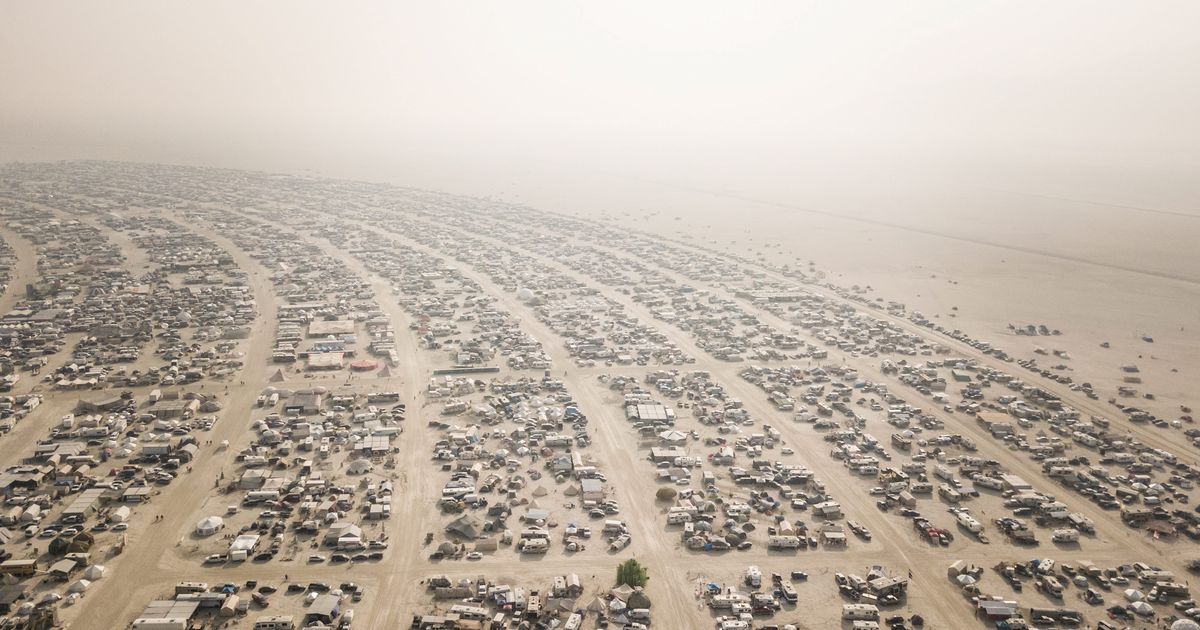
Burning Man’s 70,000 Attendees Are Descending Upon a Wildfire Evacuation Zone Some Nevada locals say now’s not the time for Mad Max cosplay. By , who writes the Substack "The Golden Hour." She is the author of “The Stolen Year” and “The Art of Screen Time.” Aerial view of Burning Man’s temporary city from 2017. Photo: Amazing Aerial/Shutterstock Aerial view of Burning Man’s temporary city from 2017. Photo: Amazing Aerial/Shutterstock Aerial view of Burning Man’s temporary city from 2017. Photo: Amazing Aerial/Shutterstock Typically, in the month before Burning Man, the annual weeklong festival that takes place in the northern Nevada desert, Andy “Lost Machine” Tibbetts is in his happy place, a vast Reno-area maker space called the Generator, welding together some of the climbable sculptures the event is known for, like a 22-foot-tall melting Dalí clock or a Baba Yaga cottage on chicken legs. Instead, he’s spent August anxiously watching the orange skies from his house in the northern Nevada hills through two consecutive and adjacent wild-land fires, the Bug and Hawk Fires. “It’s been like three weeks of helicopters, airplanes, and just your general chaos,” he says. He sent his 8-year-old son to stay with friends outside the potential evacuation zone and prepared to flee with his cat and laptop on a moment’s notice. Altogether, the Bug and Stallion Fires, which started August 8 and 10, and the Hawk Fire, which followed two weeks later, swept through more than 150,000 acres, leading to road closures, power outages, and evacuations of up to 90,000 people at a time. Almost 50 homes and other structures have been destroyed so far; there have been several injuries, and one of Tibbetts’s neighbors lost 20 German shepherds. All this disruption is coming in the lead-up to the Burning Man festival, which brings at its peak about 70,000 people to this region from all over the world. Gates officially open Monday, August 31, but just over half of the attendees will arrive earlier to build the big art installations and other features of the temporary city. There’s predictably a lot of anxiety about the festival at a time when nerves are shot and resources are stretched thin. There are rumors about evacuees not being able to secure hotel rooms thanks to out-of-towners. Some Facebook users are asking Burners to cancel their trips: “Stay Away! Unless you want to show up and help. Thank you. Love you Burners but maybe this is not your year.” Others suggest the event should be canceled forever. “Party goers driving by the disaster and devastation on their way to a good time. Kinda makes you think that the heavy carbon footprint and all that time and money might be not helping the burning planet.” A spokesperson for the Burning Man Organization declined to comment and pointed us to their August 24 Facebook post, where they urged Burners to “stay informed,” “avoid interfering with emergency response,” and “plan stops and lodging in areas not affected by evacuation activity or closures.“ “The biggest question is not simply whether the fire will reach Burning Man,” says Donald Abbott, who sits on the city council in Sparks, just east of Reno. “It is whether tens of thousands of visitors can arrive without interfering with the needs of residents, evacuees, and first responders.” He’s also concerned about air quality for the attendees, which is exacerbated on the site by diesel generators and propane-burning, flame-spewing sculptures like El Pulpo Magnifico. However, others feel more optimistic about the festival proceeding as usual. At this point, with the fires largely contained, “Burning Man should not really be that much affected,” says Dan Fuhrman, a retired fire captain with 31 years of experience fighting wildfires in the state and a self-described “old Burner” who attended the festival for two decades starting in 1993. He allows that these fires have happened unusually close together both in time and space and were spread quickly by the zephyr winds of the Great Basin in three-digit temperatures. But he says wild-land fires, as opposed to forest fires, don’t tend to last long in this desert landscape of dry grass and brush. “Sun goes down, fire goes out. That’s what we say in Nevada.” Could there be yet another fire closer to and during the event itself, I ask? Fuhrman admitted that it was a possibility. “Burning Man is two hours north of Reno. The highway to get there is a single-lane road for miles and miles and miles, and there’s sagebrush all around. There could be a fire impacting that, absolutely.” But it wouldn’t be any worse than the mud bath in 2023 or the wind, rain, and dust storms during setup last year, he says. “Worst case, they shut down the highway for a couple of hours as the fire burns through.” That frankly sounds terrifying. And while more and more participants set up their own Starlink connections during the event to stay on the internet, it’s a stretch to imagine most people will be continuously monitoring their phones for either fire or air-quality alerts. A fireball billows up from a 52-foot-tall wooden man at Burning Man in 2000. Photo: David McNew/Getty Images Tibbetts says the fires have already created plenty of logistics headaches. “I know a lot of people order stuff last minute from Amazon, and the Amazon fulfillment center for this whole region was in the evacuation area,” he says, and closed for days. “This time of year UPS will send an entire truck of orders just to the Generator. This would be an intense time of building, assembling art and art cars, and a lot of people just have not been able to get any work done on their projects. They’ve been evacuated.” That said, none of the people I talked to who had planned on going — even the newbies — were actually reconsidering their participation. They are just planning to tread lightly. “For us it was a no-brainer … We just didn’t stop in Reno at all,” a friend texted me from inside the burn. She had come from Oakland and was setting up a large theme camp. “Not sure there is much to argue about. As far as I know, everyone is avoiding taking up essential services while also supporting local businesses and tipping extra to help people whose jobs may be impacted,” says a 23-time Burner from L.A. who’s known on the playa as Nine-Fingered Panda. When we spoke, Tibbetts was food-prepping and packing up his camper to head there himself. It would, of course, be a big hit on the local economy if Burning Man scaled down or moved elsewhere. In normal Burn years, the influx of visitors fills hotels and strips Walmart shelves bare; it’s a major income boost for year-round artisans like Tibbetts and local businesses. “It’s our Black Friday,” says Danielle Vincent, who sells antiques at a stall in the Reno Public Market. She got to know the area because of Burning Man, which is also where she met her husband and where he proposed; they moved to Nevada, ironically, after one too many fire evacuations from Grass Valley, California. This month, her mother’s memory-care facility was in an evacuation zone, causing many sleepless nights. Still, she finds the online conversation a bit extreme. “People here in Reno are saying that Burners suck as a whole,” says Vincent. “That they’re self-centered, they’re awful. They throw trash everywhere. They are a drain on resources.” While it’s true that, for years, there have been complaints about gnarly road accidents from tired and impaired drivers leaving Burning Man and trash strewn along roads and in parking lots from Lake Tahoe to Reno, some Burners also coordinate aid efforts to local communities and to disasters around the country. This year, a group called Burners Without Borders sent a pallet of “energy relief kits” for distribution to displaced people in Reno, which include portable solar-power stations, solar lanterns, and emergency crank radios, and others are collecting donations for members of the Pyramid Lake Paiute tribe affected by the Stallion Fire. It’s become a familiar pattern: Extreme-weather events are intensifying clashes between tourists and locals about whose priorities matter. New Orleans dealt with “disaster tourism” in the wake of Katrina. Maui went so far as to ban short-term rentals after the Lahaina Fire in 2023 to ease the pressure on the housing market. Vegas and Reno, meanwhile, practically invented American tourism, and to this day, “Nevada’s economy is highly dependent on visitors,” points out Pamela Mahoney Tsigdinos, an author who wrote about the tensions in the local Nevada Current. Events like wildfires are a further test of an area that has been booming in population since the pandemic with people drawn by the camping, hiking, and skiing seasons at Lake Tahoe, along with those driven out by higher housing costs elsewhere in the West. “The numbers are starting to get ahead of what the roads and the infrastructure can handle in terms of water, access to services,” says Mahoney Tsigdinos. That’s not just a Burning Man problem. “The climate-change situation is accelerating,” says Vincent, the antiques seller. “We need to radically accept reality for what it is, instead of pointing fingers at each other. And we need to understand that this is just a new era that we’re entering, and we get to adapt to it.” Does adapting mean leaving certain things behind? “Some people are saying that going out to Burning Man and burning fossil fuels and creating a gigantic bonfire in the middle of fire season is incredibly stupid, and I feel really bad saying so, but,” she admits, ”they do have a real point there.” Burning Man Is Descending Upon a Fire Evacuation Zone Your product is saved! You’ll receive emails when your saved products go on sale. Manage preferences.
Burning Man’s 70,000 Attendees Are Descending Upon a Fire Evacuation Zone
Full Article
Original Source
Read the full article at Curbed →KhanList aggregates and links to publicly available news content. We do not host full articles from third-party sources. Always verify important information with original sources.