
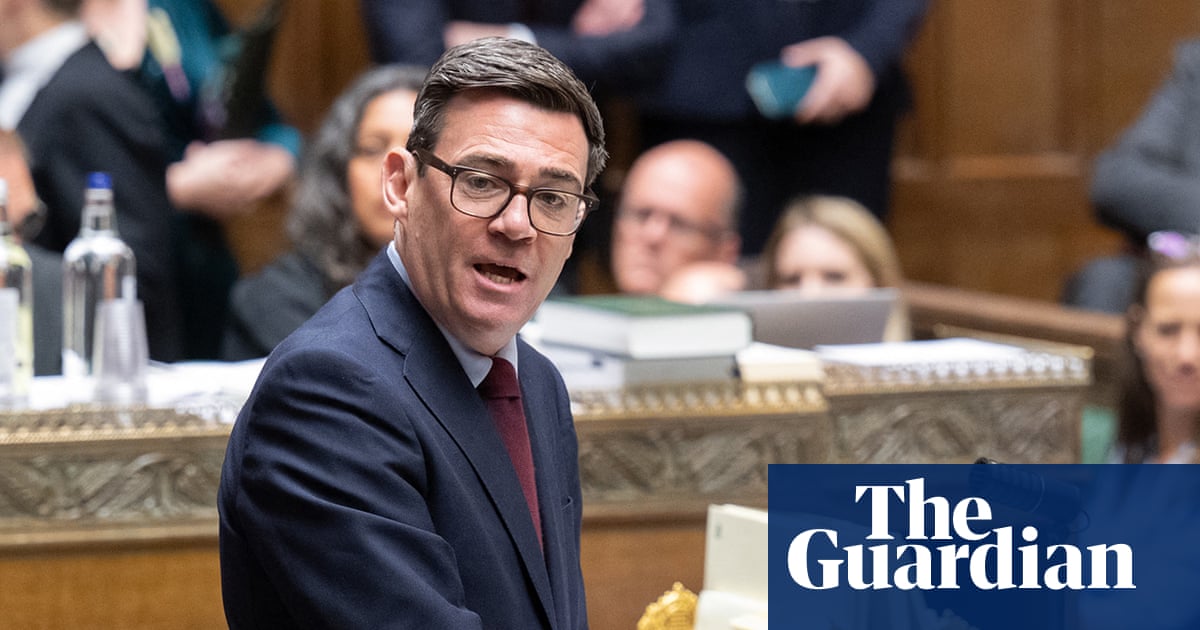
There was a time when placing Israel under strict trade sanctions would have been a politically risky thing for a British prime minister to do. Andy Burnham, however, considers it an electoral asset.As Kemi Badenoch attacked him over defence spending at prime minister’s questions on Wednesday, Burnham deliberately turned the topic to the trade ban on illegal settlements which he had announced on Tuesday.With the foreign secretary, Ed Miliband, sitting to his left, the prime minister said: “In this difficult and dangerous world Britain has to stand for something, Britain has to show leadership, Britain has to stand for fairness against injustice.“Where people are being bullied out of their homes and intimidated, we will always stand with the underdog and take what action we can to support them. That, Mr Speaker, is leadership on the world stage: Britain being true to what it’s always been about.“That is what the British people expect of us and that is what this government will do.”Under the new sanctions announced on Tuesday, goods produced in illegal settlements in occupied Palestine will be banned from being imported into the UK and those who help build or finance settlements will face sanctions.The measures drew a sharp response from the Israeli government, which announced the closure of the British consulate in East Jerusalem.Domestically, the opposition has been led by Badenoch, who has long been a staunch ally of Israel.In a piece in the Jewish Chronicle, the Conservative leader warned that the prime minister risked “fanning the flames of antisemitism here at home”.“For all Labour claim to have rooted out antisemitism internally, the degree of anti-Israel hatred means that Labour’s approach to many of these issues is Corbyn in all but name,” she added.Others in her party, however, have struck a less aggressive tone.On Tuesday, the shadow foreign secretary, Tom Tugendhat, said: “None of us here rejects the government’s stated aim that we must do everything we can to end the circle of violence and support the Abraham accords and the two-state solution.“What we reject is performative politics, acting alone, that leaves our envoys irrelevant and our voice weaker.”Some senior Conservatives even backed the government.Edward Leigh, who as father of the house has held his seat longer than any other MP, told the Commons on Tuesday: “I am proud to say that I absolutely and fully support what he is doing today, because it is about standing up for freedom, for morality and for justice for all people in this world.”The government has reason to believe it is on strong electoral ground with this decision.A poll by YouGov earlier in the summer found 50% of British voters supported a ban on trade with West Bank settlements, while only 16% were opposed.While Labour, Liberal Democrat and Green voters were the strongest backers of such a move, even Conservative and Reform voters were in favour overall.Labour officials hope the announcement may help them make up ground with progressive and Muslim voters who have moved away from the party since the 2024 election.Many say they remain angry about an interview given by Keir Starmer soon after the Gaza war began in which the then prime minister said he thought Israel had the right to withhold water and electricity from Palestinians.The disillusionment among Muslim voters was particularly important in the Green party’s victory in Gorton and Denton.Meanwhile Labour lost a large part of its broader progressive base during the local elections, in which the Greens took a number of councils and mayoralties in central London.Zack Polanski, the leader of the Greens in England and Wales, tweeted on Tuesday: “Ed Miliband’s statement on Israel is only a first step. We need to go further: a full ban on goods, services & investment.”Labour and the Greens are now again locked in battle, over the Holborn and St Pancras seat, which Starmer has vacated.Though the policy was in train long before that byelection was called, it could prove an important campaign tool for Labour canvassers looking to reassure their core voters.
Burnham sees sanctions against Israeli settlements as an electoral asset
Full Article
Original Source
Read the full article at Theguardian →KhanList aggregates and links to publicly available news content. We do not host full articles from third-party sources. Always verify important information with original sources.