
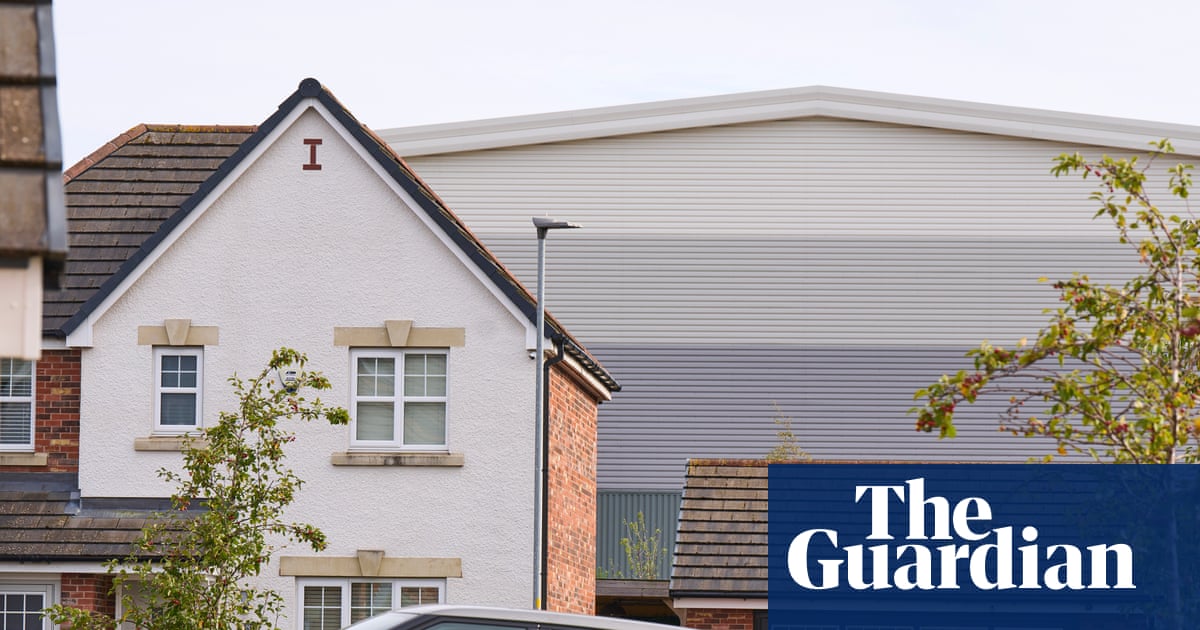
Andy Burnham raised safety concerns about dozens of lorries leaving a “monster” warehouse near a primary school because there was “no safe crossing” for children, a public inquiry has heard.Concerns about the 18-metre-high “megashed” in the village of Astley, Greater Manchester, are being examined by Britain’s office of the transport commissioner.A deputy transport commissioner, John Baker, launched an environmental public inquiry after significant local opposition to the round-the-clock operation by the logistics company Whistl.Whistl is asking for a licence to increase its number of HGVs at the site from 40 to 50 and the number of trailers from 60 to 70.But people living nearby told the inquiry on Wednesday that granting the licence would worsen the “catastrophic” impact on those living nearby, with some left suffering with anxiety, sleep deprivation and depression.The inquiry also heard that shortly before he became prime minister, Burnham wrote to the transport commissioner’s office to oppose Whistl’s plans.Steve Retford, pictured standing in his back garden, is one of many people affected by noise from the warehouse. Photograph: Christopher Thomond/The GuardianIn the letter sent in February, which was not shown at the inquiry but has been seen by the Guardian, the then Greater Manchester mayor expressed concerns about the route taken by dozens of HGVs to access the 17-acre site near his Makerfield constituency.Burnham said schoolchildren would be forced to share the road with huge lorries “despite there being no pedestrian crossings, no lollipop service, no traffic calming and sections where the pavement is extremely narrow or ends entirely”.John Peters, who co-founded the Astley Warehouse Action Group, told the inquiry, at the Brick Community stadium in Wigan, that it was a recipe for disaster, adding: “I hope I never have to say I told you so.”The Whistl warehouse, which was named Britain’s joint-worst new building this year, was approved by Wigan council in 2024 after a planning application by PLP, a firm part-owned by Peel Group, one of Britain’s biggest landowners which is run by the billionaire John Whittaker.Whistl wants permission to increase the number of HGVs using the site from 40 to 50. Photograph: Christopher Thomond/The GuardianThe outcome of the inquiry, expected in early December, is seen as a test case of how local groups could challenge similar large industrial developments across Britain.The Labour government has relaxed planning rules to allow big logistics projects on previously protected land as the UK strives to compete in the race for AI and the growing e-commerce market, which increasingly relies on next-day deliveries.Peters, who said he had lived in the village since 1979, was in tears as he likened Whistl’s “megashed” opening in the summer to “a plane crash-landing in that field”.He said one year ago the only medication he took was a single statin to lower blood cholesterol levels: “I now take high blood pressure [medication], statin, anti-depression and a sleeper. That’s the state I’m in. I know in our group we’re in a truly bad state so I dread to think what would happen [if Whistl’s licence was approved].”David Gerrard, a builder who lives opposite the site, appeared emotional as he described the effect on his wife and their three daughters.skip past newsletter promotionafter newsletter promotionHe said they were routinely woken throughout the night by the sound and light from lorries. Gerrard, whose house has declined in value by an estimated £170,000 as a result of the disruption, said he recently counted 113 wagons over a seven-hour period from 5.30am. “How are we supposed to live with this? It’s ruining our lives,” he said.James Healey, a leading acoustics expert commissioned by the residents, said he had never before seen planning approval given to such a noisy warehouse so close to people’s homes.He said: “In my 22 years in consultancy I’ve never seen a planning application be approved with a sound impact such as this, so it’s unprecedented in my experience.”A report by Healey, who chairs the UK Institute of Acoustics building acoustics group, concluded that those living closest to the site faced “severe health risks” from the excessive noise.The warehouse overshadows nearby homes in the village. Photograph: Christopher Thomond/The GuardianCarole Retford, whose property is overshadowed by the warehouse, became close to tears as she described being “exhausted through lack of sleep” and mood swings from “anxious to quite depressed”.Another resident, Paul Bullow, said: “Physically, mentally, it’s draining, it’s constant. It never stops. It just brings levels of stress that weren’t there before but are now there all the time. It’s completely unacceptable.”In September, Whistl volunteered to pause overnight operations between midnight and 6am and introduced quieter electric vehicles. Giving evidence, Whistl executives conceded that they might not have chosen the site had they known the level of concern it would cause.Patrick Sadd, Whistl’s barrister, said the company accepted the “extremely moving” evidence and that the impact on some residents had been “far-reaching”. He said the company deserved credit for working “tirelessly” to find a solution and would continue to do so, including exploring the possibility of erecting sound-insulating structures.
Burnham raised safety concerns about Manchester ‘megashed’, inquiry hears
Full Article
Original Source
Read the full article at Theguardian →KhanList aggregates and links to publicly available news content. We do not host full articles from third-party sources. Always verify important information with original sources.