
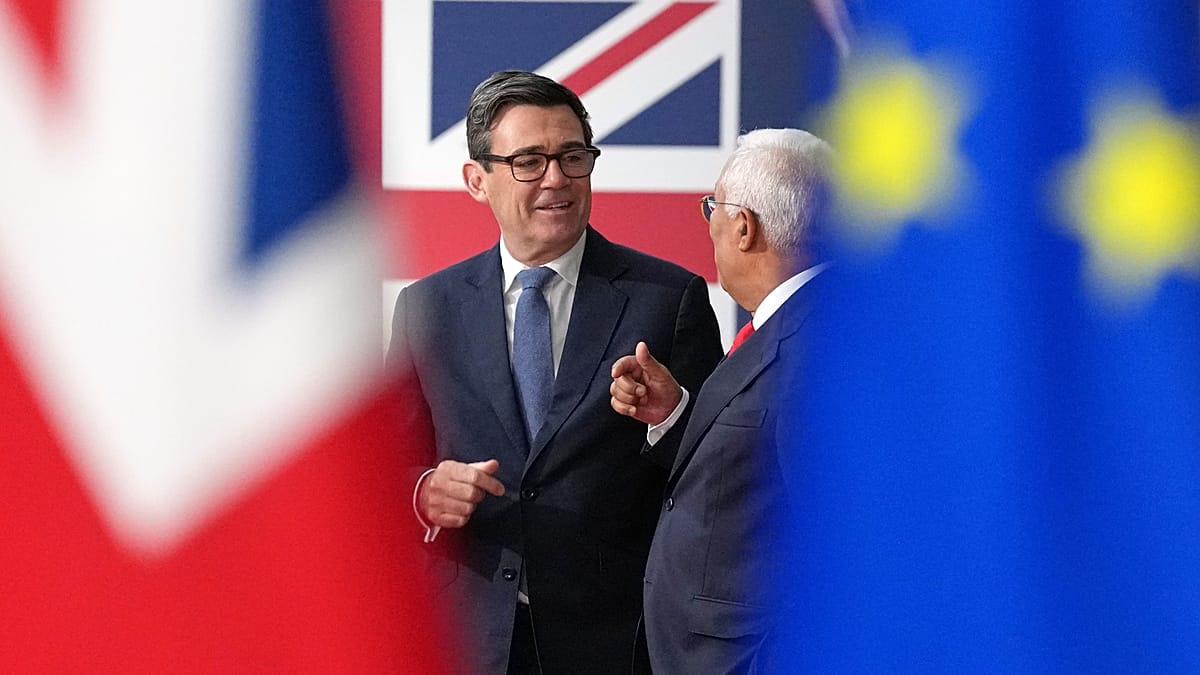
British Prime Minister Andy Burnham has secured the biggest breakthrough in relations with the European Union since Brexit. But after a landmark summit in Brussels on Friday, a more fundamental question remains: what kind of relationship does Britain ultimately want with its nearest neighbours? ADVERTISEMENT ADVERTISEMENT The second EU-UK summit since Brexit delivered a series of agreements covering food and agricultural standards, carbon markets and youth mobility. Yet for all the diplomatic fanfare, it also exposed the limits of rebuilding ties one deal at a time. "Today, we do draw a line on a decade of drift and division by reconnecting with old friends, by building a much more constructive relationship with our nearest neighbours and our largest market," Burnham told reporters. "This is a good day for Britain, and this is a good day for Europe." But is this as good as it gets? The case for closer cooperation has rarely been stronger. Donald Trump's unpredictable foreign policy, Russia's war in Ukraine and China's increasingly assertive trade agenda have given Britain and the EU powerful reasons to work together. London has taken a leading role in the Coalition of the Willing, which is preparing security guarantees for Ukraine in the event of a peace agreement with Russia. Britain is also part of the European negotiating team endorsed by EU leaders last week to ensure Europe's interests are represented in the peace talks. On security, the two sides are increasingly acting as partners. On trade and economic relations, however, the old Brexit arguments have proved harder to escape. The price of closer ties EU governments remain determined that Britain should not enjoy the benefits of membership without accepting the corresponding obligations. That principle has shaped every stage of the negotiations, even as both sides acknowledge the need for closer ties. “Difficult geopolitical circumstances call for keeping like-minded countries close,” an EU diplomat told Euronews. "But this does not mean compromising our interests." Indeed, some of Friday's agreements could still run into trouble over an unresolved dispute about university tuition fees. Brussels wants EU students to pay the same fees as their British counterparts, while London is offering a more limited reduction. British participation in the EU electricity market has also been left for further negotiations, with several member states demanding a UK contribution to the bloc's cohesion funds, which support poorer regions. Not everyone in Europe believes such a hard line is helpful. “We need to get out of the mindset that Britain needs to be punished. Let’s not concentrate on the past and revisit old arguments. Let’s focus on the future,” Finnish President Alexander Stubb said at the EU Enlargement Forum on Monday. The disputes underline a wider problem: negotiating individual agreements may deliver practical improvements, but each new deal risks reopening arguments over money, sovereignty and the balance of rights and obligations. Beyond the piecemeal approach Since moving into Downing Street from Greater Manchester's mayoral office in July, Burnham has been unusually forthright about Brexit's shortcomings. He has argued that leaving the EU failed to deliver its promised benefits, declared the existing relationship inadequate and even raised the possibility of Britain eventually rejoining the bloc. But while Burnham has been clear about what he wants to move away from, he has been less specific about what should replace it. Friday's summit appeared to mark a turning point. The Prime Minister himself acknowledged that the sector-by-sector approach was approaching its limits and said Britain would begin exploring more ambitious options for its long-term relationship with the EU. His government is preparing a ten-year plan for Britain, due to be published next month, setting out ambitions for economic growth, reindustrialisation and greater opportunities for young people. Burnham believes those goals cannot be separated from the country's relationship with Europe. He also proposed an informal brainstorming exercise with EU leaders over the coming year, ahead of the next summit, to examine what a more comprehensive settlement might look like. "What we are announcing today is probably the limit of what we can achieve in this Parliament, given what needs to be done to implement it," he said. "But we want to inform the Parliament after this one so that decisions can be taken about that long-term relationship." Crucially, Burnham has stopped short of committing himself to any particular destination. He insists the British public will ultimately decide how far the country should go. An open door, but on Brussels' terms The EU's response has been cautiously encouraging. European Council President António Costa made clear that Brussels would respect whatever course Britain chose, just as it had respected the 2016 referendum result. "We will equally respect whatever decision the United Kingdom takes about the future of its long-term relationship with the European Union," he said. "Of course, we follow with great interest the debate you have relaunched about our common future." European Commission President Ursula von der Leyen was similarly receptive, welcoming Burnham's willingness to consider the bigger picture and declaring Brussels open to brainstorming. But neither offered any indication that the EU would relax its fundamental principles, particularly the indivisibility of the single market's four freedoms and the balance between rights and obligations. The contrast with the treatment reserved for Canada is striking. Ottawa's proposal to become the bloc's first "associate member" was greeted with cheers and applause in the European Parliament in September. Despite German reservations about the terminology, Brussels moved quickly to offer Canada closer consultations at both political and technical levels. Britain, by contrast, had to fight for a much narrower concession: a so-called "decision-shaping" arrangement allowing British officials to participate in certain EU technical discussions where the UK is closely integrated with European rules, but without a vote. Burnham defended the arrangement on Friday, arguing that getting British experts back into the room was a significant step forward. London also welcomed language in the summit declaration on reciprocal market openness, which could help British manufacturers avoid being excluded from the EU's proposed "Made in Europe" preferences for public procurement. The fact that Friday's summit took place at all was itself a diplomatic achievement. Its prospects had been uncertain after Burnham replaced Keir Starmer in July. "Today's summit is the continuation of last year's summit and the work that we've been doing for the past year," an EU official said. "The idea today is very much to have concrete deliverables for the relationship and, of course, for our citizens." The immediate priority for both sides will be implementing Friday's agreements and settling the outstanding disputes over tuition fees and electricity market access. But the more consequential debate will unfold over the coming year, as Burnham sets out the options for Britain's longer-term future in Europe. For Brussels, the question is whether London is finally ready to define the relationship it wants, rather than continuing to negotiate its individual components. For Burnham, the challenge is greater still: turning growing public dissatisfaction with Brexit into a coherent political proposition without reopening all the divisions of the past decade. Friday's summit may have drawn a line under the acrimony of Brexit. But it has left the biggest question of all for another day: how close does Britain really want to get?
Burnham drew a line under Brexit at the EU-UK summit. But where does Britain go next?
Full Article
Original Source
Read the full article at Euronews →KhanList aggregates and links to publicly available news content. We do not host full articles from third-party sources. Always verify important information with original sources.