
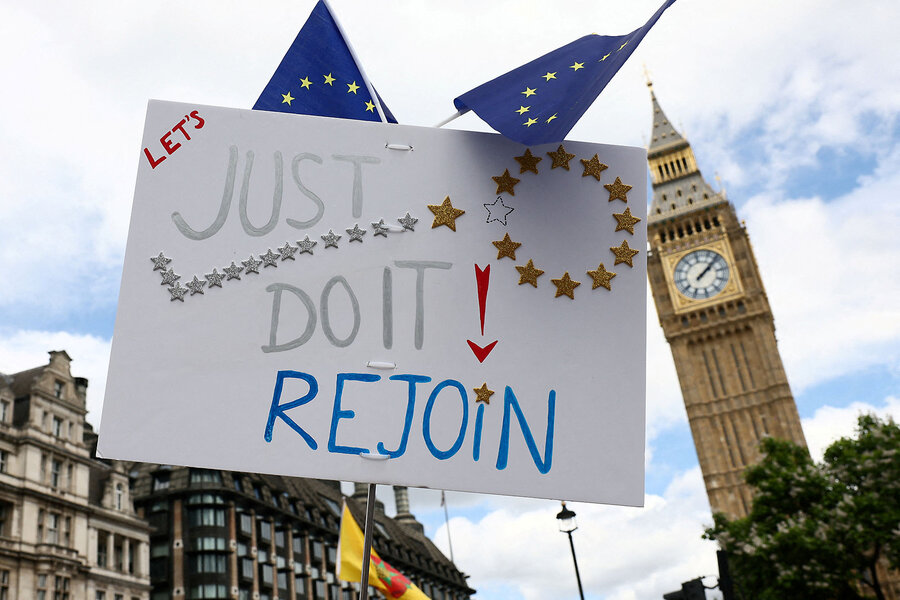
London | Nov. 19, 2026, 2:43 p.m. ET | 4 min read “Sunlit meadows!”That was the promise offered to millions across Britain a decade ago. All they had to do was vote to end their country’s 43-year partnership with their nearest neighbors – a so-called Brexit from the then 28-nation European Union.Brexit did win, narrowly, in June 2016. Its support was powered by a nationalistic, anti-immigrant “Make Britain Great Again” message with echoes of another campaign then underway: Donald Trump’s run for the U.S. presidency. Yet now, Britain is embarking on a very different debate. With polls finding a majority of Britons convinced that Brexit was a mistake, Prime Minister Andy Burnham last month broke a decadelong taboo for major-party leaders by saying it out loud, and raising the possibility of eventually rejoining the EU.And he’s due to meet EU leaders in Brussels on Nov. 20 for talks on efforts to smooth his country’s relationship with the bloc.The political tremors that’s causing, along with the practical obstacles to reversing Brexit, might also hold lessons for the United States, should a future president seek to revisit equally dramatic changes Mr. Trump has made to U.S. partnerships and alliances. The reason for the buyer’s remorse over Brexit has its roots in the referendum campaign.Britain’s two main parties – the Conservatives of then-Prime Minister David Cameron, and Labour, now under Mr. Burnham’s control – backed staying in the tariff-free EU. It was Britain’s main trading partner. Leaving, they argued, would be an exercise in economic self-harm.But the leading pro-Brexit voices – Boris Johnson, a Conservative dissident on the issue, and Nigel Farage, now head of the anti-immigration Reform UK – made a powerful, emotional pitch. Toby Melville/APFormer British Prime Minister Boris Johnson (at back) and Britain's Reform UK leader Nigel Farage attend the annual Remembrance Sunday ceremony in London, Nov. 8, 2026. It was Mr. Johnson who promised sunlit meadows. He and Mr. Farage presented Brexit as a potential “independence day,” freeing Britain from rules made by EU leaders whom British voters couldn’t hold to account.Above all, they said Brexit would slash immigration, by liberating Britain from the EU’s bedrock provision for free movement of people between its member states.Yet what detail they provided on a post-Brexit relationship with the EU was vague and reassuringly upbeat in equal measure. They projected confidence the EU would agree to trade terms broadly in line with pre-Brexit ones, and that Britain could also seal lucrative new trade deals globally. Ten years on, the sunlit meadows are looking distinctly cloudy. Britain’s economy is sputtering. Economists calculate its GDP is at least 4% below what it would have been without Brexit. Customs requirements and other paperwork have added costs, especially onerous for smaller British businesses.While free immigration from the EU is over, larger numbers have come in from non-European countries. And there’s a new, post-Brexit challenge: large-scale arrivals of migrants by boat across the English Channel from France. Jean-Francois Badias/APA group of migrants attempt to cross the English Channel in a dinghy off Neufchâtel-Hardelot, France, Sept. 23, 2026. Europe remains Britain’s largest trading partner. Yet in a changed world, Brexit advocates’ hopes of a major new trade deal with America haven’t panned out. Under Mr. Trump, not only the EU, but also Britain, have been hit by tariffs.There’s also a concern Britain could be frozen out of the EU’s response to the Trump administration’s loosening commitment to European alliances: a megafund set up to support military industries, and a “Europe first” procurement strategy aimed at avoiding overdependence on U.S. or Chinese products.Mr. Burnham’s immediate focus is on such near-term issues, and on reducing regulatory friction with Europe. He might also agree a limited version of free movement to facilitate short-term stays for British and EU young people.All these issues have been part of months-long talks about ways of improving British-EU relations that began under Mr. Burnham’s Labour predecessor, Keir Starmer, and have been intensifying ahead of the November 20 meeting in Brussels. But in the run-up to his talks with EU leaders, Mr. Burnham is also clearly aware of the pitfalls in a more fundamental rethink of Brexit. That’s one reason, since raising the idea of an eventual return to the EU, he has stressed he simply wants a serious national debate on the way forward. Any major steps would come only after the next election, now set for 2029, and would be put to voters in the campaign. Stefan Rousseau/PA/APBritain's Prime Minister Andy Burnham (at left) and President of the European Commission Ursula von der Leyen attend a bilateral meeting during the European Political Community summit in Dublin, Nov. 12, 2026. There’s already been pushback from pro-Brexit politicians: Mr. Farage has termed talk of restoring freedom of movement a “betrayal.”That has reinforced jitters in Mr. Burnham’s party, especially among legislators in constituencies that voted for Brexit.Their concern: Reopening the divisive referendum debate could be a gift to Mr. Farage, reinvigorating his anti-immigration message at a time when finance controversies have been deflating his position in the polls.There’s also a potentially even trickier obstacle. Before Brexit, Britain had secured a hefty reduction of its EU financial contributions, as well as opt-outs from key policy decisions it opposed, including participation in the bloc’s single currency, the euro.The EU’s remaining 27 members would have to agree on the terms of a British return, and it’s far from certain the old arrangement would be on offer.Recent surveys do show a majority of Britons in favor of applying to rejoin. But when one poll asked respondents whether they’d back reentry even if the old membership terms weren’t available, the figure dropped sharply: from 58% to a mere 35%. Deepen your worldviewwith Monitor Highlights.Politics with respectGet political stories with respectful analysis.There‘s a world of new ideas in everyBooks newsletter.There‘s more to life, enrich yours withCulture & Learning weekly.Follow humanity‘s discoveries withScience & Nature stories in your inbox.Gain a spiritual perspectivefrom the stories in your inbox.Want to understand the deeper impact of critical events? Learn the Monitor‘s insight.Already a subscriber? Log in to hide ads. There’s a cautionary message in all this – not just for Mr. Burnham, but potentially for America, if a future president moves to restore transatlantic bonds eroded under Mr. Trump.It’s that while breaking up is hard to do, getting back together might prove just as difficult. ALREADY A SUBSCRIBER? LoginReal news can be honest, hopeful, credible, constructive.The Christian Science Monitor was founded in 1908 to lift the standard of journalism and uplift humanity. We aim to “speak the truth in love.” Our goal is not to tell you what to think, but to give you the essential knowledge and understanding to come to your own intelligent conclusions. Join us in this mission by subscribing.
Burnham breaks Brexit taboo ahead of EU summit
Full Article
Original Source
Read the full article at Csmonitor →KhanList aggregates and links to publicly available news content. We do not host full articles from third-party sources. Always verify important information with original sources.