
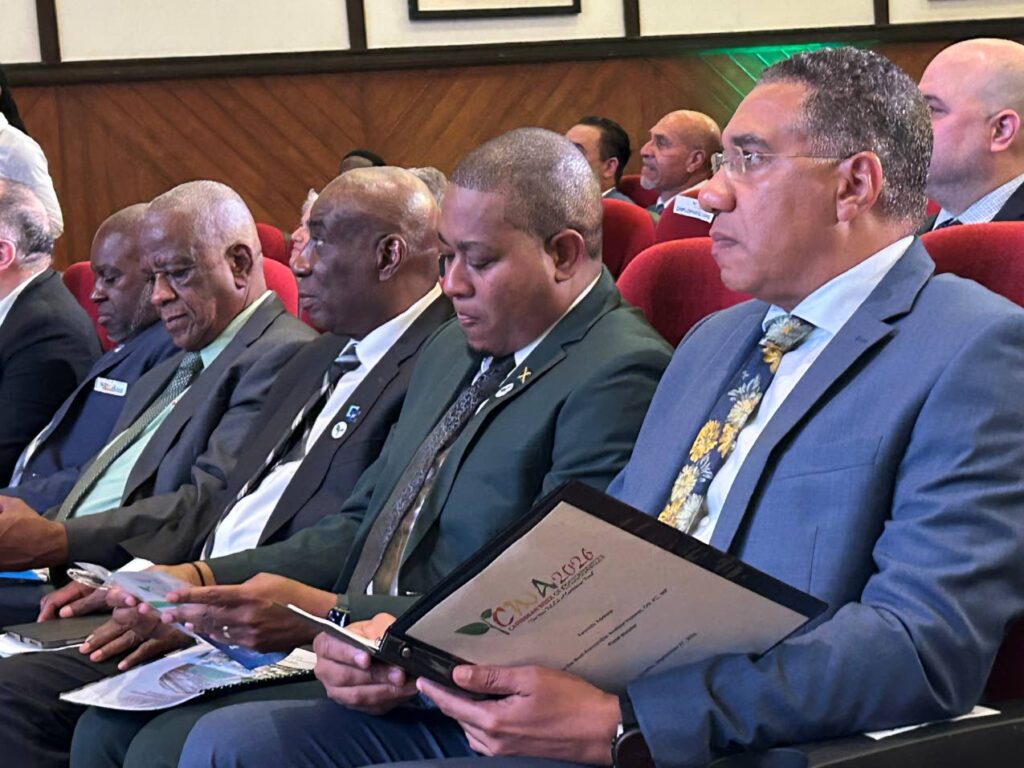
Prime Minister Dr Andrew Holness (right) and Minister of Agriculture Floyd Green (second right) among participants at the opening ceremony of Caribbean Week of Agriculture at the Ocean Coral Spring Hotel in Trelawny on Sunday night. (Photo: Horace Hines) CORAL SPRING, Trelawny — Prime Minister Dr Andrew Holness has urged regional governments to cut bureaucratic red tape which he says is slowing agricultural investment. According to Holness, cumbersome regulations are undermining efforts to modernise the agricultural sector and improve its competitiveness. Addressing the opening ceremony of Caribbean Week of Agriculture (CWA) at the Ocean Coral Spring Hotel in Trelawny on Sunday night, Holness said regional governments must become more responsive to investors seeking to introduce technology, controlled production systems, and modern equipment, particularly when such investments are capable of increasing agricultural output and efficiency. “My protest is not that we must not regulate. My protest is that we must be speedier, faster, more strategic in how we regulate,” Holness told delegates. He said investors could face delays as they navigate regulations governing the importation of seeds, livestock and equipment, at a time when agricultural enterprises need to move quickly. “I’m certain, as I’m speaking for Jamaica… by virtue of the nods that I’m seeing all around the room, that this is a common challenge across the region,” added Holness. He argued that the regulatory problem must be addressed alongside other measures aimed at raising productivity and lowering the cost of doing business. “The long-term competitiveness of our agricultural sector will depend increasingly on productivity,” said Holness as he charged that the region must generate greater yields, increase output per worker, use water and energy more efficiently, reduce post-harvest losses, and secure better returns on investment. The prime minister said regional governments could help achieve this through sustained spending on irrigation, mechanisation, research, technology, extension services, and infrastructure connecting farms with markets. But he underscored that public investment alone will not be enough to transform the agricultural sector. Holness called for a significant expansion of private-sector investment in agriculture, saying the region needs commercially viable projects capable of attracting long-term capital and creating stronger relationships among farmers, processors, distributors, and retailers. The prime minister also urged regional governments to work with private investors to establish long-term supply contracts that would give farmers greater certainty about their markets. Holness argued that the absence of dependable markets contributes to agriculture being viewed as a short-term and difficult-to-finance enterprise. Prime Minister Dr Andrew Holness delivering the keynote address at the opening ceremony of Caribbean Week of Agriculture at the Ocean Coral Spring Hotel in Trelawny on Sunday night. (Photo: Horace Hines) “The Government must be an instrumental partner alongside the private sector, in the establishment of a system of long-term supply contracts, where farmers can invest with the security of knowing there is a market for their products,” he said. Holness added that this year’s CWA programme provides opportunities for investors and agricultural enterprises to connect, including through investment opportunities being presented by the Jamaica Agro Investment Corporation. He said those opportunities must ultimately be converted into bankable ventures capable of generating sustained economic activity. The prime minister’s call for reform comes as Jamaica continues to rebuild its agricultural sector following the devastation caused by the Category 5 Hurricane Melissa nearly a year ago. He noted that farmers lost crops, livestock, equipment and infrastructure, while rural roads and irrigation systems were damaged and agricultural businesses disrupted. But Holness argued that the reconstruction effort should not simply seek to replace what was destroyed. “Yet our ambition must extend beyond restoring what was lost. We must use the reconstruction process to modernise our agriculture sector, improve its productivity, and strengthen its capacity to withstand future shocks,” he said. He pointed to irrigation as a critical area of investment, particularly amid increasingly unpredictable rainfall and the intense drought being experienced in much of the region at this time. Holness said the Government’s investments in three agro-parks, together with the Pedro Plains Irrigation Scheme, are expected to increase the proportion of Jamaica’s arable land under irrigation to more than 50 per cent. According to Holness, agriculture must also be repositioned as an attractive commercial sector for young people, with opportunities extending beyond traditional farming into agro-processing, logistics, packaging, marketing, distribution and agricultural technology. He further called for stronger links between agriculture and tourism, which he said generates significant demand for local produce, seafood and processed goods. But he cautioned that Caribbean agriculture cannot rely solely on domestic and tourism markets. CWA 2026, being held under the theme ‘The New Face of Caribbean Food Systems’, runs from September 27 to October 2 and has attracted about 670 delegates from 34 countries. Holness told the delegates that the real test of the regional gathering would be whether discussions translate into investment, commercial partnerships, and concrete reforms.
Bureaucracy choking agri-investments across the Caribbean, says Holness
Full Article
Original Source
Read the full article at Jamaicaobserver →KhanList aggregates and links to publicly available news content. We do not host full articles from third-party sources. Always verify important information with original sources.