
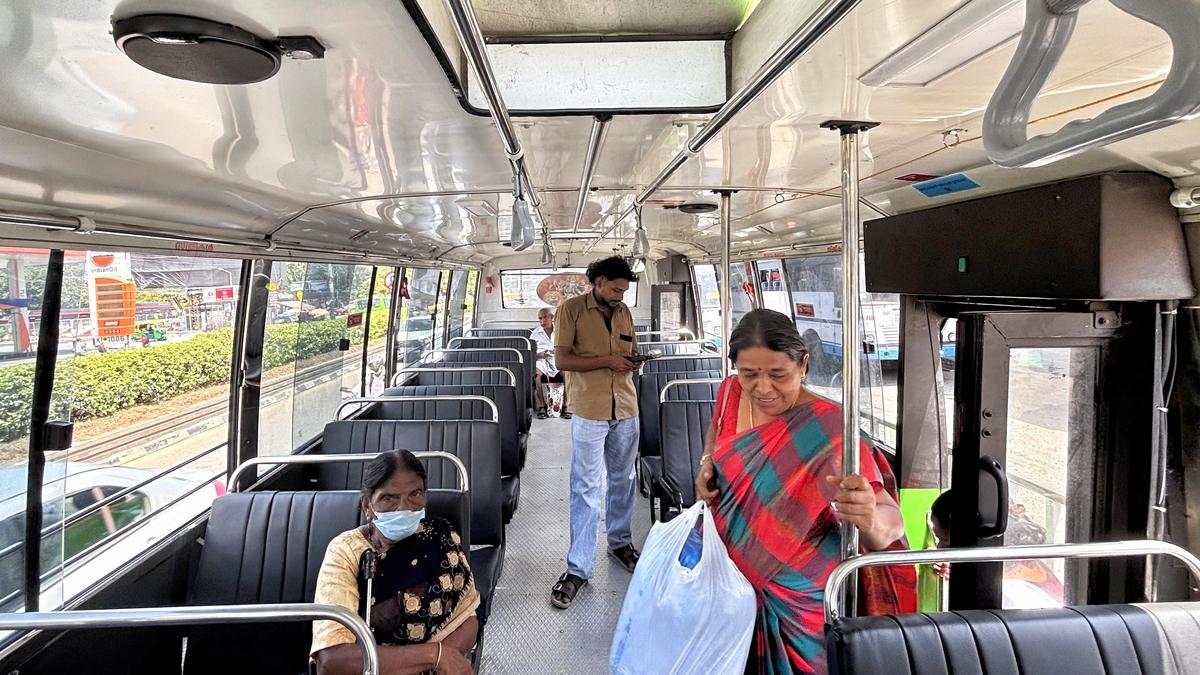
It was raining intermittently on a cloudy evening when a private bus on the Attingal–Venjaramoodu route entered the crowded Attingal private bus stand in Thiruvananthapuram in Keralam.Even before the engine fell silent, the bus crew spotted another bus at the stand—a service that, according to the route schedule, should have left the stand around 30 seconds ago. Within moments, a heated argument began between the crew of the two buses. The crew of the former bus alleged that the latter bus was eating into their business by deliberately delaying its departure and poaching passengers. After several minutes of heated exchanges, the latter bus finally left the stand, with only a handful of passengers. A private bus on the East-Fort to Nettayam route in Thiruvananthapuram parked adjacent to a Kerala State Road Transport Corporation bus at the East Fort bus stand. With the Keralam government introducing the Priyadarshini free travel scheme, the private bus operators claim that they are struggling to survive. | Photo Credit: NIRMAL HARINDRAN Though that confrontation ended there, another, milder altercation erupted inside the former bus. The owner-turned-conductor directed his frustration towards the driver. Throughout the journey, the conductor had repeatedly urged the driver to speed through the heavy evening traffic, skip some stops and ensure that the bus reached the stand on schedule.K.N. Rajesh (name changed), a middle-aged driver with around 22 years of experience at the wheel, said no amount of skill acquired over the years could have helped him beat the heavy evening traffic in the town and the delay was unavoidable. Yet, the bus had lost a handful of passengers as it arrived about 30 seconds late. The delay will cause a cascading effect on passenger numbers at nearly half the stops along the route, he says.“As bus workers, we try to avoid such situations. In our bid to maintain time and minimise losses, we may inadvertently commit minor traffic violations such as jumping a red signal at the last moment or skipping certain stops or services,” says Rajesh.The episode offers a glimpse into the daily dramas unfolding across Keralam’s public transport network, where intense competition, fuelled by dwindling revenues of private bus operators, has become commonplace. The situation has worsened since the State government introduced the Priyadarshini free travel scheme on Ordinary buses of the Kerala State Road Transport Corporation (KSRTC) for women and transgender persons on June 15, 2026.Janatha Sabu, a private bus owner and member of the Kerala Motor Transport Workers’ Welfare Fund Board, notes that the industry has been in the doldrums since the COVID-19 outbreak, with nearly a third of its passenger base switching to alternative modes of transport. The Priyadarshini scheme has now dealt another severe blow to the already struggling private bus industry, eroding more than 50% of its existing passenger base, observes Sabu.The resulting scramble for getting passengers has intensified competition and turned bus stands across the State into venues of frequent confrontations. The scheme, a poll promise of the United Democratic Front, has now emerged as a major success, with women passengers embracing the scheme. Transport Minister C.P. John says the scheme had facilitated an average 12.93 lakh free journeys a day in 100 days, entailing a financial liability of around ₹267 crore for the KSRTC.While acknowledging the scheme’s popularity, the private bus operators say they are not entirely opposed to it, even though it had severely affected their livelihood.700 private buses stop operationsT. Gopinathan, general secretary of the All Kerala Bus Operators Organisation, says that around 700 private buses had ceased operations during the first 100 days of the scheme. More than half of the buses still in operation are reportedly running reduced services and earning low daily revenues.“The State government should hike the minimum fare to ₹15 for all categories of passengers, along with an increase in student fares, to offset the losses suffered by private buses. Otherwise, the private bus sector will face a slow death,” says Gopinathan.Daily revenue has fallen by around ₹2,000 to ₹3,000 for private buses operating in southern Keralam, where KSRTC services are more extensive than in the central and northern parts of the State.Many operators are left with barely ₹500 to ₹1,000 in daily profit after meeting fuel expenses, employees’ wages and maintenance costs. Fuel prices alone have risen by around ₹9 a litre following the West Asia crisis, observes Sabu, who operates three buses.An interesting anecdote about Kerala’s private bus industry is closely intertwined with the State’s enduring tea culture. Sunil Kumar, owner of Saroma Travels, which once operated a fleet of 10 buses but now runs only four services in Thiruvananthapuram city, recalls the long-standing relationship between the price of a cup of tea and the minimum bus fare. “When I entered the industry in 1994, the minimum bus fare was ₹1, and a cup of tea too cost ₹1. By 1996, both had risen to ₹2, and they continued to rise together at regular intervals,” he recalls.Just before the introduction of the Priyadarshini scheme, the minimum private bus fare in Keralam was ₹10, so was the price of a cup of tea. But things changed after the West Asia war. While the tea prices rose to ₹15 across the State, the minimum bus fare remained unchanged despite a sharp increase in fuel prices and other operational costs, including price of spare parts and accessories.“Besides these increases, the State government’s free-travel scheme came as a body blow to the industry that has already been struggling to survive,” Kumar says.Private bus revenues have also failed to keep pace with the rise in the consumer price index over the years. The disparity is evident from the experience of Shaji, a bus owner and office-bearer of the Kerala Private Bus Federation. “Fifteen years ago, the minimum bus fare was ₹5, and a single bus generated ₹7,000-₹8,000 in revenue a day. Even today, buses on the most profitable routes earn only around ₹9,000 to ₹10,000 a day. The interesting part is that diesel that cost ₹35 a litre 15 years ago costs ₹104 today. The daily wage of bus crew has risen from ₹300 to around ₹1,100 during the same period,” explains Shaji.Long day, low wagesThe plight of bus crew members is even more distressing. An average crew member begins the day around 5 a.m., with most private buses starting services between 5.30 a.m. and 6.30 a.m. The workday often stretches until 9 p.m. or 10 p.m., making for 12-15-hour shifts.Crew members who once earned around ₹1,100 to ₹1,200 a day often receive only ₹700 to ₹800 on less profitable routes because of falling revenues.Rajesh G., who has worked as a private bus conductor on the Irinjalakuda-Triprayar route for the past 24 years, says the demanding work schedule bears little relation to the remuneration. “The only reason many of us continue in this profession is that we do not possess any other skills or means to support our families. During the COVID-19 pandemic, I tried selling lottery tickets on the streets to make a living, but the income was not enough to support my family. That eventually forced me back into the only profession I know,” Rajesh sighs.Happy womenOn the other hand, the latest turn of events has brought cheer to women across Keralam, although the major beneficiaries of the free-ride scheme are those in southern Keralam and parts of central Keralam. According to Deepa M., a native of Kallambalam and a private-sector employee, the scheme has been a boon, particularly for women working in low-paying jobs in textile shops, sales and other unorganised sectors. “Saving an average of ₹1,000 to ₹1,800 a month means a lot to an ordinary homemaker,” she feels.However, she points out that the scheme has its drawbacks too. “My son studies in a school in Sreekaryam, Thiruvananthapuram. He travels from Kallambalam to Sreekaryam, a route where KSRTC enjoys a virtual monopoly. Student concession is available only on KSRTC Ordinary buses, which are now overcrowded with women passengers, forcing him to travel on KSRTC Fast Passenger buses, which do not offer student concession. Whatever I save through the free-ride scheme is lost on my son’s daily commute,” Deepa says.The major grievance of private bus operators is the manner in which the State government implemented the scheme without introducing measures to shield the private bus sector from its adverse impact. The government could have extended the scheme to private buses as well. An income-based scheme applicable to both the KSRTC and private buses would ensure that economically weaker sections continue to receive the benefits while also supporting the student community, feel bus operators.“Such a model would reduce pressure on routes inadequately served by the KSRTC and enable the State to extend the benefit to people across Keralam by making optimum use of the existing public transport network,” feels Gopinathan.An expert committee headed by former Transport Commissioner K. Padmakumar has submitted a report to Chief Minister V.D. Satheesan recommending several measures to address the concerns of private buses numbering around 11,000, including according the sector industry status. However, private bus operators have rejected most of the recommendations, saying they do little to address their immediate concerns.The road ahead remains uncertain for the private bus operators.
Bumpy Ride: Private bus sector in Keralam staring at a crisis
Full Article
Original Source
Read the full article at Thehindu →KhanList aggregates and links to publicly available news content. We do not host full articles from third-party sources. Always verify important information with original sources.