
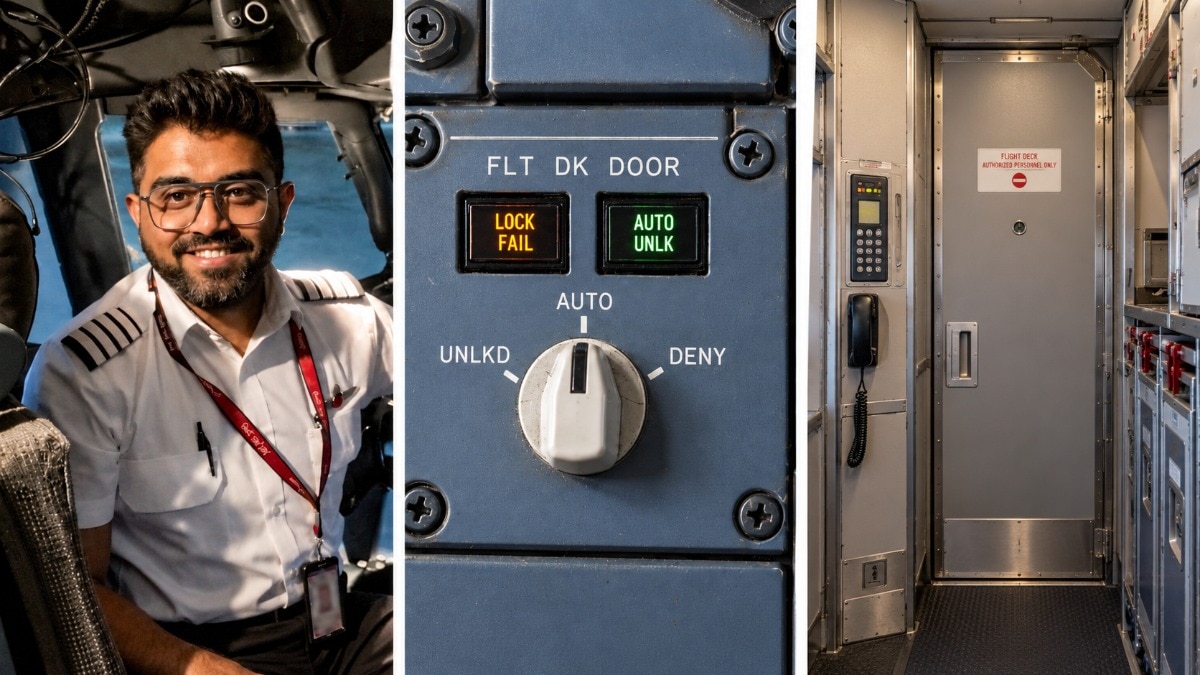
The turning point in last week's dramatic rescue of an Israel-bound flydubai flight, quite literally, was the twist of a doorknob. Captain Smit Machchhar, mortally wounded and bloodied after an axe attack by his co-pilot, dragged himself to the cockpit panel, reached for the knob and twisted it open. "I had that one last fight left in me," Machchhar told Israeli PM Benjamin Netanyahu on October 3. "If I don't do it, I'm going to die... and just went for the door and opened the door."Three passengers rushed into the cockpit and overpowered the radicalised Omani pilot and then one of the passengers levelled the plane before a backup pilot on board took over and landed the aircraft safely at Saudi Arabia's Tabuk airport an hour later.Captain Machchhar's heroic move was crucial because the rogue co-pilot Hamam al-Hamami was barring the entry of cabin crew. Cabin crew can punch in a keypad on the door from outside the cockpit to request access, but the pilots decide who can enter, by turning a three-position knob on the centre pedestal. The knob moves can move to 'unlock', 'normal' or 'deny'.Israeli news reports now suggest that al-Hamami intended to crash the aircraft into its eventual destination, the Ben Gurion Airport in Tel Aviv. This would make the September 30 flydubai incident the closest the world has come to a September 11, 2001-style attack, in which Al Qaeda pilot-hijackers stormed into four US airline cockpits, and crashed the jets into three landmarks, the twin towers of the World Trade Centre and the Pentagon, killing close to 3,000 people. POST-9/11 PROTOCOLSAl-Hamami's purported target is one of West Asia's busiest airports and handles 600 flights and around 100,000 passengers a day. It is likely that the rogue pilot would have aimed the jet at one of the busy terminals filled with passengers and docked aircraft, making it the first such attack in aviation history. Al-Hamami was protected by the cockpit doors reinforced to be bullet and blast resistant and to prevent forced entry -- all features introduced post 9/11. There was thus no way passengers and flight crew could have broken in to overpower him.Flying to Ben Gurion would have been tough for the rogue pilot. This is because shortly after the aircraft squawked a 7500 code indicating a hijacking, a series of precautionary post-9/11 measures had kicked in. Israel Air Force jets were scrambled. The airliner was being tracked by air traffic radars of at least three countries, and presumably, by IAF radars, as it dropped from 33,000 feet to 17,000 feet. The airliner was on the Saudi-Jordan border, an hour away from its destination, meaning IAF jets would be in visual contact of the airliner as soon as it crossed Israeli airspace. What would happen next is what countries like the US, Israel and India have practised in the years after 9/11: how to prevent hijacked airliners from being turned into guided missiles. In 2001, as the 9/11 attacks unfolded, US pilots were given unprecedented orders to decide for themselves whether to shoot down aircraft that threatened a city -- two US pilots even contemplated ramming their jets into hijacked aircraft because they had no ammunition.Under 'Falcon Virgo' exercises, the US now practises shooting down hijacked airliners several times a month. Exercises involve renting commercial jets piloted by 'hijackers' to simulate contingencies.The Indian Air Force has rehearsed similar contingencies after the Cabinet Committee on Security approved a policy on August 5, 2005 permitting the shooting down of hostile aircraft when there is conclusive evidence it will be used as a missile against strategic targets or dense populations. In India, the decision, however, is never that of the pilot's."The protocol is for our fighter jets to fly close to the hijacked airliner to watch what is going on in the cockpit. If we find there is some trouble going on inside the cockpit, we report back to the Prime Minister's Office (PMO). We would get clearance directly from the PMO to engage," says Group Captain Hemonto Panging Pao (retired). The former Su-30MKI commander's squadron rehearsed similar scenarios in 2008-09 when intelligence indicated a hijacked airliner would be used to target Bengaluru.Similar protocols exist in Israel. The 60-minute lag would have given the Israeli cabinet plenty of time to respond to the incident and authorise its pilots to take appropriate action. If the hijacked airliner disregarded warnings and continued to fly into Israeli airspace, the order to engage it would be given. The fighter jets would almost certainly have shot down the Boeing 737 Max 8 using cannons or missiles, killing all 174 passengers and six crew members.Fortunately for Israel and the world, none of this came to pass. Captain Machchhar summoned just enough strength to reach for the door knob, giving this story a heroic twist, and adding a glorious chapter in aviation history.- Ends
Built to prevent another 9/11, flydubai cockpit door nearly enabled one
Full Article
Original Source
Read the full article at Indiatoday →KhanList aggregates and links to publicly available news content. We do not host full articles from third-party sources. Always verify important information with original sources.