
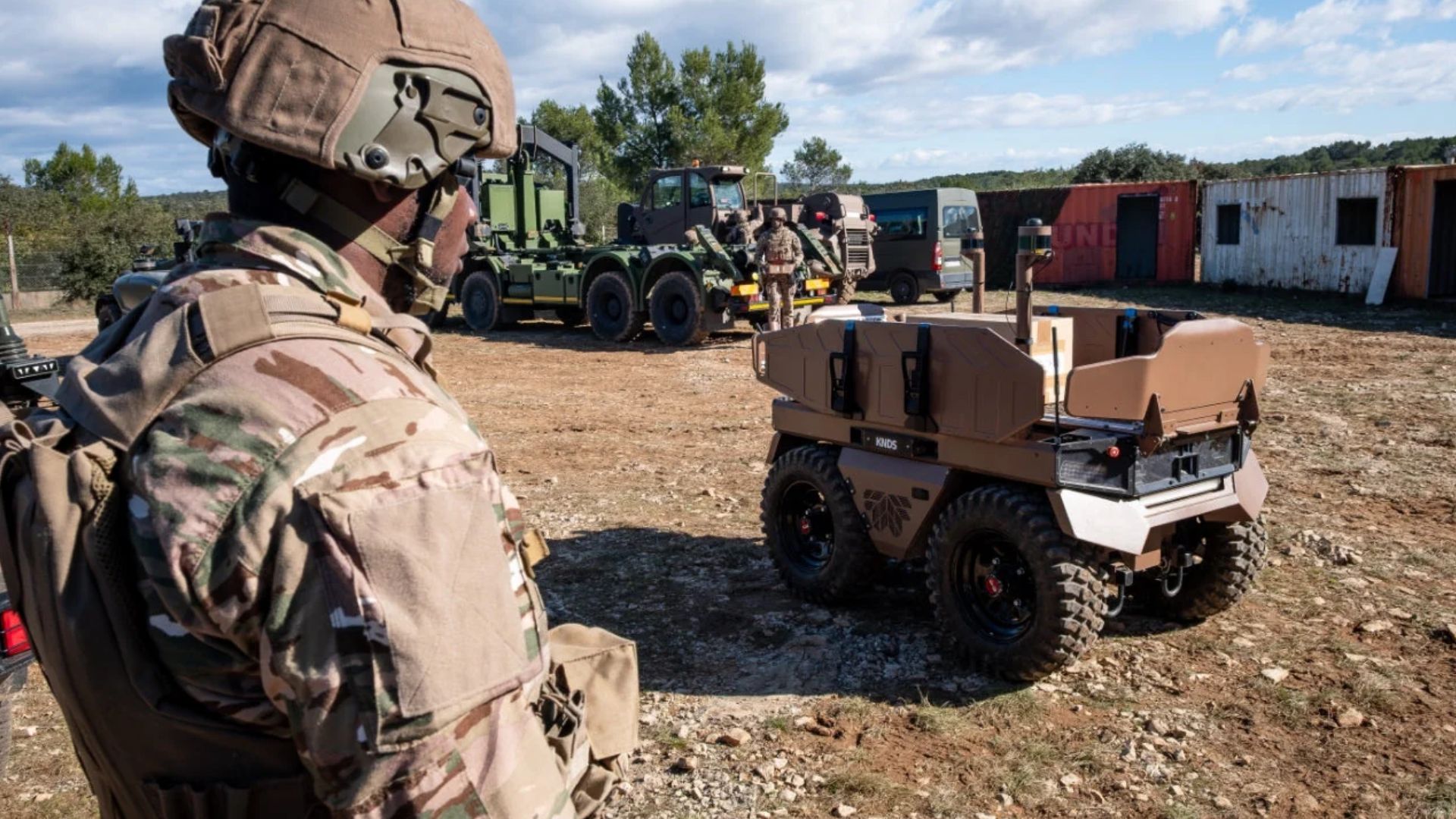
France’s Army Technical Section (STAT) has handed over the first of three KNDS-FORVIA robotic mules for field testing.CLAT Via XKey TakeawaysThe French Army’s Maintenance Brigade tested a new load-carrying unmanned ground vehicle during Exercise DOUMENC in November 2026, with two additional units scheduled to follow.Developed in just one year by defense contractor KNDS and automotive supplier FORVIA, the robotic mule progresses through three control tiers ranging from handheld remote operation to bounded autonomy.Designed to haul spare parts and infantry gear, the platform aims to lighten soldiers' loads and reduce human exposure to hostile fire during battlefield resupply and repair missions. The French Army has begun field trials of a new load-carrying unmanned ground vehicle (UGV) designed to haul heavy equipment and support battlefield maintenance crews without exposing soldiers to hostile fire. Handed over to the army’s Maintenance Brigade during Exercise DOUMENC in November 2026, the robotic mule represents the first of three vehicles slated for rapid evaluation. Developed in just one year through a partnership between Franco-German defense contractor KNDS and French automotive supplier FORVIA, the platform reflects a broader push by France’s armed forces to accelerate adoption of ground robotics. Rather than spending years perfecting a fully autonomous system before putting hardware in the field, military engineers are deploying the vehicle in stages so troops can train alongside unmanned machines immediately. Three-tier autonomy According to the French Army Technical Section, known by its French initials STAT, the initial evaluation took place during Exercise DOUMENC from November 7 to 11, 2026, in coordination with the Direction Générale de l’Armement (DGA) and the Logistics Brigade. Equipped with an open mesh cargo flatbed, the wheeled UGV is built to haul crates of spare parts, tools, and infantry gear across rugged terrain. The program is structured around three progressive levels of control. At the baseline tier, soldiers operate the vehicle directly using a handheld remote controller. At the second level, an integrated robotization kit allows a remote operator to steer the mule from a safe distance using live onboard camera feeds. At the third tier, the UGV navigates autonomously within operational boundaries defined by the KNDS and FORVIA system architecture. STAT described the trial as “a first concrete step” toward ground robotics that everyday soldiers can operate routinely. By gradually scaling from manual teleoperation to bounded autonomy, the army aims to reduce the physical load carried by troops while shielding mechanics and resupply teams from direct enemy fire. Civil tech drives defense robotics The pairing of KNDS and FORVIA highlights how European defense planners are tapping commercial automotive manufacturing to shorten development cycles. While KNDS brings heavy military vehicle engineering and combat robotics experience, having previously converted a legacy AMX-30 main battle tank into a remote-controlled platform using its TOXO robotization kit, FORVIA contributes high-volume automotive electronics, sensors, and chassis integration. Exercise DOUMENC itself carries symbolic weight for French military logistics. Named after Captain Aimé Doumenc, who organized motorized supply convoys along the Voie Sacrée during the 1916 Battle of Verdun, the 2026 drill serves as France’s national evaluation ground for modernizing combat sustainment. Toward unmanned ground fleet France’s army leadership has set a long-term goal of fielding battle-ready robotic units by 2040, with logistics and load-carrying mules serving as the practical entry point before armed ground systems enter service. Alongside the KNDS-FORVIA mule, STAT and French regiments have tested multiple unmanned platforms throughout 2026, including the hydrogen-powered Hermione UGV and compact forward-reconnaissance rovers. Two additional KNDS-FORVIA vehicles will join the Maintenance Brigade in upcoming trials to refine autonomous navigation and payload handling under realistic field conditions. Get the latest in engineering, tech, space & science - delivered daily to your inbox.Kaif Shaikh is a journalist and writer passionate about turning complex information into clear, impactful stories. His writing covers technology, sustainability, geopolitics, and occasionally fiction. A graduate in Journalism and Mass Communication, his work has appeared in the Times of India and beyond. After a near-fatal experience, Kaif began seeing both stories and silences differently. Outside work, he juggles far too many projects and passions, but always makes time to read, reflect, and hold onto the thread of wonder.
Built in just one year: French Army tests new robot mule to haul battlefield gear
Full Article
Original Source
Read the full article at Interestingengineering →KhanList aggregates and links to publicly available news content. We do not host full articles from third-party sources. Always verify important information with original sources.