
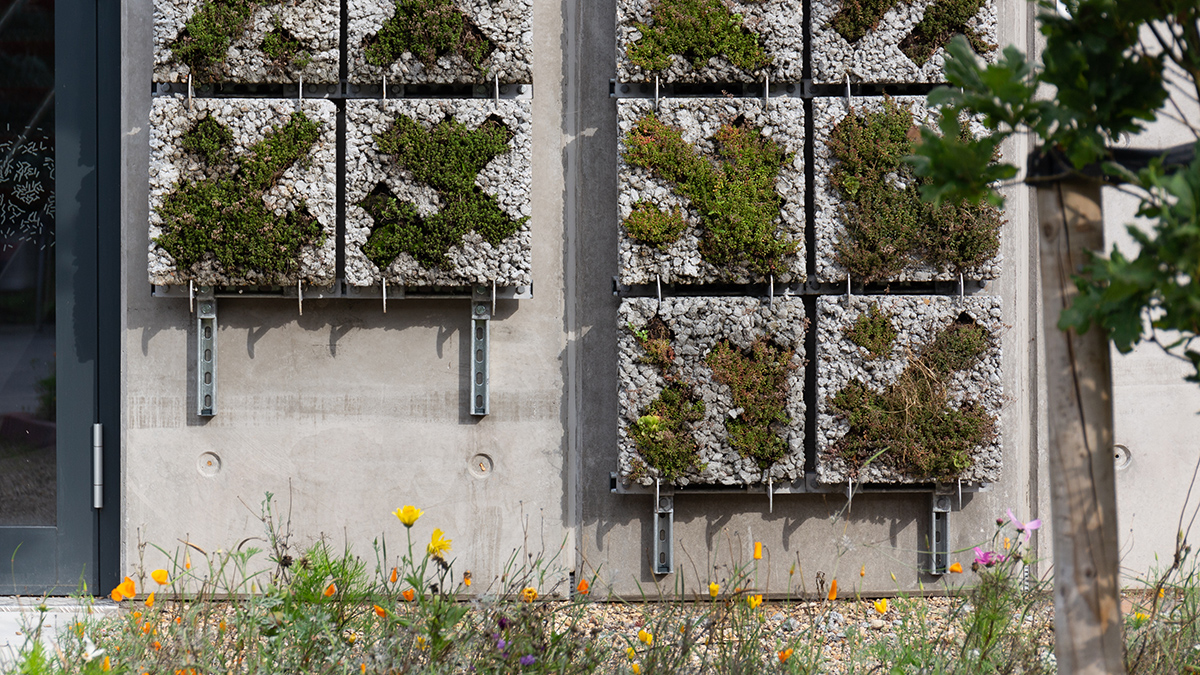
It’s a Tuesday morning in the year 2036. A maintenance worker arrives at your apartment to take a look at that crack in your kitchen wall. She carries no drywall, sealant, or fillers. Instead, she checks to see whether the friendly bacteria in the wall itself have started healing the fissure. Next, she leans out the window to see whether the moss coating in your living wall is still lush and able to filter out pollutants from the city air. Before leaving, she inspects the fungus-based acoustic paneling on your ceiling. Good news—it still blocks the sound of your neighbor’s loud music. This is the world of bioengineered living materials. There’s no denying that familiar building materials like concrete and asphalt are a massive success. They are highly practical and cheap to produce at scale. But they are not cost-free. Cracks can emerge in concrete even before the champagne is popped at a new building’s opening. Over time, water widens cracks and degrades supporting steel structures. The urban heat island effect means the dark, impervious surfaces commonly found on buildings and roads make cities hotter than the surrounding countryside. Concrete production accounts for around 6% of global greenhouse gas emissions, with most of those emissions linked to producing the cement that binds the material. Over the years, researchers have tried to make greener concrete by tweaking its chemical or physical properties. But genuinely alternative construction materials still haven’t penetrated the market at scale. That could change thanks to an emerging field: engineered living materials (ELMs). This new wave of construction materials is made using organisms such as algae, bacteria, and fungi. Proponents say ELMs can match conventional building materials (such as concrete, fiberglass, or wall paneling) for long-term resilience, while offering additional functionality and reduced environmental impacts throughout their life cycles. But displacing heavy industry will be no easy task. Picoplanktonics was an installation at the 2025 Venice Architecture Biennale that used a cyanobacteria-based ELM as an example of a large-scale structure. Credit: Valentina Mori/Biennale di Venezia Dormant Helpers: Living, Self-Healing Concrete One ELM gaining traction is self-healing concrete. A pioneer in this field is Henk Jonkers, a researcher at the Faculty of Civil Engineering and Geosciences at Delft University of Technology (TU Delft) in the Netherlands. In 2010, Jonkers led a study showing that adding bacteria and nutrients to a standard concrete mix allowed cracks to heal on their own. The healing happens through a biomineralization process known as microbially induced calcite precipitation (MICP). When certain types of bacteria metabolize nutrients, they produce calcium carbonate, the principal ingredient in limestone. In his experiments, Jonkers took advantage of MICP by mixing dormant bacterial spores into a concrete mixture. He observed that when a crack formed and moisture entered, the bacteria were activated and started precipitating limestone that filled the crack. These images show how ELMs can precipitate limestone that fills a crack into which moisture has penetrated. The process is called microbially induced calcite precipitation. Click image for larger version. Credit: Henk Jonkers/TU Delft An ELM project initiated by TU Delft used self-healing concrete for a local Dutch tramway. Credit: Henk Jonkers/TU Delft The initial MICP results published in academic journals were promising, but limited by time: The efficacy of the self-healing capabilities of the ELM-enhanced concrete seemed to shrink over weeks, and the concrete itself tended to crush the spores within it over more extended periods of time. Jonkers and TU Delft spun off the research into the private company Basilisk Self-Healing Concrete in 2014. Basilisk claims its ELM product can self-heal cracks up to 0.8 millimeter wide. The concrete has been successfully deployed in a range of international projects, including retaining walls on the Dutch railway network and a water treatment plant in Japan. Other researchers at TU Delft are now testing MICP on traditional lime-based masonry mortar. If successful, this mechanism could help repair traditional houses in places like the Dutch city of Groningen, where natural gas extraction induces mild earthquakes (up to about magnitude 3.4) that frequently damage structures. Grown, Not Poured: Replacing Construction Staples Entirely Researchers are also studying ELM use cases in which active bacteria (not dormant spores) immediately get to work in turning biomass into solid material. Because biomass is often industrial waste, this form of microbial production may also present an upcycling opportunity. One company using bacteria to turn biomass into finished goods is the start-up Cresco Biotech, a British company that works with academic partners to develop composite materials such as acoustic and thermal boards. The bulk of that composite material is biomass that includes industrial waste and agricultural by-products: hemp hurds, mining waste, and the fast-growing perennial grass Miscanthus. Like Basilisk, the ELM Cresco uses is a limestone-producing bacterium, which acts as a binder to hold the rest of the biomass together. “We want this [ELM] to be almost like a universal binder, where you can be at a local place and build a small facility there where a lot of the different waste gets aggregated,” said Cresco cofounder Ege Savas. A similar process has been suggested for growing construction materials on Mars. The nonprofit Pioneer Labs recently published a series of studies about a candidate microbe—a uniquely engineered version of a bacterium—that could be taken to the Red Planet and used to produce bioplastics, which could then be used as raw material for 3D printing a range of items from cups to cabins. Many planetary scientists are skeptical of this claim, but not of the underlying ELM process. “This microorganism, sPL.001, is not for terraforming Mars—it’s for making feedstock for 3D-printed houses,” Chris McKay of NASA’s Ames Research Center told Scientific American. Welcome to Fungus Town Back on Earth, another ELM generating buzz is mycelium, the root-like structure of fungi usually hidden beneath the soil. Scientists and engineers love mycelium because of its versatile properties. It grows fast, is flame-retardant and water-repellent, and has desirable acoustic qualities. Mycelium, the root-like structure of fungi such as mushrooms, is another ELM construction component researchers are experimenting with. Paper, rice, coffee grounds, orange peels, and foliage are some of the components of mycelium-based ELMs, seen here. Credit: Globa et al., 2025, https://doi.org/10.3390/biomimetics10090573 In the United States and several other countries, you can already buy mycelium-based leather alternatives, vegan burgers, and even coffins. That said, you’re unlikely to see a fungal skyscraper anytime soon. In its pure form, mycelium isn’t strong enough to be a structural material. The New York company Ecovative, which produces packaging and acoustic insulation, is experimenting with strengthening the material in different ways. In one way, mycelium acts as a binder for other organic materials in a substance called a mycelium composite. In another, the fungal tissue is harvested in sheets itself. In a recent study funded by DARPA (the Defense Advanced Research Projects Agency), Ecovative scientists even infused mycelium with a conductive polymer to make prototype computing chips. Though much less accurate than semiconductor-based systems, the authors say they are cheap and biodegradable enough for disposable uses, such as sensors that detect hazards or food spoilage. A challenge with mycelium is developing standardized and scalable ways to produce the material. To boost its aesthetic appeal, an Australia-Singapore research team grew mycelium composites with an array of textures, patterns, and colors. Other groups are exploring novel production techniques, like using textile meshes to grow large, robust mycelium structures in a variety of shapes. Alive at Point of Use Just as a wooden beam is not living, ELMs on the market tend to be dead or dormant at the point of use. Some use cases, however, call for a still-living component. Imagine you wanted a water-repellent building facade, for instance. Once dead, mycelium stops excreting the hydrophobic proteins that make it water-repellent. But so-called “dirty” ELMs maintain some living elements and would make a mycelium product desirable for such a nonsterile, real-world situation. One scientist working with dirty ELMs is Martyn Dade-Robertson, colead of the Living Construction group at Northumbria University in the United Kingdom. He coauthored a 2023 study showing how a leather-like form of mycelium could be engineered to self-heal when small holes were punched into it. Beyond Self-Repair: What Else Could Engineered Living Materials Do? Regulate heat and moisture. Mycelium composites or algae-and-bacteria biofilms in walls and coatings can passively regulate humidity and temperature, cooling ambient air by a few degrees in experiments.Sequester carbon dioxide. Algae or cyanobacteria in panels or coatings absorb carbon dioxide (CO2) via photosynthesis and store it as biomass; some bacteria can turn CO2 into solid carbonates.Treat waste. Buildings that process their own waste, for example, with biodigesters built into the plumbing.Purify water. Living layers grown into filtration structures that clean water as it passes through, some actively breaking down pollutants rather than just trapping them.Bioadapt surfaces. Coatings on conventional materials that let living things thrive, for example, a moisture-holding concrete layer that moss loves—helping to cool surfaces, hold rainwater, and filter air.Self-regenerate. Bricks that regenerate when cut and reseeded, so a single brick could in principle yield many.Resist fouling. Bio-based surfaces that stop algae and biofilm from taking hold—a well-known problem that adds drag to ship hulls, and can also damage building facades.Hybrid living structures. Concepts like Baubotanik, which blend plants and engineered structures, such as roofs and bridges, that combine trees with synthetic materials. To understand the mechanism, first picture a classic mushroom growing in soil. Its spores are contained in the cap of the fruiting body that pokes out above the surface. Wind or animals spread the spores, and new fungi grow elsewhere. But some fungi also reserve spores in the underground mycelium as a “backup plan” for when conditions are very bad. In the experiment, Dade-Robertson and colleagues first grew a leather-like mycelium and poked holes in it. Then, by dramatically reducing the nutrient supply, they forced the mycelium into an emergency state, awakening the backup spores. Once active, the mycelium began growing again and healed itself. “It was a very clear and beautiful little experiment,” Dade-Robertson said. “You just literally put a little bit of nutrient in the hole as a patch, and you had a completely healed structure.” Indeed, organisms are masters of tracking environmental conditions and responding to them. “The beauty of biology is that you’ve got a living cell sensing and recording some information, then you have a system, and it’s only a small step to acting upon it,” said Tom Ellis, a synthetic genome engineering and synthetic biology researcher at Imperial College London. Ellis believes this ability is what researchers should focus on when designing dirty ELMs. A building material might be designed, for instance, so that whenever heat stress exceeds acceptable levels, the living cell component releases a substance to cool or otherwise regulate its temperature. Stopping the Micro-Life from Escaping the Building As ELM research evolves, it is opening opportunities for geotechnical engineers, architects, biomedical engineers, and others. And if deployed at scale, it could transform blue-collar jobs such as building maintenance. “You have to think about your building being nurtured in the way that you would nurture a garden.” “You have to think about your building being nurtured in the way that you would nurture a garden,” explained Dade-Robertson. “Whether it has disease, whether it’s being outcompeted by invasive species, whether your neighbor’s house is growing onto yours, and all kinds of other things [that] as the technology develops become new issues that you didn’t envisage before.” Dade-Robertson was part of the team that created the OME, an experimental space at Newcastle University that is part of the Hub for Biotechnology in the Built Environment, where Dade-Robertson is codirector. The OME, which includes both a laboratory and a furnished apartment, allows Hub researchers to carry out experiments as well as investigate practical ways ELMs and other biotechnologies can be used and scaled. One of the experimental projects being researched by scientists at the OME is this bacteria-based ELM rainscreen cladding. Credit: Ben Bridgens, Hub for Biotechnology in the Built Environment The OME project brings together biotechnologists, engineers, materials scientists, designers, and architects. Current projects are investigating ELMs involving algae and mycelium. Scientists say interdisciplinary initiatives like this will be essential to considering practical realities and unforeseen consequences of ELM research and development. Bioethical guidelines, perhaps similar to AGU’s Ethical Framework for Climate Intervention, can also help establish codes of conduct for scientists, engineers, entrepreneurs, and policymakers engaging in the ELM space. Researchers are already investigating biosafety measures. These include genetic kill switches and the design of systems that can be easily deactivated by chemicals or temperature. Living in the Real World Jonkers said researchers and consumers should also be wary of hype and not assume that bio-based materials are automatically more desirable. “I tell my students, if you were bitten by a poisonous snake and you have 10 seconds left to live, would you be happy and say it doesn’t matter because it was bio-based?” Wood is a case in point. It might seem eco-friendly to create wood-based cities, and that can work locally, such as in regions of Scandinavia with local access to sustainable forestry. But converting forests into timber production forests without site-specific analyses would be incredibly damaging to biodiversity, planned communities, and carbon sequestration efforts. Scientists and entrepreneurs should not underestimate the financial challenge of breaking into the multitrillion-dollar construction industry. Even when biomaterials do offer clear advantages, Jonkers and other scientists said, scientists and entrepreneurs should not underestimate the financial challenge of breaking into the multitrillion-dollar construction industry, which is projected to keep growing steadily. The start-up investment in biomaterials is often steep; construction firms and their funders may be unwilling to pay the higher up-front costs to remediate cracks that won’t emerge for years. The main benefits of technologies like self-healing materials, therefore, may not be seen for decades. “You can’t be in competition with something that is not really a product, but a commodity,” said Savas, recognizing that ELMs are unlikely to compete in markets like general-purpose concrete and steel. Scaled to individual or community use, what ELMs could do is reduce greenhouse gas emissions as well as the need for toxic chemicals habitually used in maintenance, contribute to energy efficiency, and create more sustainable waste management systems. Bioengineered living materials are perhaps less a new industry than one aspect of a broader movement to green our cities. Author Information James Dacey (@JamesDacey), Science Writer Citation: Dacey, J. (2026), Building the cities of tomorrow with living materials, Eos, 107, https://doi.org/10.1029/2026EO260351. Published on 2 November 2026. Text © 2026. The authors. CC BY-NC-ND 3.0Except where otherwise noted, images are subject to copyright. Any reuse without express permission from the copyright owner is prohibited.
Building the Cities of Tomorrow with Living Materials
Full Article
Original Source
Read the full article at Eos →KhanList aggregates and links to publicly available news content. We do not host full articles from third-party sources. Always verify important information with original sources.