
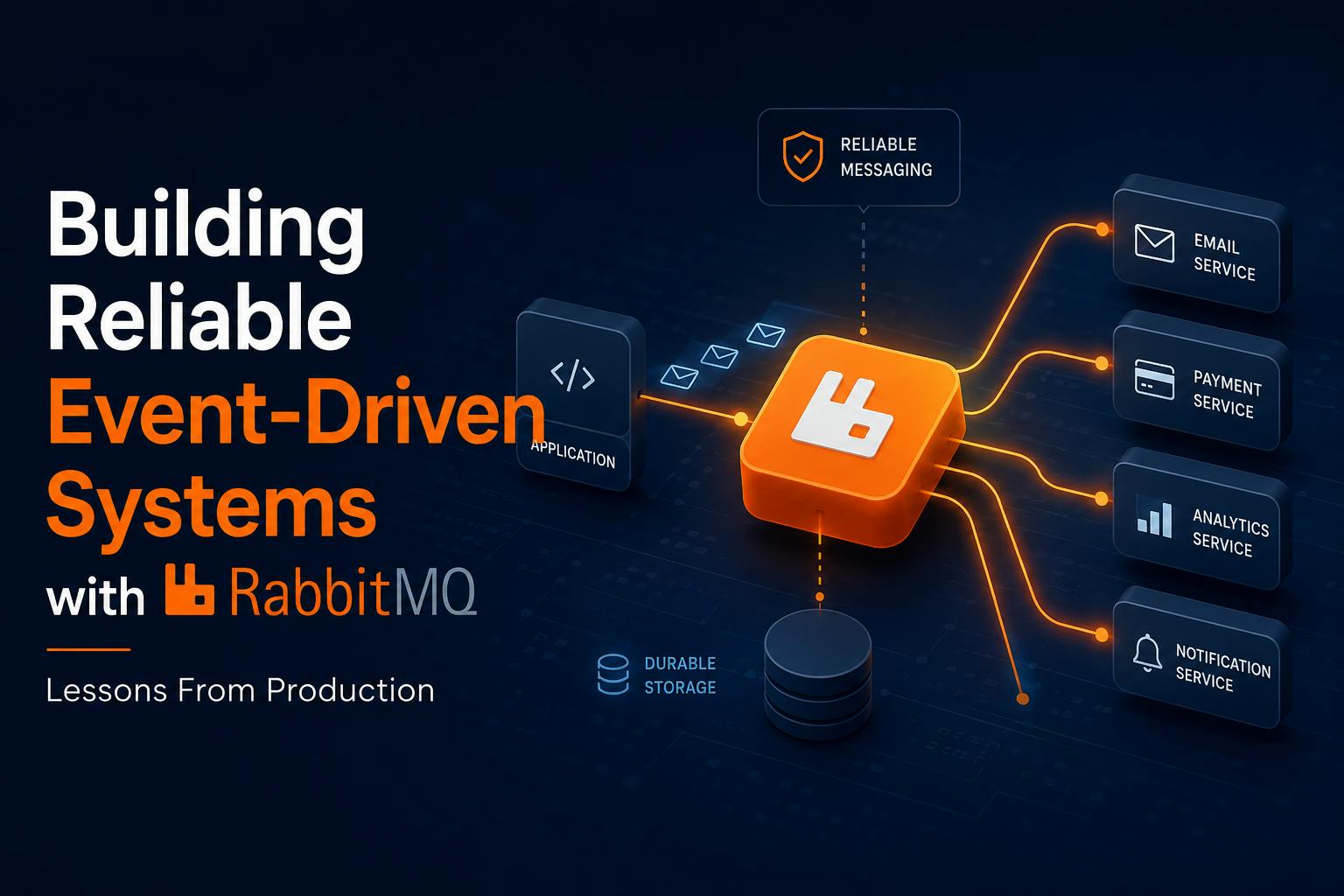
Building Reliable Event-Driven Systems with RabbitMQ: Lessons From ProductionBuilding a distributed system is relatively straightforward when everything works as expected. The real engineering challenge begins when services fail, messages are delivered more than once, consumers restart halfway through processing, or traffic suddenly increases.Over the years, I have worked on systems where synchronous communication was sufficient at the beginning but became increasingly difficult to maintain as the application grew. One approach that has worked particularly well for separating responsibilities and improving resilience is event-driven architecture.RabbitMQ has been one of the tools I have used to implement this pattern.In this article, I want to go beyond simply showing how to publish and consume a RabbitMQ message. Instead, I'll discuss some of the architectural decisions that matter when RabbitMQ becomes part of a production system.The Problem With Doing Everything SynchronouslyConsider an API responsible for processing an order.A simple implementation might look like this:Client | v API | +----> Save Order | +----> Process Payment | +----> Send Email | +----> Update Analytics | +----> Notify External Service | v Response This architecture can work perfectly well for a small application.The problem is that the request now depends on several operations succeeding.If the email provider takes three seconds to respond, the user waits.If the analytics service is unavailable, we have to decide whether the entire request should fail.If an external service becomes slow, that latency can propagate back through our API.More importantly, many of these operations don't actually need to happen before responding to the user.This is where asynchronous processing becomes useful.Instead of asking the API to perform every operation directly, it can complete the critical transaction and publish an event describing what happened. +--> Email Consumer | API --> RabbitMQ +--> Analytics Consumer | +--> Notification Consumer The API no longer needs to know how each downstream operation is implemented.It simply communicates:OrderCreated or:PaymentCompleted Consumers decide what should happen next.That separation is one of the biggest advantages of event-driven architecture.RabbitMQ Is Not Just a Background Job QueueIt is easy to introduce RabbitMQ as simply:"Put slow work in a queue."That is useful, but it misses an important architectural benefit.A message broker can become a boundary between services.Imagine a payment service successfully processes a transaction.Without messaging, it might directly call several services:Payment Service | +--> Notification Service +--> Accounting Service +--> Analytics Service The payment service now knows about all three systems.Adding another downstream requirement means modifying the payment workflow again.With events, the relationship changes.Payment Service | v PaymentCompleted | v RabbitMQ / | \ / | \ v v v Email Accounting Analytics The payment service only needs to publish the fact that the payment completed.This reduces coupling and makes it easier for the system to evolve.But introducing a message broker also introduces a new class of problems.Assume Messages Will Be Delivered More Than OnceOne of the most important lessons when designing message consumers is simple:Never assume a message will only be processed once.Suppose a consumer receives:{ "event": "payment.completed", "paymentId": "pay_123", "amount": 250 } The consumer processes the payment successfully.Before it acknowledges the message, however, the process crashes.RabbitMQ doesn't know that the business operation completed. From the broker's perspective, the message was never acknowledged.It may therefore deliver it again.If processing that message means crediting an account, creating an invoice, or triggering another payment operation, duplicate processing can become a serious problem.The consumer should therefore be designed to be idempotent.Conceptually:Receive message | v Has event already been processed? | +--+--+ | | Yes No | | Ignore Process | v Record event ID | v ACK A simple implementation might associate every event with a unique identifier:{ "eventId": "evt_8912", "event": "payment.completed", "paymentId": "pay_123" } Before performing the operation, the consumer checks whether evt_8912 has already been processed.This small architectural decision can prevent extremely difficult production bugs.Acknowledgements Should Follow Successful ProcessingRabbitMQ acknowledgements tell the broker that a message can safely be removed.That means the order of operations matters.A dangerous pattern is:Receive | v ACK | v Process If the consumer crashes after acknowledging but before completing the operation, the message can be lost.A safer flow is:Receive | v Validate | v Process | v Persist result | v ACK If processing fails before the acknowledgement, RabbitMQ can retry or reroute the message depending on the queue configuration.This gives us at-least-once delivery, but it is also why idempotency becomes so important.Retries and idempotency should generally be designed together.Not Every Failure Should Be Retried ForeverRetries are useful for transient failures.For example:Connection timeout Database temporarily unavailable External API returns 503 Retrying those operations may succeed later.But imagine receiving:{ "userId": null, "email": "invalid" } If the consumer requires a valid user ID, retrying the same message indefinitely will accomplish nothing.The message itself is invalid.Without a strategy for these failures, one problematic message can repeatedly cycle through the system.A better approach is to introduce controlled retries and a dead-letter queue (DLQ).Main Queue | v Consumer | Failure | v Retry Queue | +----> Retry | Maximum attempts reached | v Dead Letter Queue The DLQ provides somewhere for messages to go when automated recovery is no longer appropriate.Those messages can then be inspected, monitored, corrected, or replayed.Exponential Backoff Prevents Retry StormsAnother mistake is retrying failed operations immediately.Imagine an external API becomes unavailable and 5,000 queued messages depend on it.If every failed message retries immediately, we can unintentionally generate thousands of additional requests against a service that is already struggling.Instead, retries should generally introduce increasing delays.For example:Attempt 1 -> immediate Attempt 2 -> 5 seconds Attempt 3 -> 30 seconds Attempt 4 -> 2 minutes Attempt 5 -> DLQ The exact strategy depends on the application, but the principle remains the same:Failure handling should reduce pressure on unhealthy dependencies, not increase it.Keep Messages FocusedAnother architectural decision is determining what information should be placed inside an event.Suppose we publish:{ "event": "user.created", "userId": 42 } A consumer may then need to call the user service to retrieve additional information.Alternatively, we could publish:{ "event": "user.created", "userId": 42, "firstName": "John", "email": "john@example.com", "country": "UK" } Now the consumer may be able to process the event independently.There is no universal answer here.Publishing too little information can create additional network dependencies.Publishing too much information increases payload size, duplicates data, and can expose information consumers don't need.I prefer designing events around the information required to describe the business event while being deliberate about sensitive or rapidly changing data.Separate Business Events From CommandsAnother distinction that becomes valuable as systems grow is the difference between an event and a command.A command says:SendWelcomeEmail It asks another component to perform an action.An event says:UserRegistered It describes something that has already happened.That difference affects coupling.If a user service publishes SendWelcomeEmail, it knows that an email needs to exist.If it publishes UserRegistered, multiple consumers can independently react:UserRegistered | +--> Welcome Email | +--> Analytics | +--> CRM Sync | +--> Audit Log The producer does not need to know which consumers exist.For systems that need to evolve over time, that can be extremely valuable.Don't Forget ObservabilityAsynchronous systems are harder to debug than synchronous ones.In a traditional request:Client -> API -> Database -> Response the execution path is relatively easy to follow.In an event-driven system:API | v Queue | v Consumer A | v Another Queue | v Consumer B an operation may cross multiple processes and machines.Without proper observability, investigating a failed workflow becomes difficult.At minimum, I like events to carry identifiers that allow related operations to be connected:{ "eventId": "evt_8912", "correlationId": "req_7821", "event": "payment.completed", "timestamp": "2026-08-26T10:30:00Z" } Structured logs can then include the same correlation ID:correlationId=req_7821 This makes it possible to trace the lifecycle of a business operation across services.Metrics are equally important.For critical queues, I want visibility into things such as:queue depthprocessing rateconsumer failuresretry countsdead-letter messagesmessage processing durationA growing queue can be an early indication that consumers cannot keep up with producers.Scaling Consumers Is Usually StraightforwardOne advantage of queue-based processing is the ability to scale consumers independently.If one consumer can process 100 messages per second and incoming traffic grows beyond that capacity, additional consumers can be introduced. +--> Consumer 1 | RabbitMQ -----+--> Consumer 2 | +--> Consumer 3 This works particularly well in containerized environments where consumers can be scaled horizontally.However, increasing consumer count isn't always the solution.The database or downstream API may become the actual bottleneck.Scaling from 5 consumers to 50 consumers is counterproductive if all 50 are competing for the same constrained database connection pool.Queue depth therefore needs to be interpreted alongside downstream capacity.RabbitMQ Doesn't Remove Complexity — It Moves ItEvent-driven architecture can make systems more resilient and easier to scale, but it is not automatically simpler.With synchronous communication, we reason primarily about requests and responses.With asynchronous communication, we also need to reason about:duplicate messages message ordering retries dead-letter queues consumer failures event schemas eventual consistency observability backpressure That additional complexity should be justified.I wouldn't introduce RabbitMQ simply because an application uses microservices.For many systems, a synchronous API and a well-designed database are perfectly sufficient.Messaging becomes valuable when there is a genuine need for asynchronous processing, service decoupling, independent scaling, resilience against temporary downstream failures, or event-driven workflows.Final ThoughtsThe most important lesson I've learned from working with RabbitMQ is that publishing and consuming messages is the easy part.The difficult part is designing what happens when things go wrong.A production-ready messaging architecture should answer questions such as:What happens if this message arrives twice?What happens if the consumer crashes after updating the database?How many times should a failed operation be retried?Where do permanently failed messages go?How do we trace one operation across multiple consumers?What happens when producers generate messages faster than consumers can process them?If those questions are considered early, RabbitMQ can provide a strong foundation for building resilient distributed systems.If they are ignored, the message broker can simply move complexity from one part of the architecture to another.The goal isn't to make a system asynchronous.The goal is to use asynchronous architecture where it gives us better reliability, scalability, and separation of responsibilities.
Building Reliable Event-Driven Systems with RabbitMQ: Lessons From Production
Full Article
Original Source
Read the full article at Hackernoon →KhanList aggregates and links to publicly available news content. We do not host full articles from third-party sources. Always verify important information with original sources.