
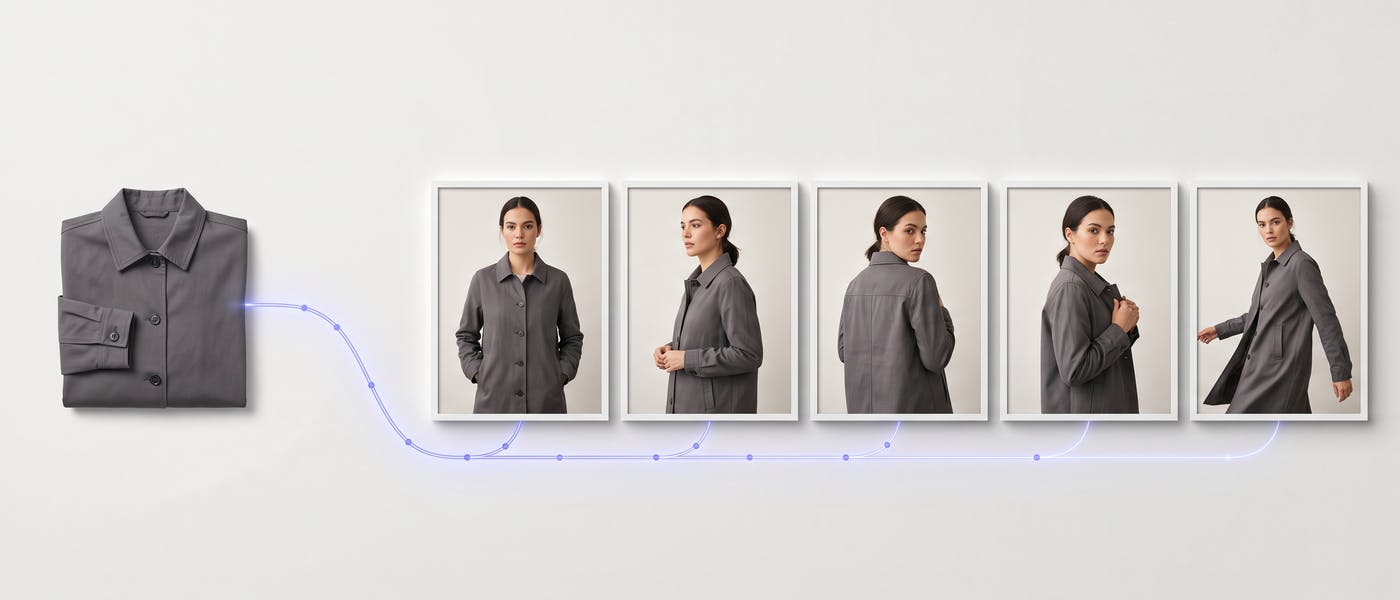
Fashion e-commerce has a content problem that does not look like a content problem until you try to scale it. Every SKU needs a packshot, an on-model shot, often several poses, and is refreshed every season. The traditional answer is a studio: models, a photographer, a stylist, retouching, and a turnaround measured in weeks. That works for a lookbook. It falls apart at ten thousand SKUs a month.Generative image models look like an obvious fix, and for a demo they are. The hard part is not making one nice picture. A product listing is not one image, it is a set, usually around five: different poses and angles of the same item. Those images are shown side by side on the same page, so they have to agree with each other at the pixel level. The same garment down to the stitching, the same model identity, the same lighting, the same background colour, frame after frame. Because the customer sees them together, any discrepancy stands out immediately. This is the problem we have spent our time on, and the interesting engineering is almost entirely about constraints, not creativity. Why naive generation fails for fashion If you hand a garment photo to a general text-to-image model and ask for an on-model shot, you usually get something plausible and wrong. The silhouette drifts. A three-button jacket comes back with two buttons. A knit loses its weave. A logo turns into abstract mush. For a moodboard, none of this matters. For a product detail page, it is a returns problem and a trust problem, because the customer is buying the exact item in the photo. So the first design decision is that the garment is not a prompt. It is a hard constraint. The pixels of the real product, the stitching, the print, the fabric texture, the fit, have to survive the generation step intact. Everything else (the model, the pose, the background, the lighting) is what you are allowed to synthesise. Framing it that way turns an open-endedgeneration task into a much more tractable and testable transformation problem. The pipeline, not the model The model is one component. What actually ships product imagery is a pipeline with a few distinct stages, each of which you can measure and regression-test on its own: Ingest and normalise. Accept whatever brands already have: flat-lays, packshots, existing PDP images, at mixed resolutions and aspect ratios. Normalise colour space and resolution so downstream stages get predictable inputs. Garment isolation and preservation. Identify the garment region and lock its detail so it is carried through generation rather than re-imagined. This is the stage that decides whether the output is usable or just pretty. Identity. Choose the model. Either a fixed library identity or a brand-owned digital twin built from a reference photo, so the same face and body are reusable across a catalogue instead of a new stranger in every shot. Composition and generation. Place the preserved garment on the chosen identity in the requested pose and setting. Consistency and QC. Verify the output matches the source garment and the rest of the set before it is allowed out. Treating each stage as a separate, observable unit is what makes the system debuggable. When an output is wrong, you want to know *which* stage drifted, not stare at a black box. Consistency is the real product The metric that matters is not "is this image good" but "do these five images of the same product agree with each other." They land on one page as a set, so the eye compares them directly. A customer scrolling a PDP will forgive a lot, but not a jacket that changes shade between the front and back shot, or a model whose face drifts from pose to pose. So consistency has to hold across four axes at once: garment detail, model identity, lighting, and background colour, all pinned across every pose and angle in the set. That has to be engineered deliberately: stable identities that are addressable and reusable, deterministic handling of the preserved garment region, and lighting and background colour that are fixed rather than left to the sampler. It is closer to a rendering-consistency problem than a creative one. If you are building anything similar, budget more time for the consistency and verification layer than for the generation model itself. That is where the credibility of the whole output lives. Make it an API, because the value is in the automation A web tool that produces one image at a time is a nice demo and a bad fit for how a catalog team actually works. Their images live in a PIM or a DAM, feed a shop platform, and get regenerated whenever a line changes. The only version of this that survives contact with a real operation is a programmable one. That means a proper interface: submit a job (a folder of garments, a chosen identity, output settings), get back a job id, poll or receive a webhook, and pull results as a batch. Idempotent jobs, retriable failures, and predictable output naming matter more than any single clever feature, because someone is going to wire this into a nightly pipeline and never look at a UI again. What I would take away if I were building this Constrain first. Decide what must be preserved exactly and treat it as immovable. The quality of the output is mostly decided before the generative step runs. Split the pipeline into observable stages. You cannot fix drift you cannot locate. Optimise for consistency, not single-image wow. Catalogues are judged as sets. Ship an API early. Batch, jobs, webhooks, and idempotency are what turn a model into a content pipeline a team can rely on. None of this is specific to fashion. Any domain where generated media has to match a real-world source (product photography, real estate, technical documentation) hits the same wall: the model is the easy 20 percent, and the constraint, consistency, and integration layer is the other 80. That is the part worth building carefully.
Building Consistent AI Fashion Imagery for Product Catalogs
Full Article
Original Source
Read the full article at Hackernoon →KhanList aggregates and links to publicly available news content. We do not host full articles from third-party sources. Always verify important information with original sources.