
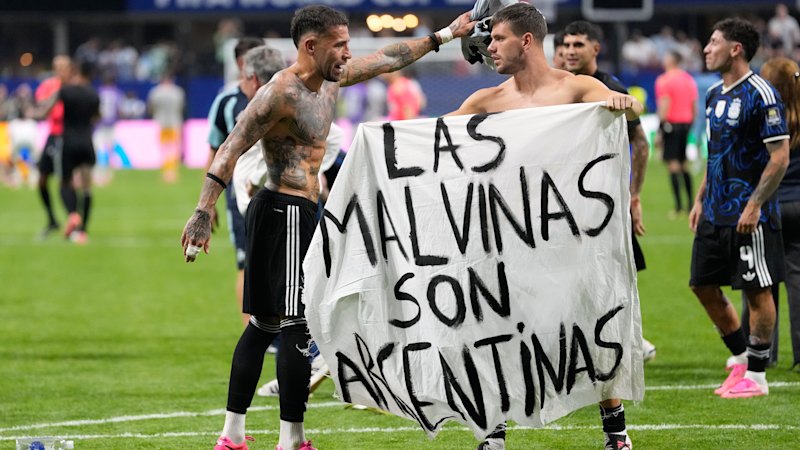
London: Britain has hit back at Argentina over a contested claim to the Falkland Islands in an escalating argument that includes calls to build up the Royal Navy more than four decades after the two nations went to war.The British government dismissed the rival claim after public anger at Argentine players who ran onto the field after their World Cup semi-final with a banner declaring their country owned the islands.Giovani Lo Celso and Nicolas Otamendi hold the banner.AP Photo/Rebecca BlackwellThe taunts from the Argentine players came moments after their team defeated England 2–1 on Wednesday (Thursday morning AEST), setting up a World Cup final between Argentina and Spain on Sunday (Monday morning AEST).“The World Cup might not be ours, but the Falkland Islands definitely are,” said a spokesperson for Prime Minister Keir Starmer.While government officials have sought to be diplomatic, the anger in London has turned the football match into a geopolitical argument.Reform UK leader Nigel Farage, whose party leads public polling, linked the war with the football shortly before the match began, posting on social media: “Let’s do it all over again just like 1982.”In the wake of the defeat on the field and the Argentine banner-waving, Farage called for more spending on the military.“Whilst I am disgusted at the behaviour of some Argentinian players last night, the most important thing to do is build up the Royal Navy quickly,” he posted.Conservative Party leader Kemi Badenoch also took a firm line against the Argentine claims.“The Falkland Islands are British. The Conservatives will always defend them,” she said.While the dispute is making headlines in Britain because of the World Cup, the government’s concerns are founded on renewed claims from Argentine President Javier Milei, a right-wing leader often praised by US President Donald Trump.Argentina’s President Javier Milei and US President Donald Trump during the Board of Peace signing ceremony at the World Economic Forum in January.BloombergThe US Department of War has canvassed a policy shift to reconsider the British title to the islands, according to a leaked memo reported by Reuters in April.The policy options were prepared by Elbridge Colby, the Pentagon’s under-secretary of defence for policy, and were shaped by his frustration that the UK and other allies did not agree to US requests for aid in the war against Iran, Reuters reported.Combined with the Trump administration’s strong support for Milei, including a $US20 billion ($28.6 billion) currency swap that shores up the Argentine economy, the leaked memo has heightened concerns about a diplomatic clash with Buenos Aires about the islands.Victoria Villarruel, Argentina’s vice-president, stepped up the geopolitical rhetoric before the match by calling England a bunch of “usurping pirates” and declaring that this was not just another match.“It’s putting the brakes on the invaders. Go Argentina! Because until our last breath, we’re going to claim what’s ours!” she wrote.The Falkland Islands are a British overseas territory with a population of about 3600 people. In a referendum in 2013, some 99.8 per cent of its inhabitants voted to remain British.The war began in April 1982 when the military junta ruling Argentina sent soldiers to seize the islands. Britain’s then prime minister, Margaret Thatcher, responded by sending a nuclear-powered submarine, two aircraft carriers and other ships. In a major shift in the war, the Royal Navy sank the Belgrano, one of Argentina’s biggest naval vessels, on May 2, 1982. Days later, the Argentine Navy sank the Sheffield, a British destroyer.A man walks past a street mural depicting late soccer star Diego Maradona and bearing the message “we will return to the Falklands”.AP Photo/Rodrigo AbdBy June 1, after British troops had retaken the island and a ceasefire was declared, the war had led to the deaths of 649 Argentine and 255 British personnel.The military junta was replaced in 1983 after years of human rights abuses, including the deaths of as many as 30,000 opponents and dissidents who “disappeared” while in custody, some of them thrown from aircraft over the Atlantic Ocean.UK Business Secretary Peter Kyle told the BBC after the World Cup semi-final that the way the banner had been unveiled on the field was “an egregious violation of the rules” of the World Cup because the competition sought to avoid political activity as part of the football.FIFA said its independent disciplinary committee was assessing the match and considering the “relevant circumstances” before deciding on any further steps.When the British media asked the prime minister’s office about his opinion of the coming final between Argentina and Spain, a spokesperson for Starmer replied: “The PM wishes both teams well for the final, especially Spain.”Get a note directly from our foreign correspondents on what’s making headlines around the world. Sign up for our weekly What in the World newsletter.From our partners
‘Build up the Royal Navy’: UK brawls over Falklands war after World Cup loss to Argentina
Full Article
Original Source
Read the full article at Smh →KhanList aggregates and links to publicly available news content. We do not host full articles from third-party sources. Always verify important information with original sources.