
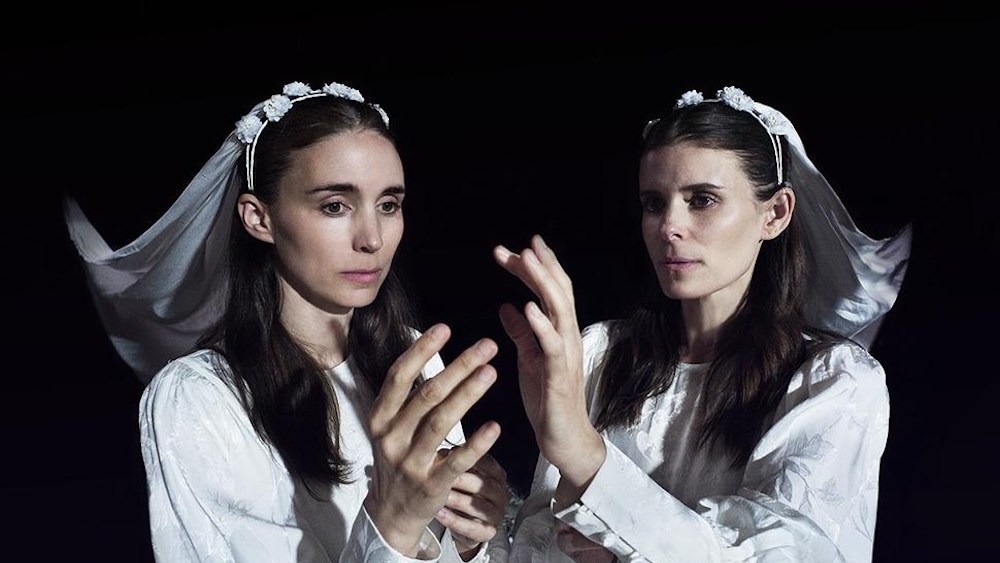
Occasionally sublime, often ridiculous and always extravagantly weird, Werner Herzog‘s “Bucking Fastard,” unlike its gorgeously interlinked protagonists, is a film of multiple personalities that only rarely speak in unison. Kate and Rooney Mara, appearing together — oh so together — for the first time, are endlessly fascinating playing two sisters who speak and react simultaneously and identically, less a pair of people than a palimpsest of a single person. This unprecedented duality is not simply a casting and acting coup, it is rich with potential meaning and mood: there is something inexpressibly sad and beautiful about the ideas it prompts, about the loneliness of the human condition, about the polite savagery of society towards its outliers, about the nature of kinship and whether it’s possible — and maybe even enviable — for two people to share one soul, the way they might share a teapot. But this is Werner Herzog, and by God and the fundamentally chaotic nature of the Universe, Herzog gonna Herzog. And so, despite the already richly strange premise, there must also be dream sequences in which fluttering birds twitter madly in their cages, sidebars about sneering hunters culling probably-not-rabid foxes and baroque digressions about the genome of the cave salamander. With Ernst Reijseger’s wonderfully varied score keeping pace, through folk fiddle and classical cello and stretches of wondering, wandering piano, there just have to be touches of fairytale and a dose of Looney Tunes. For some reason we need loads of quasi-mythological musings on the nature of devotion and whole lot of mummery about the Orkney Islands, all stuffed into a narrative that becomes increasingly estranged from anything resembling a reality to which we might usefully return, arms laden, with all these new splendors to relate. Popular on Variety Herzog’s script is inspired, partially, by his meeting Freda and Greta Chaplin, twin sisters whose unique and inexplicable manner of speaking, in addition to their anti-social behavior, gave them some minor U.K. notoriety in the 1980s. Transposed to Ireland — or rather, to a skewed and fantastical idea of Ireland — they become Jeanie (Kate Mara) and Joanie (Rooney Mara), the Holbrooke sisters, who as the film begins are up in court after a restraining order has been filed against them. Making much of the “precedent” he is setting in Irish law, the judge (Simon Delaney) allows both sisters to take the stand together and to give evidence as one — our first taste of the Maras’ remarkable mirroring-and-matching abilities. The case has been brought by their neighbor, Mr Mulroney, with whom the two women, as one, believe themselves completely, forever-and-ever in love. (The Holbrookes are simultaneously childlike and horny as hell.) Limo driver Mulroney has indeed been enjoying their sexual favors, with the cat-who-got-the-cream smugness of, well, a man who has a regular threesome going with two comely if somewhat oddball sisters. He’s played by Orlando Bloom, who really does look the part of the heartbreaker-gone-a-bit-to-seed. He even quite sounds the part too, except when he stumbles up against a long “i” and his Irish accent swerves into Oirish. Anyway, Mulroney recently ended things with the girls in order to get married, which cued several fanciful attempts at revenge, which continue well after the trial has ended. During one such act of whimsical vandalism, as they set a letterbox on fire under the impression that it will prevent Mulroney from sending love letters to his wife, they are witnessed by another neighbor, kindly Mr Westmoreland (John Kavanagh). Rather than being even mildly fazed, Westmoreland is one in a long line of (mostly) men whose protective instincts are stirred by these strange apparations, in their matching ankle-length chambray dresses, their matchingly shapeless cardigans and matching embroidered handbags, slung over opposite arms — the better to walk in lockstep, elbow touching elbow. (Props to costume designer Maeve Paterson for giving them a frumpy Tradwife aesthetic that is, after a while, a real look). He offers them a refuge in the city — if it’s Dublin it is, again, the unrecognisably quaint Dublin of Herzog’s imagination rather than a place its inhabitants might deem authentic — in a turret-like top room, where they can be visited by the lonely widower and by their social worker, Timothy (a lovely, gentle and too-brief turn from Domhnall Gleeson). Other men on the street and at work in the surroundings alternately lust after and spy on the sisters. One passerby even cajoles them into taking a selfie for his socials, a jolting moment when we realise that all of this is supposedly taking place in the present day, despite letterboxes and old-lady headscarves still being a thing and nobody appearing to have a TV. No matter, soon their Aunt Louise writes to invite them back to the countryside, where to all intents and purposes, it is the past: There, they can farm and ramble and spend their evenings crotcheting by the fireside. And behind that Sligo farmstead looms spectacular, cave-speckled Keshcorran Hill, where the sisters, and DP Peter Zeitlinger’s wistfully magic-tinged photography, will find their final purpose. It feels almost heretical to wish that a Werner Herzog film were just a little less outlandish. But while “Bucking Fastard” gives us, in the Mara sisters’ uncannily synced-up performances, a novelty worth the price of admission alone, it is mired in so much mythology and mystery that by the end, the fact of the sisters being two who respond and react as one becomes all but immaterial. If anything, perhaps it’s born of fondness: Herzog has amassed a rogues’ gallery of freaks and madmen and outcasts in his back catalogue, but seldom has he dealt with any of them this kindly, this sweetly and with this little hard-edged insight into why they behave the way that they do. It is a shame, because the loopy, fantasy-tinged episodes in which they end up embroiled are never as thrilling or as moving as the simpler moments, as when four hands gracefully pour tea from a single pot, or when two hands compose a letter in tandem but in different handwriting, or when the pair ignore their reflections and instead use the other as a mirror by which to knot their matching headscarves just so. Instead of probing, or even further observing, this intricate psychology, Herzog becomes preoccupied with the sisters’ dream of escape to a “better world than this one,” to “Arcadia or Atlantis or Orkney.” That they actually end up in a Slovenian rock formation full of stalactites and chandeliers is quite literally neither here nor there, for a story whose coherence has long since disappeared into the caves and forgotten dreams — now remembered — of Werner Herzog’s magpie mind.
‘Bucking Fastard’ Review: Herner Werzog’s Uddled-Mup Fairytale Stars the Mara Sisters as You’ve Never Seen Her Before
Full Article
Original Source
Read the full article at Variety →KhanList aggregates and links to publicly available news content. We do not host full articles from third-party sources. Always verify important information with original sources.