
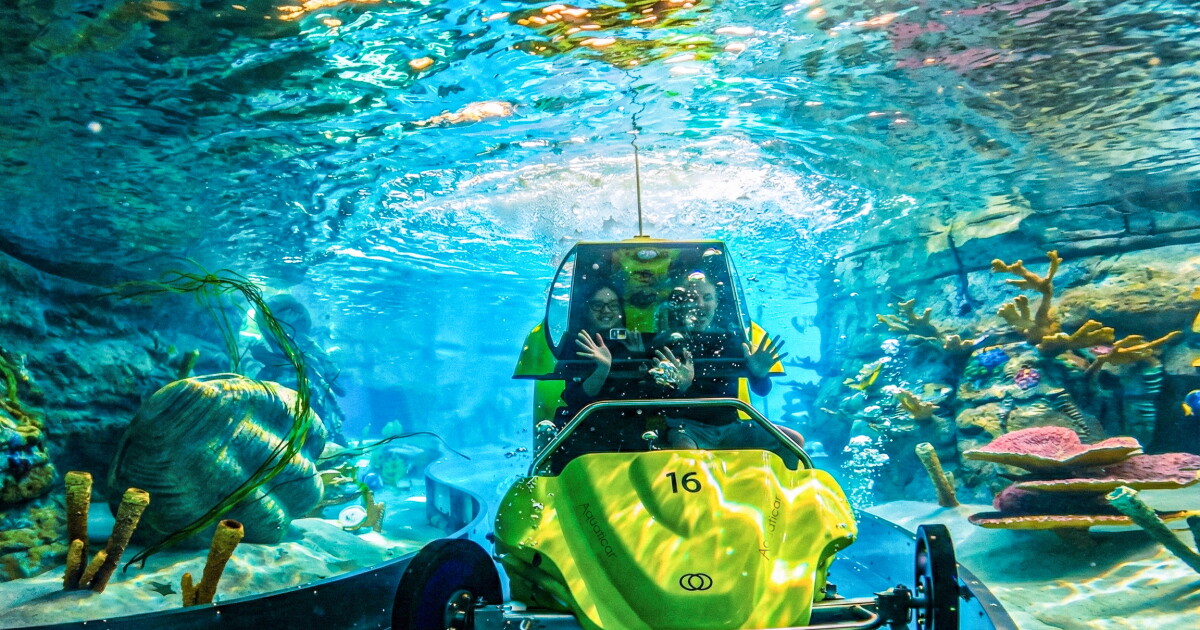
Ordinarily, if you're in a car that's underwater, that is not a good thing. Such is not the case with the Aquaticar, however, a new amusement-park-ride vehicle which is powered by bubbles.Designed and manufactured by California firm Sub Sea Systems, the two-passenger, three-wheeled vehicle is the key component of the company's Aquaticar Underwater Adventure Ride. The first such system is already in use at the AquArabia Water Theme Park in Saudi Arabia, where it began operations this April. Based on a 6-minute ride, one system has the capacity of handling up to 300 guests per hourSub Sea Systems Although courses can be customized for each client, a typical layout may incorporate a total of 17 self-steering Aquaticars taking passengers for 6-minute underwater rides along a 137-m (450-ft) circuitous track. The depth from the wheelbase of the car to the surface is 2.5 m (8.2 ft).As can be seen, each passenger sits with the top of their body dry inside an air-filled watertight canopy, allowing them to breathe normally. The bottom of their body gets wet. Passengers remain dry from the chest upSub Sea Systems And no, the cars aren't just traveling through plain ol' swimming pools. The twisty, turny tracks are flanked by scenery for passengers to gawk at, plus the vehicles can be outfitted with Bubble Pulse Guns which allow passengers to shoot toroidal vortices (spinning bubble rings) at underwater targets.But what's all this about "bubble power"? Air is piped in by hoses running beneath the trackSub Sea Systems Well, a network of hoses installed beneath the track delivers air to a series of wand-like triggers located at regular intervals along the surface of the track. The car mechanically engages those triggers as it passes over them, causing them to release air into an intake on its underside.Some of that air is directed into the canopy, entering through nozzles at the top (the passengers' exhaled breath is directed out of the canopy via exhaust vents at the rear). The rest of the air is used to turn the car's rear wheel, via what is known as the Bubble Engine.This setup consists of two large vertically-oriented rotors sitting side-by-side, that are linked to the rear wheel by a chain drive. Each of the rotors in turn has a series of louvered scoops running around its outside edge (where the inner tube would go, if the rotor were a wheel rim). The Bubble Engine's two enclosed rotors can be seen at the back of the Aquaticar – the round openings allow the air to escape from the scoopsSub Sea Systems As the air rises up, it fills those scoops and pushes them up too, causing the rotors to turn. The rotors thus cause the linked rear wheel to turn, moving the Aquaticar forward. This process is repeated as the car progresses down the track, going from one trigger to the next in line.Each vehicle is equipped with an onboard camera that is monitored by staff, along with a push-to-talk button that allows passengers to communicate with staff members at any time. Other safety features include an onboard air cylinder that provides an additional 25 minutes of breathable air, plus air bags that allow the car to be raised to the surface and moved off the track if needed. A second-generation version of the Aquaticar Underwater Adventure Ride is already in the worksSub Sea Systems The Aquaticar was invented by Sub Sea Systems CEO/Founder Jim Mayfield, who was inspired by one of the company's existing products, a tethered diving helmet called the SeaTREK."My dad’s initial idea was to create a system, like SeaTREK, but bigger where two guests sitting side-by-side could share in the excitement of being underwater," says his daughter Hannah de Bie, Sub Sea Systems' VP of Marketing and Communications. "He's a grandfather to six grandkids, and is always inspired to create products that he can share with his whole family – from his kids to his grandkids. Thus, Aquaticar was born."Source: Sub Sea Systems
Bubble-powered car is ready to take you on an underwater ride
Full Article
Original Source
Read the full article at Newatlas →KhanList aggregates and links to publicly available news content. We do not host full articles from third-party sources. Always verify important information with original sources.