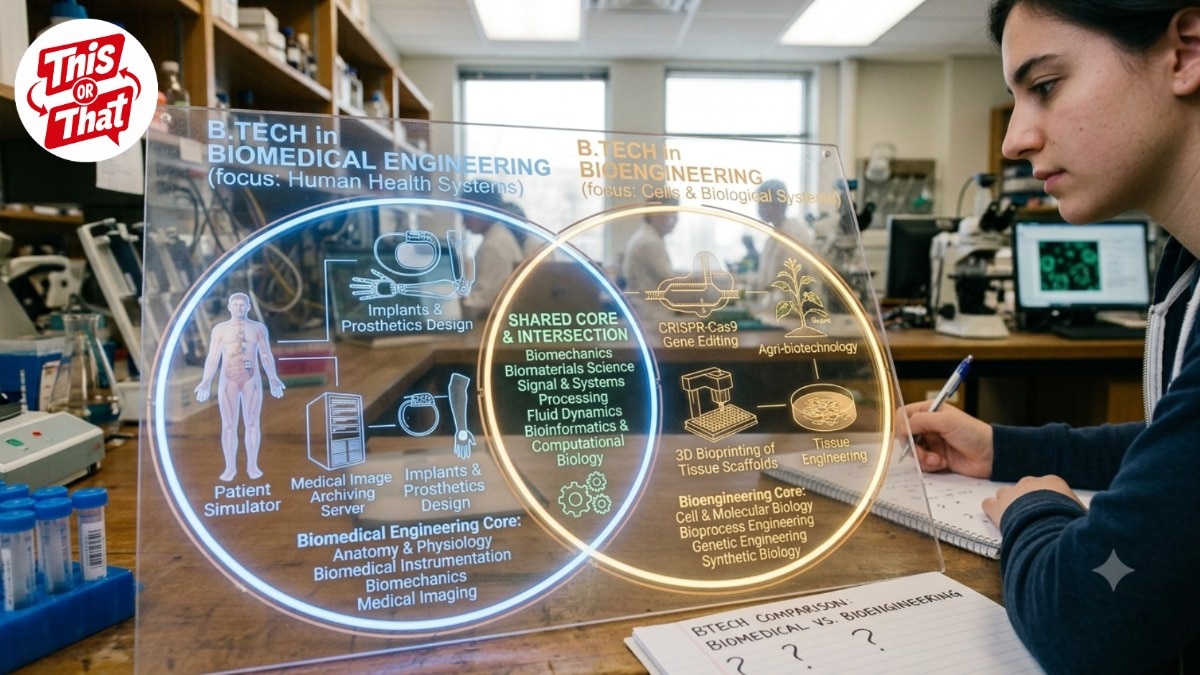
Students comparing BTech in Bioengineering and Biomedical Engineering need to weigh curriculum, applications and career paths. The choice hinges on whether they prefer broader biological innovation or healthcare-focused technology.BTech Bioengineering or Biomedical Engineering: Differences, eligibility, career options (AI-generated)Students interested in combining biology with engineering often find themselves choosing between BTech in Biomedical Engineering and BTech in Bioengineering. While the two programmes share a common scientific foundation, they differ in their curriculum, applications and career pathways. Here's a closer look at what each course offers to help students make an informed admission decision.Choosing an engineering branch is no longer limited to traditional options such as Computer Science or Mechanical Engineering. As healthcare, biotechnology and life sciences continue to evolve rapidly, interdisciplinary fields are attracting increasing interest from students who want to apply engineering principles to solve biological and medical challenges.Among these emerging disciplines, Bioengineering and Biomedical Engineering are often confused because both combine engineering with biology. However, their areas of focus, the problems they address and the industries they serve are distinct. Understanding these differences can help students align their academic choices with their interests and long-term career aspirations.BTECH IN BIOMEDICAL ENGINEERING OR BIOENGINEERING: AT A GLANCEParameterBTech in BioengineeringBTech in Biomedical EngineeringDurationFour yearsFour yearsEligibilityClass 12 with PCM (some institutes also accept PCB/PCMB)Class 12 with PCM (PCB/PCMB accepted by some institutes)AdmissionJEE Main, JEE Advanced, BITSAT, VITEEE, SRMJEEE, CUET and state-level entrance examsJEE Main, JEE Advanced, BITSAT, VITEEE, SRMJEEE, CUET and state-level entrance examsFocus areaBiological systems, biotechnology, genetics and environmental applicationsHealthcare technologies, medical devices and patient careCore subjectsMolecular biology, biomaterials, tissue engineering, bioinformatics, computational biologyHuman physiology, biomechanics, biomedical instrumentation, medical imaging, biomaterialsIndustriesBiotechnology, pharmaceuticals, agriculture, genomics, researchMedical devices, diagnostics, hospitals, healthcare technologyHigher studiesMTech, MS, MSc, MBA, PhDMTech, MS, MSc, MBA, PhDBest suited forStudents interested in biotechnology and interdisciplinary researchStudents interested in healthcare innovation and medical technologyBTECH IN BIOMEDICAL ENGINEERING OR BIOENGINEERING: QUICK VERDICTChoose BTech in Bioengineering if... students are interested in biotechnology, genetics, biological research and solving challenges across multiple sectors. Choose BTech in Biomedical Engineering if... students want to design medical devices, diagnostic equipment and technologies that improve healthcare.Either programme is a good fit if... students enjoy biology and engineering equally and want to build technology-driven solutions for real-world problems.BTECH BIOMEDICAL ENGINEERING OR BIOENGINEERING: WHY DO STUDENTS COMPARE THESE TWO COURSES? The confusion is understandable. Both programmes sit at the intersection of biology and engineering, and both require students to apply engineering principles to living systems.They also share foundational subjects during the initial years of study, including mathematics, engineering mechanics, biology and basic sciences.However, the similarities begin to diverge as students progress through the programme.According to Dr Gayathri V, Professor and Head of the Department of Biotechnology at Hindustan Institute of Technology and Science (HITS), Bioengineering has a broader interdisciplinary scope, while Biomedical Engineering is specifically geared towards healthcare technologies."Bioengineering integrates engineering with biological sciences to address challenges across healthcare, agriculture, environmental science and biotechnology. Biomedical Engineering, meanwhile, applies engineering directly to medicine, helping develop technologies that improve diagnosis, treatment and patient care," she explains.BIOMEDICAL ENGINEERING OR BIOENGINEERING: WHAT DO STUDENTS STUDY IN EACH PROGRAMME?Although both degrees blend engineering with biological sciences, their curriculum reflects different end goals.A BTech in Bioengineering exposes students to a broad range of subjects, including molecular biology, biomaterials, bioinformatics, computational biology, tissue engineering, biosensors and regenerative medicine. Students also explore applications in agriculture, environmental sustainability, industrial biotechnology and synthetic biology.Biomedical Engineering, on the other hand, focuses more closely on medicine and healthcare. The curriculum includes anatomy, human physiology, biomechanics, biomedical instrumentation, medical imaging, rehabilitation engineering and implantable medical devices. Many institutions also introduce students to robotics, artificial intelligence in healthcare and digital health technologies.Dr Gayathri notes that while Bioengineering aims to improve biological systems using engineering, Biomedical Engineering concentrates on developing technologies that assist doctors, hospitals and patients.BIOMEDICAL ENGINEERING OR BIOENGINEERING: WHAT SKILLS ARE REQUIRED?Both programmes require analytical thinking, problem-solving ability and a strong foundation in mathematics and science. However, the type of curiosity each discipline demands differs.Students who enjoy laboratory research, genetics, biotechnology and interdisciplinary scientific exploration may find Bioengineering more aligned with their interests.Biomedical Engineering is often better suited to students who are fascinated by healthcare, medical technology and engineering design. Their work frequently involves collaborating with doctors, researchers and healthcare professionals to improve patient outcomes through technology.Communication skills, teamwork and adaptability are equally important, as both fields evolve rapidly with advances in science and engineering.BIOMEDICAL ENGINEERING OR BIOENGINEERING: ADMISSION PROCESS AND ELIGIBILITYAdmission to both programmes generally requires candidates to have completed Class 12 with Physics, Chemistry and Mathematics (PCM). Some universities also accept students from PCB or PCMB backgrounds, particularly for Bioengineering and Biomedical Engineering programmes.Admissions are typically based on entrance examinations such as JEE Main, JEE Advanced, BITSAT, VITEEE, SRMJEEE, CUET and various state-level engineering entrance examinations.Several institutions across India offer these programmes, including the IITs, Anna University, Vellore Institute of Technology, SRM Institute of Science and Technology, Manipal Institute of Technology, UPES, Thapar Institute of Engineering and Technology, and Hindustan Institute of Technology and Science.Students should check individual university eligibility criteria, as admission requirements may vary.BTECH IN BIOMEDICAL ENGINEERING OR BIOENGINEERING: PLACEMENTS AND CAREER OPPORTUNITIESThe growth of biotechnology, precision medicine, digital health and medical technology has expanded career opportunities for graduates of both disciplines.Bioengineering graduates typically find opportunities in biotechnology companies, pharmaceutical research, genomics, agricultural biotechnology, synthetic biology and government research laboratories. They contribute to research, product development, quality assurance and innovation across multiple sectors.Biomedical Engineering graduates generally work with medical device manufacturers, diagnostic companies, hospitals and healthcare technology firms. Their work includes developing imaging systems, prosthetics, implantable devices, wearable health monitors, surgical equipment and rehabilitation technologies.Dr Gayathri points out that rapid developments in artificial intelligence, regenerative medicine and biotechnology are creating new opportunities in both fields, although the industries they serve remain different.Placement opportunities ultimately depend on factors such as the institution, academic performance, internships, skill development and industry demand.BTECH IN BIOMEDICAL ENGINEERING OR BIOENGINEERING: HIGHER EDUCATION OPPORTUNITIESGraduates from both disciplines have several options for higher studies in India and abroad.Popular choices include MTech, MS, MSc, MBA and PhD programmes.Students may also specialise in emerging areas such as tissue engineering, regenerative medicine, biomedical imaging, synthetic biology, computational biology, drug delivery, bioinformatics and artificial intelligence in healthcare.As research investment increases globally, postgraduate education continues to open doors to specialised research and innovation-driven careers.BTECH IN BIOMEDICAL ENGINEERING OR BIOENGINEERING: WHO SHOULD CHOOSE WHAT?Students who are interested in biological sciences beyond healthcare – including biotechnology, genetics, agriculture and environmental sustainability – may find Bioengineering a better match for their interests.Those who are passionate about designing medical technologies, improving patient care and working alongside healthcare professionals may be better suited to Biomedical Engineering.Dr Gayathri believes that the decision should not be based on which programme appears more popular, but rather on where students want to apply engineering principles."Students interested in multidisciplinary biological innovation often prefer Bioengineering, while those who aspire to develop medical technologies generally choose Biomedical Engineering," she says.Although Bioengineering and Biomedical Engineering share common scientific foundations, they prepare students for different kinds of careers.Bioengineering offers a broader interdisciplinary approach, spanning biotechnology, biological research, agriculture and environmental applications. Biomedical Engineering is more specialised, focusing on healthcare technologies, medical devices and improving patient care.There is no universally "better" programme. The right choice depends on a student's interests, aptitude, career aspirations and the kind of problems they hope to solve. Before making a decision, students should compare course curricula, research opportunities, faculty expertise, industry exposure and internship options offered by different institutions.Disclaimer: This comparison is part of our This vs That series. The courses have been selected based on popular student comparisons and do not represent a ranking or endorsement.- EndsPublished By: Mridusmita DekaPublished On: Jul 29, 2026 13:57 IST
BTech in Biomedical Engineering or BTech in Bioengineering: What to choose
Full Article
Original Source
Read the full article at Indiatoday →KhanList aggregates and links to publicly available news content. We do not host full articles from third-party sources. Always verify important information with original sources.