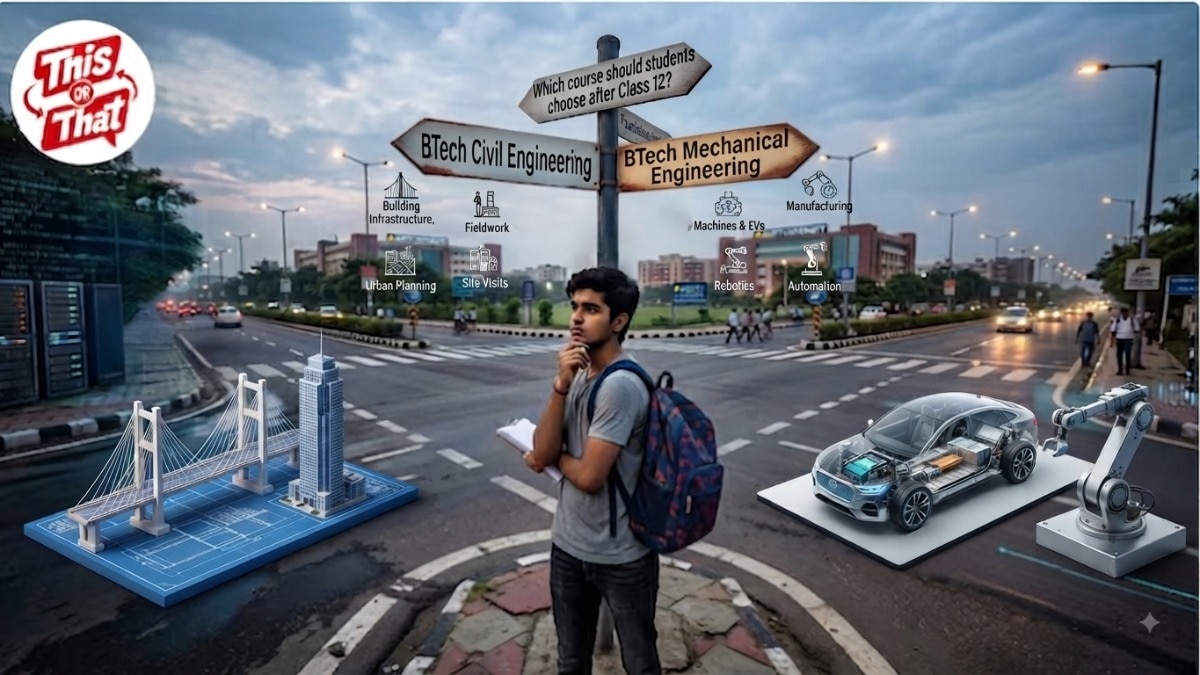
This story compares BTech Civil and Mechanical Engineering across curriculum, skills, careers, placements and higher studies. It explains which branch suits students based on their interests, strengths and career goals, helping Class 12 students make an informed choice.Every year, lakhs of engineering aspirants face the same dilemma after Class 12. With AI and data science dominating the headlines, two core branches, BTech in Civil Engineering and BTech in Mechanical Engineering, still build the physical world around us. This story breaks down the differences in curriculum, skills, careers, and fit to help students decide which suits them better.ParameterBTech Civil EngineeringBTech Mechanical EngineeringDuration4 years4 yearsEligibilityClass 12 with PCM + JEE Main/State-level entranceClass 12 with PCM + JEE Main/JEE AdvancedCore subjectsStructural, Geotechnical, Transportation, Environmental, Water Resources, BIM, GIS, Drone Surveying, Smart InfrastructureThermodynamics, Fluid Mechanics, Applied Mechanics, Design, Robotics, Mechatronics, EV, Smart ManufacturingSkills neededAnalytical thinking, 3D visualisation, planning, project management, communication, teamworkCritical thinking, creativity, problem-solving, design, collaboration, technical analysisCareer optionsStructural Engineer, Project Manager, Transportation Engineer, Environmental Engineer, BIM SpecialistDesign Engineer, Manufacturing Engineer, EV Engineer, Robotics Engineer, Industrial AutomationRecruitersL&T, Tata Projects, Afcons, Shapoorji Pallonji, NHAI, CPWD, Metro Rail, GMR, Adani, DLFL&T, Tata Motors, Mahindra, Maruti Suzuki, Bosch, BHEL, GAIL, NTPC, ISRO, DRDO, RelianceHigher studiesMTech, MS, PhD in Structural, Geotechnical, Transport, Environmental and Construction fields; MBA via CAT/GMATMTech via GATE, MS abroad, MBA via CAT/GMAT; specialisation in Robotics, EV and Smart ManufacturingBest suited forStudents who like building infrastructure, fieldwork, planning and long-term public projectsStudents who like machines, product design, manufacturing, automation and emerging technologiesWHY STUDENTS COMPARE THESE TWO COURSESMechanical and Civil Engineering are among the oldest engineering disciplines in India. As Dr Bhim Singh, HOD – Mechanical Engineering, Manav Rachna University notes, “whatever we see around us – cars on the road, aircraft in the sky, bridges, metro, highway and factories are the result of the expertise of mechanical and civil engineering.”With India pushing self-reliance in manufacturing and infrastructure, both branches remain relevant despite the buzz around AI and cybersecurity.For Class 12 students who enjoy physics and maths but are unsure whether to work on machines or on structures, the confusion is natural. Both offer 4-year BTech programs, similar eligibility, and strong government and private sector demand. WHAT STUDENTS STUDY IN EACH COURSECivil Engineering has moved far beyond bricks and concrete.According to Dr Lokesh Choudhary, Associate Professor, Department of Civil Engineering, MRIIRS, the program now covers “Structural, Geotechnical, Transportation, Environmental, Water Resource Engineering, Surveying, Concrete Technology & Project management, BIM, GIS, AI, Digital Twin Technology, Drone Surveying, Remote Sensing, and Smart Infrastructure Monitoring.” Students also get field exposure through labs, survey camps, site visits, and industrial projects.Mechanical Engineering focuses on the design-to-lifecycle of products and systems. The core includes thermodynamics, fluid mechanics, applied mechanics, design, robotics, mechatronics, electric vehicles and smart manufacturing.Dr Singh explains that Industry 4.0 has transformed the branch with “AI, IoT, robotics, data analytics, digital twins and cyber physical systems.” The rise of EVs has introduced new areas such as battery thermal management and vehicle dynamics.Overlap: Both require strong PCM fundamentals, problem-solving, and use of software tools. Both now integrate AI, data, and sustainability into traditional engineering.SKILLS REQUIREDCivil Engineering demands aptitude for analytical and problem-solving, mathematical comprehension, 3D visualisation, planning and management abilities, and effective communication for site and team coordination, as per Dr Choudhary.Mechanical Engineering requires critical thinking, creativity, communication, and collaboration. Students must be comfortable with design, prototyping, and working across manufacturing and automation systems.In short, Civil leans toward planning large systems that serve people—mechanical leans toward creating and improving machines and processes.PLACEMENTS AND CAREER OPPORTUNITIESIndia’s infrastructure push is driving demand for Civil engineers. Dr Choudhary points to programs like National Infrastructure Pipeline, PM Gati Shakti, Bharatmala, Sagarmala, Smart Cities Mission, Jal Jeevan Mission and Metro expansion as factors creating “the highest ever demand for civil engineers.”Top recruiters include L&T, Tata Projects, Afcons, NCC, GMR, ADANI, DLF, CPWD, NHAI and Metro Rail Corporations. Roles span planning, design, construction, project management, consulting and quality assurance.For Mechanical, the growth of manufacturing, EVs and smart factories is key.Dr Singh cites a NITI Aayog report projecting that India’s EV ecosystem could create 5 million direct and indirect jobs by 2030. Recruiters include L&T, Tata Motors, Mahindra, Maruti Suzuki, Bosch, Reliance, BHEL, GAIL, NTPC, ISRO, DRDO and Indian Railways. Careers cover automotive, aerospace, manufacturing, industrial automation, and energy systems.Placement outcomes in both depend on internships, certifications in software, communication skills, and project experience. The article avoids placement guarantees as outcomes vary by institution and student effort.HIGHER STUDIESBoth branches offer MTech through GATE and MS abroad. An MBA via CAT or GMAT is also common. Civil graduates can specialise in Construction, Transportation, Structural, Geotech, Environmental, Water Resources or Earthquake Engineering.Mechanical graduates can go deeper into Robotics, Automation, EV technology, Smart Manufacturing or Aerospace.WHICH STUDENTS SHOULD CHOOSE WHICH?There is no universally “better” branch. The choice comes down to interest and work style.Choose Civil Engineering if you enjoy building things that last, are interested in infrastructure, urban planning, sustainability, and don’t mind site visits and fieldwork. If you like maths, physics, and seeing a tangible impact on communities through roads, bridges, water systems, and smart cities, this fits.Choose Mechanical Engineering if you are curious about how machines work, enjoy product design, manufacturing, robotics, and emerging tech like EVs. If you prefer labs, workshops, and working on systems that move, this is a strong option.As Dr Singh says, Mechanical “combines strong engineering fundamentals with emerging technologies such as smart manufacturing, EVs, Robotics, Automation, AI, and sustainable technologies.”As Dr Choudhary notes, Civil offers “the rewarding experience of making contributions that help sustain society for centuries to come.”Both experts emphasise institution selection. Dr Singh advises students to shortlist 5-10 colleges based on faculty, labs and alumni, and visit at least 3–4 before deciding.Dr Choudhary adds that beyond rankings, students should check NBA and NAAC accreditation, industry ties, internships, and live project exposure. Fee ranges also differ — approximately Rs 0.30 to 1.5 lakh per year in government colleges and Rs 1.5 to 4 lakh in private colleges for Civil, and Rs 3 to 7 lakh per year, including hostel, for Mechanical in reputed institutions.QUICK VERDICTChoose Civil Engineering if you want to design and manage infrastructure, work on large public projects, and are drawn to planning and construction.Choose Mechanical Engineering if you want to work on machines, manufacturing, EVs, robotics and product innovation.Either is a good fit if you have strong PCM basics, enjoy problem-solving, and want a core engineering career with long-term stability.Both Civil and Mechanical Engineering remain foundational to India’s growth story. One builds the structures we live in. The other builds the machines that move us. The right choice depends on a student’s interests, aptitude, career aspirations and willingness to develop relevant skills. With India’s focus on infrastructure and manufacturing, both paths offer meaningful, future-ready careers.Disclaimer: This comparison is part of India Today's This or That series, which explores common academic choices students face during admissions. The courses are selected based on frequently asked comparisons and are not ranked or endorsed.- EndsPublished By: Karan YadavPublished On: Aug 12, 2026 10:55 IST
BTech Civil or Mechanical Engineering: Which course should you choose after Class 12?
Full Article
Original Source
Read the full article at Indiatoday →KhanList aggregates and links to publicly available news content. We do not host full articles from third-party sources. Always verify important information with original sources.