
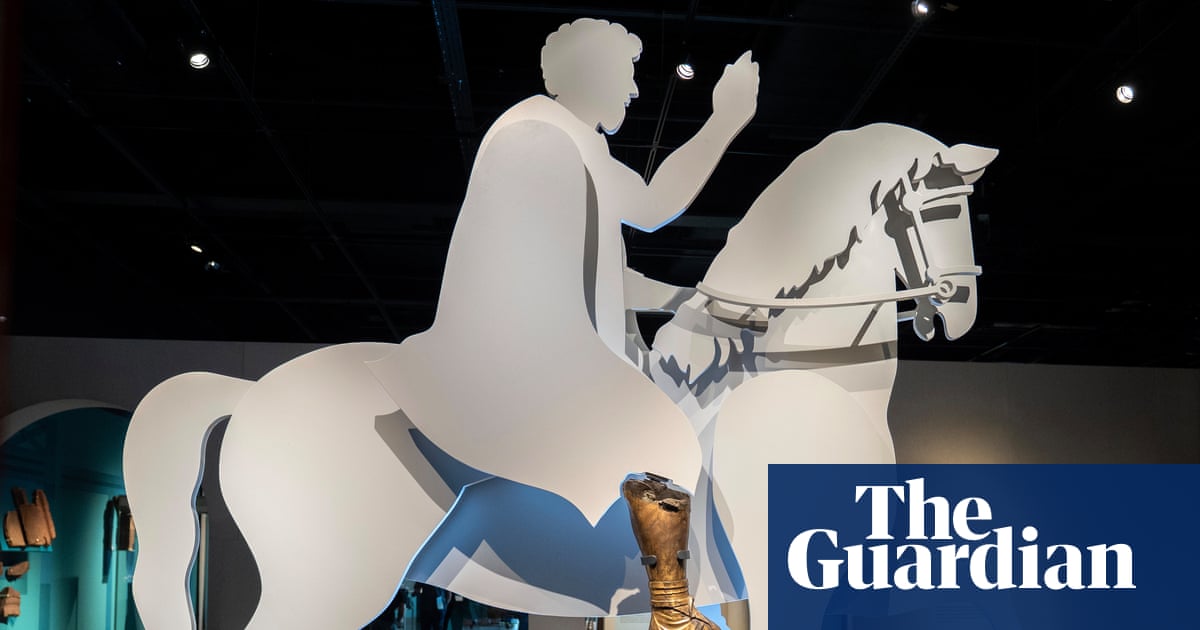
A large bronze leg found in a bog in rural Scotland more than 200 years ago and then hidden away in a duke’s storeroom is helping to rewrite the history of the Roman empire.Antiquarians argued that the so-called Mislington leg had been looted, perhaps from York, hacked off by marauding Scottish tribes and carried north over Hadrian’s Wall. “We cannot visualise the conditions which would have led to its erection anywhere north of the Great Wall,” said one scholar, James Curle, in 1932.But archaeologists now believe the hefty gilded bronze limb came from the Scottish Borders and was part of a vast statue of the emperor Antoninus Pius on horseback, erected near Hawick after his armies had wrested control of southern Scotland in about AD140.A marble bust of the emperor Antoninus Pius, during whose reign the Romans occupied parts of Scotland from AD142 to 165. Photograph: World History Archive/AlamyBearing significant similarities to imperial statues in other frontier regions, it is the centrepiece of the largest exhibition ever staged on the Romans in Scotland, which opens on Saturday at the National Museum of Scotland in Edinburgh.It had languished for 100 years in the “charter room” at Dalkeith House near Edinburgh, one of the stately homes owned by the Duke of Buccleuch, after being dug up in 1820.It is now displayed alongside other artefacts that the museum’s curators believe prove the Romans were a far more significant force north of Hadrian’s Wall than previously realised, occupying large areas of the country, producing new artworks and shaping the politics of Scotland long after they retreated.Dr Fraser Hunter, the principal curator of the exhibition, Roman Scotland: Life on the Edge of Empire, believes such statues would have had a profound impact on iron-age communities. And instead of being hacked off, the leg was carefully removed and deposited where it was found 1,700 years later.“These kind of things are not only visually dominant but they look really, really alien,” Hunter said. “There is effectively no naturalist art in the iron age – very, very little. The whole idea of depicting a person is absolutely alien to the iron-age worldview.”Among a series of firsts, the exhibition also includes a new reconstruction of a heavily decorated earthenware bowl from Inveresk, east of Edinburgh. The village is the site of a large Roman fort and town that was, Hunter believes, a centre of imperial power during the Antonine period in Scotland of AD142 to 165 – the second of three periods of Roman occupation of Scotland.Hunter estimates that about 10,000 troops, including auxiliaries from places such as modern-day Romania and north Africa, were stationed across southern and eastern Scotland, alongside perhaps another 10,000 camp followers, wives and enslaved people.Bethany Simpson, an assistant curator, said the bowl displayed a unique combination of animal reliefs involving dolphins, stags and a stylised hunting dog. “You only find it in Inveresk. It’s not seen anywhere else in Scotland; it’s not seen anywhere in the UK,” she said.Bethany Simpson, an assistant curator, with the ancient bronze leg. Photograph: Jane Barlow/PAThe museum is also showing for the first time two remarkably well preserved, locally carved stone altars from a mithraeum excavated at Inveresk. The museum uses dramatic lighting to demonstrate the vibrant colours originally painted on them.One has slits cut into its hollowed-out stone, radiating from the carved head of Mithras, with holes carved into its eyes and mouth to allow lamplight to shine out in the smoky darkness of the temple.The two spectacular altars from the Roman fort Inveresk’s mithraeum (a temple to the god Mithras). Photograph: Murdo MacLeod/The GuardianThe show also includes the entire skeleton of a horse, carefully buried at Inveresk, which was also home to a small amphitheatre – a rare find in frontier towns. “The burial of cavalry horses in Britain is rare,” Hunter said. “Normally they just get disposed of, so this must have been a valued steed, which is really interesting.”The exhibition focuses on Rome’s influence on indigenous Celtic tribes, their culture and political structures. Recent scholarship suggests there was no tradition of carving in pre-Roman Scotland, but from the Roman occupation sprang rich native styles, leading to highly ornate Pictish standing stones.Celtic rulers were beguiled by the silver used by the Romans for coins and jewellery; until then silver was unknown locally. The Romans used it to buy loyalty. Yet, by the third and fourth centuries, the Roman threat led the Pictish tribes to merge forces into an “anti-Roman coalition”.“What Roman interventions effectively do is they create a worse enemy. It’s the problem that empires often have in dabbling around their edges,” Hunter said.“So you get these larger-scale polities emerging. But they are also using Rome as a model, and the emergence of things like the Pictish symbols is absolutely tied into their exposure to sculpture and writing. So these are local responses to these kind of things, but in a highly creative, wonderfully magnificent manner.”
Bronze leg found in Scottish bog sheds new light on Roman occupation
Full Article
Original Source
Read the full article at Theguardian →KhanList aggregates and links to publicly available news content. We do not host full articles from third-party sources. Always verify important information with original sources.