
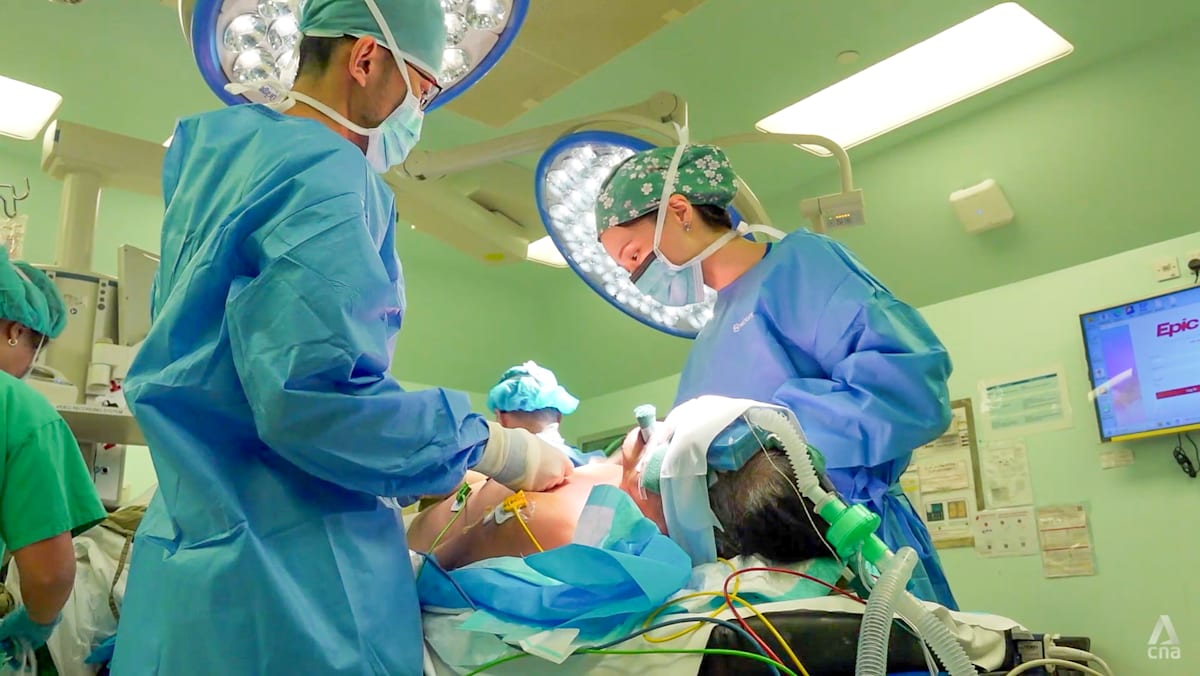
SINGAPORE: When 43-year-old Daljit Singh got crushed by a trailer truck in September, he had multiple broken ribs, a crushed chest and skin torn from muscle.He remembered screaming in pain. “But my scream was drowned out by the heavy rain,” he said.After he was rushed to Tan Tock Seng Hospital (TTSH), surgeons in the operating theatre raced to cut dead muscle tissue from his chest. Dead muscles would release toxins and cause kidney failure, said TTSH Trauma Centre director Teo Li-Tserng.The patient’s injuries required multiple operations. Doctors had to judge how long to give his damaged skin a chance to recover before there is dead tissue infecting healthy areas. They eventually removed an area of skin measuring 20cm by 30cm. Daljit Singh survived the accident. “If we didn’t intervene early,” said Teo, an adjunct assistant professor, “he may actually not recover.”A video of Singh’s family visiting, filmed by his wife, captured his eldest daughter’s worry. “Is he going to be okay?” she asked.His ordeal is one of many cases featured in Inside The Trauma Unit, CNA’s three-part series bringing viewers inside Singapore’s busiest trauma unit.Patients and their families tell their stories — from the fear of surgery to worries about work — while doctors, nurses and other specialists weigh treatment risks and coordinate care, sometimes before the full extent of a patient’s injuries is clear.“The burden is extremely high because decisions that we make can mean life or death for a patient,” Tang Jun Han, a specialist trauma surgeon and consultant in general surgery, said about the trauma team’s work. Dr Tang Jun Han preparing for an operation. Here are five reasons to watch the series, filmed over 12 weeks and premiering tonight:1. THERE’S A RANGE OF CASES, EVEN FREAK ACCIDENTSOne of the patients, 88-year-old Goh Mia Seng, was watering his plants when he fell on a heavy flowerpot, fracturing his breastbone. He spent the night before surgery lying awake, afraid that he might not survive.“Worried like crazy,” he said to Tang outside the operating theatre.It was the first time the 37-year-old doctor had seen a fractured breastbone requiring a surgical fix. “This is quite a serious injury,” he said.Goh’s age meant a lower tolerance for complications, while his blood-thinning medication increased the risk of bleeding. Tang reassured him, however, explaining how plates and screws would hold the bone in place so he could breathe more comfortably. Dr Tang (left) checking in on patient Goh Mia Seng before the operation. Tang, who is close to his grandparents, could imagine his patient’s fear of undergoing surgery. “Talk to the patient as if he or she is your family, and then spend some time addressing their concerns,” he said.After the surgery, when Goh saw the scan of his repaired breastbone, he joked: “(If) you put a bigger plate on it, I’ll become a Superman.”He also had this advice for those with a hard flowerpot at home: Replace it with a plastic one.2. SEE THE LIFE-SAVING TREATMENT IN “RESUS”Over in the resuscitation bay, or Resus, doctors must be prepared to make decisions based on “very scant information” when “time is of the essence”, said Teo. “(This) is where we manage the sickest of our trauma patients.” Dr Teo Li-Tserng is also a senior consultant surgeon at TTSH. This is where doctors had to drain air from a cavity next to Jailani Abdul Kadir’s collapsed right lung.“We need to put a tube inside, okay? Otherwise later you can’t breathe,” Yeo Jia Yi, an associate consultant in general surgery, told the 55-year-old motorcyclist.Scans had revealed the air pocket, measuring almost 6cm, after he was brought in with a shattered helmet and no memory of his accident. If left untreated, the pressure on the lungs could increase and even trigger a cardiac arrest.Yeo told him that inserting the tube carried a small risk of injury to his lungs or chest structure. Even with sedation and a local anaesthetic, “it’ll still be a bit painful”, she warned. Dr Yeo Jia Yi speaking to patient Jailani Abdul Kadir in the resuscitation bay. But it worked: An X-ray showed his lung had fully expanded. A computed tomography scan identified a fractured breastbone, though, so the medical team put him in a high-dependency unit to monitor for any heart injuries.He was discharged five days later, still an avid motorcyclist. “Even though this incident almost cost (me) my life, I’ll still be riding a bike because it’s my passion,” he said.3. MEET THE NURSES AND THERAPISTS TOOFor 31-year-old Chanel Ng, her motorcycle accident left her with multiple rib fractures and too much pain to move her right side. She described feeling “so useless” as she had to depend on the nurses during her recovery.But assistant nurse clinician Lee Wan Lih, who became a familiar face during her 12-day stay, encouraged her to perform breathing exercises despite the pain. TTSH assistant nurse clinician Lee Wan Lih’s nursing speciality is trauma care. Lee, 40, said she tended to treat younger patients like her younger sister, recognising that they could be reeling after their injuries or frightened by unfamiliar hospital surroundings.“It’s the care she gave me that touched me,” Ng said. “She made me feel less alone.”As her pain eased after surgery, senior physiotherapist Lee Pei Shan also helped her practise getting out of bed and walking.When asked to try the stairs later on, however, Ng was apprehensive. She had been holding her chest even when lifting her legs, but when she held onto the rail, she discovered she could manage the steps.By the time she was discharged, she could walk and use the toilet independently. Her sister, Christina, who initially found it “traumatising” to see her incapacitated, was equally “happy that she’s actually well”.As Ng walked out of the hospital ward, she said: “I’m sad that I’m saying goodbye to (the staff). But I’m also glad that I’m leaving.” TTSH patient Chanel Ng barely felt like moving after her surgery, but assistant nurse clinician Lee Wan Lih kept encouraging her. 4. THE TEAM DON’T JUST TEND TO PHYSICAL INJURIESNot all injuries treated in TTSH’s trauma unit are accidental. Some cases involve self-harm.Among them was a youngster with injuries to his limbs and face following a fall from height. As advanced practice nurse Eunice Tay checked for other possible injuries, including spinal damage, she asked him what led to the incident.“For the past few days, I was very sad,” the teenager told her. “I kept crying.”The team learnt that he had been upset after a disagreement with family members. Following emergency treatment, he was admitted for monitoring and psychiatric care, which also gave him a “safe space” away from his situation at home, Tay said.Another man, in his 20s, underwent surgery for a self-inflicted knife wound. He had “intrusive thoughts” for months but no suicidal intent, according to Samantha Baey, a senior resident in the general surgery department. The patient had somersaulted and landed on this knife, which the TTSH trauma team removed from his body. “So, I’m going to be discharged early today?” he asked Teo a day after his admission. But his wound needed further monitoring, and a psychiatric treatment plan was also in place after a psychiatrist had assessed him.Without understanding what triggered the incident, “even if we treat the physical injury, it’s likely to happen again”, Teo said.5. PATIENTS OPEN UP ABOUT THEIR FEARS AND HOPESFor many patients, being hospitalised meant precious time away from family and worrying about their livelihoods.Singh spent his birthday in TTSH instead of celebrating it at home. “I miss my kids’ jokes, my wife’s cooking,” he said.WATCH: Inside Singapore’s high-stakes trauma centre with Inside The Trauma Unit (9:04) What really happens inside Singapore’s busiest trauma units? Hear from the Senior Producer of Inside The Trauma Unit and the Director of Tan Tock Seng Hospital’s Trauma Centre as they share insights into the high-pressure world of emergency medicine. While the logistics worker continued receiving income, he worried that it was insufficient to support his family and hoped to make up the shortfall through overtime work.After more than six weeks and 14 operations, he was discharged on Nov 3, in time for Deepavali.Chinnaiah Raman’s road to recovery was less certain after a fall from height at work that left the 57-year-old with fractures in both legs and bruising to his brain.Far from his wife and children in India, he pleaded with his project manager visiting him in hospital: “Please don’t keep me here; send me back home.”At a multi-department meeting later, senior medical social worker Eugene Wong said his employer was “very supportive”. With months of rehabilitation ahead, which would be likely to prevent his return to work, repatriation was a possibility. Chinnaiah Raman was coming up a manhole when the winch gave way and he fell six to eight metres, according to his employer. But if he must return to Singapore to work after that, the migrant worker was hopeful of doing so. He wanted to save money “bit by bit” to build two houses for his sons, marry off both of them and then settle down for good. “I’m confident that I’ll get another job after this,” he said.Inside The Trauma Unit premieres at 9pm tonight and continues in the same time slot until Monday. Or watch it on CNA Insider’s YouTube channel, with all three episodes available at the same time tonight.
Broken bones, anxious families, life-and-death calls: Why Inside The Trauma Unit is a must-see
Full Article
Original Source
Read the full article at Channelnewsasia →KhanList aggregates and links to publicly available news content. We do not host full articles from third-party sources. Always verify important information with original sources.