
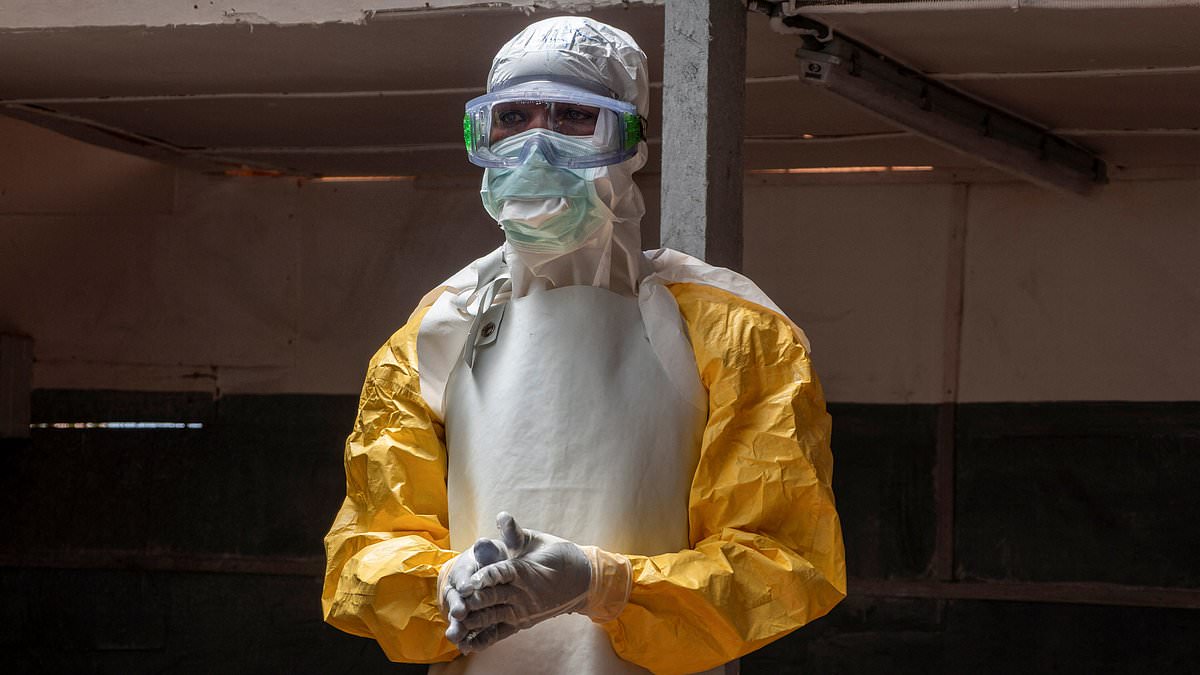
A British national working in the Democratic Republic of Congo has tested positive for Ebola.The healthcare worker is reportedly being evacuated back to the UK, where they will receive treatment for the deadly virus.The patient, who is said to be in a stable condition, is expected to land today or tomorrow.They will then be transferred to an infectious disease unit by a specialist ambulance.The case marks the first time a Briton has tested positive for the virus in the current outbreak.And it comes just a week after Africa's top health official warned that the UK is 'not safe' from the 'unprecedented' spread gripping the continent.Cases of the virus – most of which have been found in the DRC – have surpassed 10,000, while deaths hit 5,000, making it the second-largest outbreak on record.It has been driven by a rare strain, named Bundibugyo, which can kill up to 50 per cent of patients it infects. An Ebola healthcare worker wears protective equipment in Democratic Republic of the CongoThere is currently no vaccine for Bundibugyo but scientists are racing to develop a jab, with trials underway. Symptoms are the same across all Ebola variants.It starts with a flu-like fever, headache, muscle pain, vomiting and diarrhoea before progressing to internal bleeding, organ failure and, in many cases, death.The virus spreads through direct contact with the blood or bodily fluids of a person who is sick or has died from the virus.It can also be passed through contact with contaminated surfaces. The current outbreak was detected in May in the DRC and has been largely confined to African nations such as Uganda, Kenya and Nigeria.However, several people from elsewhere in Europe have been infected with Ebola.In Britain, a suspected case led to the precautionary shutdown of part of Glasgow's Queen Elizabeth University Hospital in June. The patient later tested negative.And in July, a suspected Ebola case was being monitored at a London hospital after a humanitarian worker was 'exposed' to the disease in the DRC.Just last week, however, Jean Kaseya, director general of the Africa Centres for Disease Control and Prevention, said the 'geographic extension of this outbreak is unprecedented' and warned that health officials worldwide must be prepared.'We want all countries to know that they are not safe if they don't take appropriate measures,' he said. 'Each country, not only in the African region, but all continents, must now increase the preparedness level and the possibility for treatment.'Dr Kaseya compared the current situation to countries thinking they would not be affected by Covid before the pandemic struck.'We don't want to see the UK and other countries become a hotspot,' he added.Experts said that Britain could be at risk of the virus arriving undetected for weeks – and that Dr Kaseya is 'right to be concerned'. Jean Kaseya, director general of the Africa Centres for Disease Control and Prevention, warned last week that Britain is 'not safe' from the 'unprecedented' Ebola outbreak'There have been several cases already in Europe from this epidemic,' said Dr Paul Hunter, professor of medicine at the University of East Anglia.Professor Hunter said transmission could occur from an imported case of the virus at any time, although he stressed that this is 'pretty rare'.'The fact is that Ebola is not that transmissible and usually requires close contact with a case or their body fluids,' he continued.'Furthermore, the infectiousness of a case increases as the case becomes more ill and especially as they approach death.'Professor Hunter said patients become most infectious when they are seriously ill.He said that in Britain they would be identified and hospitalised before infecting large numbers of people.He added that 'although nothing is impossible', the risk that Britain 'would become a hotspot of Ebola remains very low'.Dr Charlotte Houldcroft, assistant professor of virus genomics at the University of Cambridge, said Ebola could reach the UK subtly.This is because infected travellers can carry the virus for three weeks before symptoms appear.'The UK is at risk from any infectious disease with a long incubation period,' she said.'People can be exposed abroad, travel feeling well, but be incubating an infection that they fall ill with once back in the UK.'Ebola infections normally incubate for eight to ten days, but it can be as long as 21 days before in infected person shows symptoms.'That's a wide window for travellers to fly home not knowing they are sick.'However, Dr Houldcroft said Britain would be prepared to deal with any cases, saying that 'this isn't a situation like Covid'.'Ebola typically spreads a bit more slowly than [Covid], giving measures like contact tracing time to catch up with suspected cases.'Sir Andrew Pollard, a professor of infection and immunity at the University of Oxford, said Dr Kaseya is 'right that we should all be concerned'.But he agreed with Dr Houldcroft that the UK would be well equipped to identify cases.The origin of the Bundibugyo strain is unknown but some researchers believe it was passed on to humans by fruit bats.It was first recorded in 2007 and takes its name from the area of western Uganda, where it was spotted.It then arose for a second time in the DRC in 2012. However, both outbreaks were smaller, with estimates suggesting there were around 200 cases and 66 deaths.The current outbreak is the largest in the DRC's history and the second-largest ever, behind a major spread between 2014 and 2016 that caused more than 28,000 cases and 11,000 deaths across West Africa.A Foreign Office spokesman said today: 'A British citizen currently in the DRC has tested positive for Ebola.'The risk to the UK public from Ebola remains low.'
British person tests positive for killer Ebola after contracting it in DR Congo - first UK case in current outbreak to be treated in Britain
Full Article
Original Source
Read the full article at Dailymail →KhanList aggregates and links to publicly available news content. We do not host full articles from third-party sources. Always verify important information with original sources.