
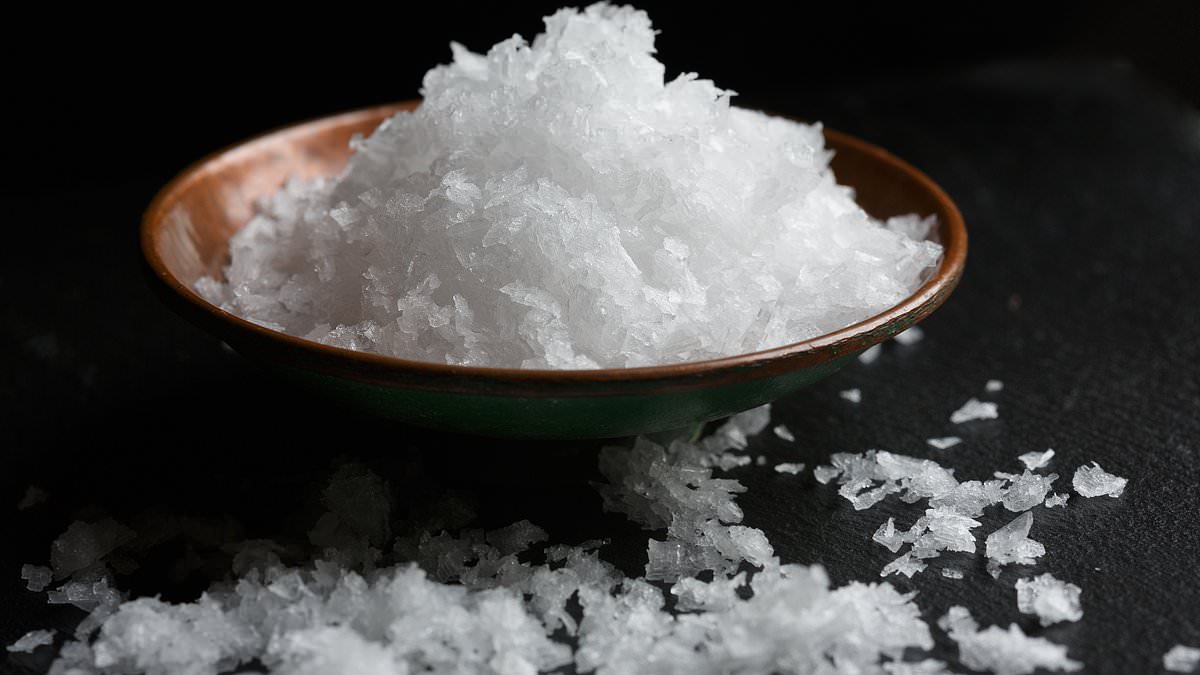
'Hand-harvested' near the town after which it is named, Maldon Salt is lauded by celebrity chefs and food influencers alike.But it seems the firm's '100 per cent sea salt flakes' from Essex have more of a continental flavour than consumers may have appreciated.A newspaper investigation has found that imported rock salt – mined in Germany – is used in the manufacture of the middle-class staple, which the firm says is used as a filtration agent and to 'enrich the seawater' with minerals.This 'salt-on-salt' technique is a traditional method which uses additional salt to strengthen the salinity of the water, reducing the energy required to evaporate the water and extract the salt crystals.The Observer spent three days monitoring Maldon's Longwick Farm production facility on the north bank of the Blackwater Estuary outside the town and saw four lorries delivering bags unloading around 12 tons of salt each. Salt bags were marked with the branding of K+S, a German mining company and one of the world's largest salt producers.After The Observer contacted Maldon Salt, it said the company updated its website last Wednesday to describe the 'salt-on-salt' production method for the first time.The website states: 'The water is settled and filtered, then prepared as brine using our long-established salt-on-salt process, in which natural, ancient sea salt forms part of the brine-making, to enrich the seawater with natural minerals.'Andrea Sella, professor of chemistry at University College London, said once two sources of salt had been blended together, they were impossible to separate. Maldon Salt is harvested from seawater drawn from the Blackwater Estuary, pictured here at Maldon, when the tides and salinity are optimal TV chef Shivi Ramoutar said Maldon Sea Salt was the one item she would always take abroadAndrew Fielding, co-author of the book The Salt Industry, said that while the salt-on-salt method was traditional, it should be disclosed if used in modern food production and customers informed.The family-run brand’s distinctive pyramid-shaped flakes form through ‘careful control of temperature, time and movement’ as seawater brine is heated and evaporated in open pans.In April, TV chef Shivi Ramoutar told The Mail on Sunday’s You magazine Maldon Sea Salt was the one item she always packed when heading abroad. According to Maldon Salt’s accounts up to the year ending March 2025, revenue was up 16.5 per cent to £39.2million, with an operating profit of almost £12million, up 1.7 per cent on the year before.Earlier this year the firm, which was founded in 1882, announced plans to expand Longwick Farm due to increased demand, particularly from export markets. Maldon salt is famed for its pyramid-shaped salt flakes Essex trading standards, supported by the Food Standards Agency, investigated the site in 2019 and 2020 and concluded there were no failures in regulation, with no legal definition to differentiate one grade of salt from another.But in Canada, labelling requirements prohibit labelling mined salt as 'sea salt' and some of the description on packets of Maldon Sea Salt in the country have been changed to Maldon Salt.Maldon Salt denied consumers were being misled.A spokesman said: 'Maldon is a heritage brand and the custodians of the ancient craft of salt making for 144 years.'Our method and techniques are part of that heritage. Rock salt is ancient sea salt that is added to seawater, which makes Maldon 100% sea salt flakes.'It is this long-established method that gives Maldon its distinctive flakes the same taste and unique texture that cooks, chefs and fans have known for generations.'Maldon Salt's products and labelling comply with all applicable food-safety and labelling legislation.'Maldon Salt is at its core, a story of place, craft and legacy and why it is loved by chefs and consumers around the world.'An Essex Trading Standards spokesman said: 'Essex Trading Standards fully investigated allegations provided to it by the FSA in 2019 and concluded at that time that no further action was required.' K+S said it delivered salt to the UK from sites across Europe, but could not comment on deliveries to specific clients.
British favourite Maldon Sea Salt uses German rock salt despite claims it's 100pc from Essex
Full Article
Original Source
Read the full article at Dailymail →KhanList aggregates and links to publicly available news content. We do not host full articles from third-party sources. Always verify important information with original sources.