
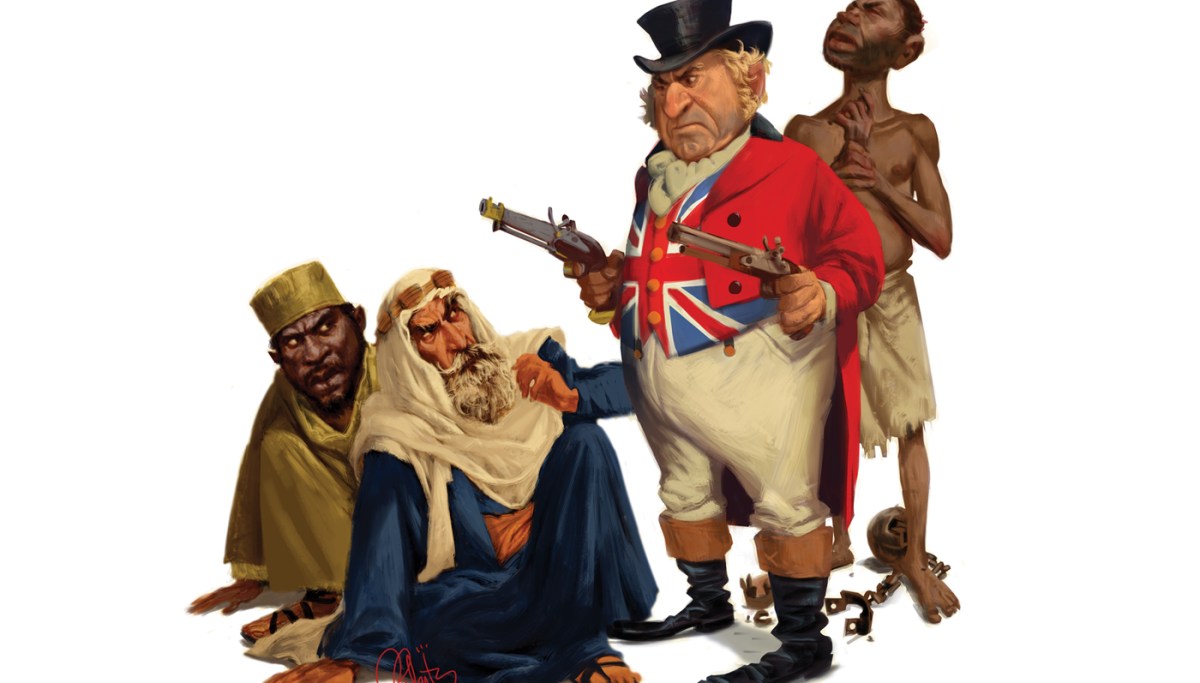
“True patriotism comes from having the confidence to talk about difficult chapters in our past,” British Foreign Secretary Ed Miliband burbled recently, adding, “We are self-confident enough to have this conversation.” The riposte to such guff is that genuinely confident people don’t need to trumpet how confident they are.The conversation Miliband was referring to is one Prime Minister Andy Burnham has begun about Britain’s role in the trans-Atlantic slave trade. It will lead him to issue a formal, unmerited, and dishonest apology on behalf of the nation.Britain’s left-wing government has ruled out slavery reparations as “inappropriate” but does not explain why. The country is in a fiscal mess and sliding ever deeper into debt, so large cash handouts would cause considerable difficulty and pain. But London’s refusal to speak up about Britain’s honorable past is clearly less about financial concerns than it is about wanting to appear to have the correct, self-loathing, left-wing opinions. For Britain to pay reparations would be iniquitous because it did more than any other country to abolish the slave trade and free captured Africans. If the Burnham government were to remove its head from the dark place where it is lodged, if it were additionally to grow a spine, it would dismiss the clamor for handouts with vigor and diplomatic anger.(Thomas Fluharty for the Washington Examiner) Instead, it has adopted a timid defensive crouch while wearing a mask of bravado. The prime minister announced a token $50 million gift to Caribbean nations in early November in the form — get this! — of solar panels. But if he believes such trinkets will quiet the rising roar for billions in hard cash, he is naive. Many black nations will answer, “Don’t try to con us with your pious words, give us money.”For all the pretense of an honest reckoning, today’s government in London is unwilling to volunteer a single word about the massive historical evidence that Britain can be proud of its history vis-a-vis slavery. Government spokespeople grudgingly acknowledge the inconvenient truth when put on the spot by questions in Parliament, but they slide quickly over that to their preferred position lamenting British colonialism.But Britain can be prouder than many African nations now demanding the right to raid its treasury. They were enthusiastic slavers themselves, and when Britain began its long and lonely campaign to end the iniquitous trade, the forebears of today’s money grubbers voiced outrage that John Bull was threatening their commercial fortunes.Modern Britain is bollixed on the question of reparations because of the sub-Marxist ideology of the Left. The nation’s leaders are animated by the fashionable falsehood that successful white peoples are always and everywhere oppressors, and unsuccessful black ones are unvaryingly blameless, oppressed, and deserving. Such a perspective can survive only among those who do not know or do not care about the facts.A rendering of the 1840 London convention of the British and Foreign Anti-Slavery Society, established to promote worldwide abolition, following abolition within the British Empire in 1833 and the end of British international trade of slaves in 1807. (Pictures From History/Universal Images Group/Getty) Slavery is the oldest institution known to humankind, and the slave trade is the oldest form of commerce. It was practiced by and against all races in all corners of the globe from time immemorial until one country, Britain, made a concerted effort to eradicate it. Slavery was endemic in North America before Europeans arrived, for example. Thousands of miles away on the eastern edge of the Mediterranean Sea, Balkan people are known as Slavs — that is, slaves — because they were routinely captured and taken into bondage by the Byzantine and Ottoman empires. Arab slavers, for centuries, raided Europe’s coast as far north as Great Britain and Ireland. They captured and stole about 1.5 million people and took them as slaves, which means Britons were enslaved by Africans, not just the other way around. In a notorious example, Barbary pirates kidnapped 107 people, the entire Irish village of Baltimore, in one night in 1631.Slavers would sometimes ransom captives back to the places from which they stole them, and sometimes instead simply sell them to buyers in slave markets. Algiers, on the north coast of the African continent, was a massive entrepot for commerce in human beings, not simply of European slaves sold into the Ottoman Empire, but also of black Africans dragged north to be traded into Europe. The trans-Saharan slave trade was a big Arab business. Even now, partly from generations of habit and partly because this slavery has not been totally eradicated, Arab peoples in the Sahel region still refer to sub-Saharan Africans as slaves. American sailors were also seized and sold by Barbary pirates, who took as their justification Quranic text giving Muslims permission to enslave infidels.It is true that Britain traded slaves for two centuries and did not outlaw slavery wholly for another generation after that. But it participated in these evils when the practice was universal. Everybody was doing it, including those who now claim to be victims. Britain did not stand out from anyone else as a slaver or slave trader. The only point at which it did stand out was when it became the first nation committed to ending slavery, a switch made despite the fact that slavery was still profitable, not, as some assert, when it was naturally displaced by capitalism. And when Britain made its U-turn, it pursued the goal of abolition with vigor at enormous cost.The Bombardment of Algiers, an 1836 painting by George Chambers depicting an 1816 attack by British and Dutch forces intended to end the slavery practices of Omar Agha, the Dey of Algiers. (Pictures From History/Universal Images Group/Getty) How did this extraordinary transformation take place? Historian Niall Ferguson has written that “it might be said that the moral transformation of the British Empire began at Holy Trinity Church, on the north side of Clapham Common,” in South London, where the “dazzling parliamentary orator, William Wilberforce, combined evangelical fervor with hard-nose political nous.”The Great Awakening in Britain’s American colonies and the growth of Methodism in Britain itself spread and deepened a horror of slavery among Anglo peoples on both sides of the Atlantic. The British anti-slavery movement, with Wilberforce at its head, gathered powerful forces on its side, including William Pitt the Younger, a university friend of Wilberforce’s who became prime minister at the age of 24; physicist John Newton; pamphleteer, parliamentary virtuoso, and founder of modern conservatism Edmund Burke; poet Samuel Taylor Coleridge; and Josiah Wedgwood, the industrial magnate known as king of the potteries.Despite ill health, Wilberforce persisted for decades in pressing Parliament to ban the slave trade. He introduced legislation to proscribe it almost every year in the 1780s and 1790s, failing again and again until he finally achieved stunning success in 1807, when Britain became the only country in the world to ban slave trading. Amazing Grace, a 2006 movie about Wilberforce’s struggle and magnificent achievement, produced by Walden Media, a sister company of the Washington Examiner, is being distributed free in the United States and internationally to colleges and charities so students can learn the truth rather than subsist on the meager diet of leftist distortions peddled in many schools.King Charles III was barracked with demands for apologies and reparations during his October tour of Caribbean nations. The irony is, as Washington Examiner columnist Daniel Hannan pointed out on X, that “the monarchy was deeply implicated in the slave trade. But not the British monarchy. The biggest African slavers were not pirates or bandits. They were kings. In the 1750s, King Tegbesu of Dahomey, in present-day Benin, was reported to be making £250,000 a year from selling slaves … equivalent to perhaps £45 million today … vastly more than any British aristocrat.” Traders on the Middle Passage did not make a practice of hunting in the African hinterland for slaves but merely bought them on the coast from locals who had been slaving before the white man arrived and continued to do so after he left.The front page of an 1840 treaty between Great Britain and the Republic of Texas for the suppression of the African slave trade. (Heritage Art /Heritage Images/Getty) In the mid-18th century, before abolition, the future King George III wrote that slavery was “repugnant to the civil law and the law of nature,” and it was he who eventually signed Wilberforce’s abolition legislation into law. African monarchs, by contrast, were incensed at Britain’s moral interference. King Ghezo of Dahomey angrily declared that “the slave trade is the ruling principle of my people [and] the source and glory of their wealth.” It is estimated that in just 1850, in what is now Nigeria, the Fulani tribe had 4 million slaves, more than all the 3.26 million slaves shipped to the Americas by Britain in the course of two and a half centuries.Prince Albert’s first speech as Queen Victoria’s husband was an attack on slaving. Although Britain had banned the trade by then and also outlawed slavery itself in 1833, other people and nations continued. The prince consort lamented, “I deeply regret that the benevolent and persevering exertions of England to abolish that atrocious traffic in human beings (at once the desolation of Africa and the blackest stain upon civilized Europe) have not yet led to any satisfactory conclusion. But I sincerely trust that this great country will not relax in its effort until it has finally and forever put an end to a state of things so repugnant.”Britain indeed did not relax its efforts until 1860. It devoted an entire squadron of the Royal Navy, even during the height of the Napoleonic Wars, to intercepting slave ships in the Atlantic Ocean and freeing their captives. It is estimated that in this way, Britain rescued 150,000 Africans from bondage and sacrificed 1,500 British sailors’ lives. The policy cost nearly 2% of annual British GDP and was probably the costliest purely altruistic foreign policy undertaken by any nation at any time in history.An African overseer threatens four enslaved women in chains on the island of Zanzibar in the mid-19th century. Slave trafficking in Zanzibar finally came to an end when the island became a British protectorate later in the century. (Bojan Brecelj/Corbis/Getty) The world is not entirely without gratitude. The African nation of Malawi is celebrating the British Empire’s anti-slavery work. It is building a museum of slavery because, as one of those involved in the project said, “Britain … was a liberator. If you look at how the slave trade was ended in Malawi, we owe that to the British.”Why is Britain being picked on for reparations demands? Why aren’t Spain and Portugal? The Spanish shipped more than a million slaves to the Americas, and Britain paid Madrid the equivalent of $66 million in 1817 to end its involvement in the trade. Portugal shipped 4.5 million Africans into slavery in its colonies — that’s why Brazil is a black nation. Arab slaving likewise lasted generations longer than did the British and was on a much bigger scale. There are even now an estimated 50 million slaves in the world, in India, Pakistan, Nigeria, and Bangladesh. Yet no one is asking these nations for reparations. How come?The explanation is almost certainly to be found in a sentence I wrote above about a deepening horror of slavery among Anglo peoples that started more than 200 years ago. The moral revulsion that eventually bore fruit in the abolition of slavery and slave trading is largely a phenomenon of the English-speaking peoples, as is so much that is good in the world. It means Britain and America are probably the easiest nations in which to foster guilt about slavery and to make reparations demands stick. The grifters aggressively holding out their hands for money today know that Anglos are their easiest marks.On Emancipation Day, which commemorates slavery’s abolition in the United Kingdom in 1833, protesters block a London street, Aug. 1, 2021. (Thabo Jaiyesimi/SOPA Images/LightRocket/Getty) Here in America, some of our own elected representatives happily believe their own country will eventually capitulate. Rep. Ayanna Pressley (D-MA), in her losing bid to become speaker of the House after her party’s victories on Election Day, put slavery reparations high in her promised agenda. She will not win her reparations campaign soon, but the clamor of which she is a part will not die down until the case against reparations is made more forcefully. Reparations in 2026 or beyond would punish people who were never slave owners and many people descended from immigrants who arrived in America after slavery was abolished. It would, at the same time, reward people who were never slaves.MAMDANI’S REPARATIONS LOGIC DOES NOT ADD UPBut the case against slavery reparations is not about what is right or fair. It is about what cynics see as possible to achieve, as doable. In this epoch, in which English-speaking peoples have been browbeaten into feeling unnecessarily ashamed of their history, they are more likely than any other people to wring their hands over the sins of their past. This makes them obviously the most inviting targets.If black nations demanded reparations from Spain and Portugal, or from Arabs and other African nations, all of whom were up to their necks in the vile commerce, they’d get short shrift. But the people making the demands are not engaged in a moral crusade. They are engaged in a financial treasure hunt. There’s an old saying about what starts as a movement becoming a business and ending up as a racket. Anti-slavery started admirably as a movement more than 200 years ago in the country now most hounded for reparations. Today, it is nothing but a racket.Hugo Gurdon (@hgurdon) is editorial director of the Washington Examiner.
Britain’s weak apologies for its past lure slavery reparations grifters
Full Article
Original Source
Read the full article at Washingtonexaminer →KhanList aggregates and links to publicly available news content. We do not host full articles from third-party sources. Always verify important information with original sources.