
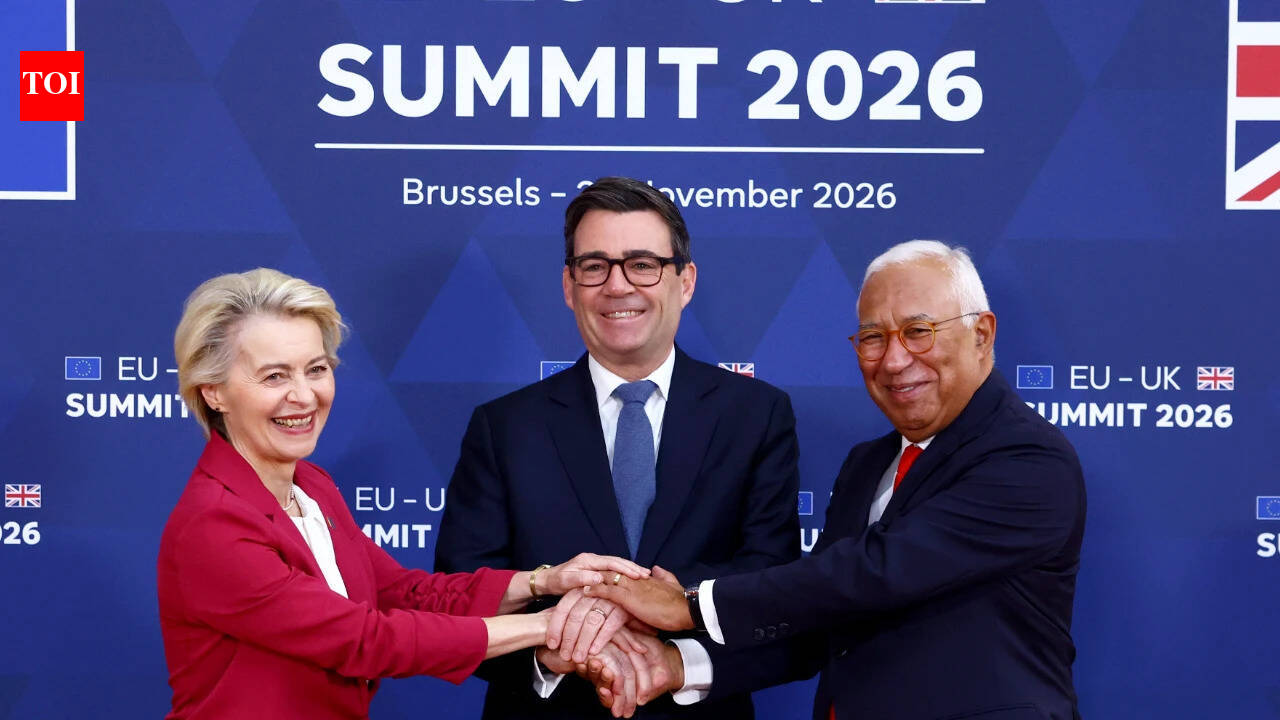
From right, European Council President Antonio Costa, Britain's Prime Minister Andy Burnham and European Commission President Ursula von der Leyen arrive for the EU-UK Summit in Brussels (AP)Ten years after voting to leave the European Union, Britain appears to be having second thoughts about one of the most consequential decisions in its modern history.Prime Minister Andy Burnham has openly questioned the benefits of Brexit, saying Britain has lost more than it gained from the split, while his government moves to rebuild economic ties with Brussels through a series of new agreements.The shift became evident at the UK-EU summit in Brussels on Thursday, where both sides agreed on a fresh set of measures aimed at repairing economic ties strained by Brexit.The agreements cover food and agricultural trade, youth mobility and cooperation on carbon emissions, marking a significant step towards closer relations without Britain formally rejoining the bloc.Under the new arrangements, Britain and the EU will ease checks and paperwork on food products, allow up to 100,000 young people from each side to live, work or study across the Channel for up to three years, and link their carbon emissions trading systems.According to the joint UK-EU statement, the agreements are aimed at reducing barriers to trade, creating opportunities for young people and strengthening cooperation on climate policy.The food and agricultural deal is expected to make trade easier by reducing sanitary and phytosanitary checks, while linking carbon markets could help businesses avoid additional costs associated with carbon border measures.However, the agreements do not signal a reversal of Brexit. Britain will remain outside the EU's single market and customs union, even as both sides seek to restore some of the economic benefits of closer integration.Why is Britain reconsidering Brexit?The renewed push for closer ties comes amid growing criticism of the economic consequences of Britain's departure from the EU.Brexit supporters had promised greater economic freedom, control over immigration and the ability to strike independent trade deals.However, the departure also introduced new barriers to trade with the UK's largest nearby market, increased costs for businesses and restricted the movement of workers between Britain and European countries.According to CNN, economists estimate that Brexit has left Britain's economy between 4 and 8 per cent smaller than it would have been had the country remained in the European Union.Burnham has been particularly vocal in his criticism of the decision. Speaking ahead of the Brussels summit, he compared Brexit to The Emperor's New Clothes, arguing that its promised benefits had failed to materialise.He said Brexit had contributed to Britain's economic difficulties, weakened Europe's position and benefited Russia by deepening divisions among European countries.The economic cost of Brexit has become a major part of the debate. According to CNN, estimates suggest that Britain's economy has lost between 2 per cent and 8 per cent in potential output because of its departure from the EU. The country has also faced additional trade paperwork, higher costs for exporters and restrictions on access to European labour markets.Burnham has argued that the existing arrangement, often described as a 'hard Brexit', is not good enough for Britain. He has also indicated that the latest agreements could contribute up to 0.5 per cent to the country's GDP, while reducing bureaucratic hurdles for businesses.Is Britain preparing to rejoin the European Union?Despite reopening the debate over Brexit, Prime Minister Andy Burnham has stopped short of committing Britain to rejoining the European Union.Following the November 20 summit in Brussels, Burnham said Britain needed to consider what its long-term relationship with the bloc should look like and indicated that he would explore future options with European leaders. However, he has maintained that the latest agreements represent the limit of what his government can achieve during the current parliamentary term.Experts believe that moving towards full membership would be considerably more complicated than restoring trade and diplomatic ties.Anand Menon, professor at King's College London and director of the think tank UK in a Changing Europe, told CNN that Burnham's rhetoric had become more ambitious, but his actual policy approach had not changed significantly from that of his predecessor."The more people talk about rejoining, the more obviously complicated an undertaking it becomes," Menon said, adding that further progress would require Britain to reconsider its existing red lines on European integration.There are also indications that Brussels would not oppose Britain's eventual return, although negotiations could prove difficult.EU foreign policy chief Kaja Kallas has said she would like to see Britain back in the bloc but warned that Brexit had left considerable mistrust within the European Union."There are still certain traumas in the European Union regarding the UK's departure from the bloc. Therefore, negotiations will not be that easy," she said, according to EU observer.European Council President Antonio Costa also said after the summit that the EU would respect whatever decision Britain takes about its long-term relationship with the bloc.Domestically, Burnham faces opposition from Brexit supporters, including Reform UK leader Nigel Farage, who has accused him of having no mandate to move Britain closer to the EU.Public opinion, meanwhile, appears more favourable towards rejoining than it was in 2016, although polling cited by CNN suggests voters remain concerned about the financial contributions, the possibility of adopting the euro and the complexities of another membership application.For now, Britain is seeking closer economic and political cooperation rather than preparing a formal membership bid. Whether that changes will depend on the next general election, public support and the terms Brussels is willing to offer.
Britain's 'mistake of the century'? UK moves closer to EU, but return won't be easy
Full Article
Original Source
Read the full article at Timesofindia →KhanList aggregates and links to publicly available news content. We do not host full articles from third-party sources. Always verify important information with original sources.